There is no government office that signs a document declaring a recession. In the United States, a recession is officially declared by the Business Cycle Dating Committee of the National Bureau of Economic Research, a private nonprofit research organization, which identifies the month the economy peaked and the month it bottomed out. Understanding how a recession is officially declared means understanding that this is a retrospective judgment call, not a countdown with a fixed trigger.
The part that trips most people up is the timing. By the time the announcement arrives, the economy has often already started recovering. That gap is not a failure of communication. It is baked into the method.
Table of Contents
- What Does an Official Recession Declaration Mean?
- How a Recession Is Officially Declared in the United States
- How a recession is officially declared, step by step
- Who Decides When the U.S. Is in Recession?
- What Data Does the NBER Use to Date a Recession?
- Why Is the Start Date Called the Peak?
- Does a Negative GDP Report Automatically Put a Country in Recession?
- How Do Other Countries Declare a Recession?
- Why Are Recession Announcements Usually Delayed?
- What Happens After a Recession Is Declared?
- Frequently Asked Questions
- Who officially declares a recession in the United States?
- Is a recession officially declared by the U.S. government?
- How long does it take to officially declare a recession?
- Why can the official recession dates change?
- Can an economy still be in recession after GDP grows again?
- Conclusion
What Does an Official Recession Declaration Mean?
An official recession declaration is a dated historical judgment, not an active switch. When the committee announces a peak and a trough, it is saying that a significant decline in activity began in one month and ended in another. Nothing about the announcement changes the economy on the day it is published.
The NBER’s working definition is blunt: a recession is a significant decline in economic activity spread across the economy, lasting more than a few months. That definition is deliberately loose. There is no threshold number of jobs, no percentage drop in output, and no set length of time.
Three tests sit inside that definition, and economists usually refer to them as depth, diffusion and duration. Depth is how large the decline is. Diffusion is how much of the economy it touches, rather than a single sector. Duration is how long it lasts. A downturn that is shallow but broad and long counts. A dramatic collapse in one industry may not.
So a recession is not the same thing as a market correction, a bad quarter, or a stretch where people feel poorer. Those can happen without a recession being dated, and a recession can be dated while the stock market is having a great year.
How a Recession Is Officially Declared in the United States
A recession is officially declared when the NBER’s Business Cycle Dating Committee determines that a significant decline in economic activity began in a specific month. The committee reviews monthly and quarterly national data, decides that the decline is broad and lasting, and names the preceding peak month as the recession’s start. There is no legal recession in the United States and no government agency involved in the call.
How a recession is officially declared, step by step
The process looks something like this, and each stage takes as long as it takes.
- The data arrives. Federal statistical agencies publish the monthly and quarterly series the committee relies on. The Bureau of Labor Statistics publishes payrolls, income, spending and unemployment figures. The Bureau of Economic Analysis publishes output and income data.
- The committee reviews the picture. Economists on the committee look for a decline that is significant, spread across the economy, and lasting more than a few months. They weigh several series together rather than treating any one number as decisive.
- They wait for the revisions to settle. Early estimates get revised. The committee wants a picture that will still look the same in a year, so it often waits through several rounds of revision before speaking.
- A peak month is announced. The committee names the last month before the decline began. At that moment, the recession starts in the official record, dated retroactively to a month that has already passed.
- A trough is announced later, separately. The end of the recession is dated only after the committee can see that activity has turned and stayed turned. This is why recessions get a start date months before they get an end date.
- A short statement goes out. The NBER publishes a brief release describing the change, typically without much narrative. That release is the official determination.
The announcement lag between the peak month and the public call has ranged roughly from four months to more than twenty months. That spread is not sloppiness. A downturn that ends quickly and a downturn that deepens for a year produce very different evidence, and the committee waits for enough of that evidence to accumulate.
Who Decides When the U.S. Is in Recession?
The Business Cycle Dating Committee makes the call. It is a group of economists affiliated with the NBER, a private, nonpartisan research nonprofit founded in 1920, based in Cambridge, Massachusetts. The committee has been dating the business cycle since the organization began its chronology, and it publishes a table of peak and trough dates that researchers, journalists and policymakers all cite.
This is the single most misunderstood fact in the topic. The NBER is not a federal agency. It receives private funding, it is not Congress, and the president, the Federal Reserve and the Treasury have no vote. There is no law requiring anyone to declare a recession, and no law that defines one. The dates exist because economists agreed to treat them as authoritative.
Two other bodies come up in conversation. The Conference Board publishes its own Leading Economic Index, which is a signal, not a dating. The Federal Reserve uses recession dating as historical context when it discusses the economy, but it does not set the dates.
What Data Does the NBER Use to Date a Recession?
The committee examines economy-wide measures and says plainly that there is no fixed rule about which measures it uses or how much weight each one carries. In practice, two series have dominated its judgments in recent decades: real personal income less transfers and nonfarm payroll employment. The table below lists the monthly indicators that come up most often, along with why each one matters and where it falls short.
| Indicator | Why the committee watches it | Limitation |
|---|---|---|
| Real personal income less transfers | Shows whether household purchasing power is genuinely falling after inflation and after removing transfer payments such as unemployment benefits. | Slow to react to sudden shocks and often revised heavily. |
| Nonfarm payroll employment | The most closely watched labor series, and one of the two most heavily weighted in recent decades. | Can hold up briefly while underlying demand is already weakening. |
| Household survey employment | A second, independent read on jobs, measured differently from payrolls. | Smaller sample, so noisier month to month. |
| Real personal consumption expenditures | Spending is roughly two-thirds of the economy, so broad-based consumer pullbacks matter. | Subject to large seasonal adjustments. |
| Real manufacturing and trade sales | Captures goods volumes, which can turn before the spending totals do. | Volatile, and only a slice of total activity. |
| Industrial production | Physical output from factories, mines and utilities. | Covers goods-producing industries rather than the whole economy. |
| Real gross domestic product and gross domestic income | Quarterly totals that anchor the peak and trough decisions, with real GDI often used to cross-check real GDP. | Quarterly, heavily revised, and published with a long delay. |
No single row in that table confirms a recession. Confirmation comes from the pattern: several of these series declining together, for a while, across more than one part of the economy.
Why Is the Start Date Called the Peak?
The start of a recession is the month of the preceding peak, which is the last month before activity began to decline. It is rarely the first month that looks bad. By the time a month is clearly negative, the turning point is usually already behind the economy.
A short hypothetical makes the distinction obvious. Suppose a country economy runs steadily through June, weakens a little in July, contracts clearly in August, and recovers in September. The peak is June. Naming August as the start would misdescribe the whole episode, because the decline began before any negative data showed up.
The same logic runs through the rest of the chronology. The peak marks the end of an expansion and the start of a recession. The trough marks the end of the recession and the start of an expansion. Both are decided separately, and the trough announcement can land months after the peak announcement.
Does a Negative GDP Report Automatically Put a Country in Recession?
No. Two consecutive quarters of negative real GDP is a rule of thumb that journalists use, not an official standard in the United States. The committee looks at the breadth and duration of the decline across economy-wide data, not at the sign of two GDP prints.
Three things make GDP a poor trigger on its own. It is quarterly, so a single strong or weak quarter can mislead. It is revised, sometimes substantially, so the first estimate of a weak quarter is not the last word. And real GDP can fall while employment stays solid, which is exactly the situation that produced two negative quarters without a dated recession in 2022.
Some other institutions do apply a mechanical convention, most notably the euro area’s widely used rule of two consecutive negative quarters of output. Where such rules exist, they are treated as one input among several, and they still do not come with a legal force.
How Do Other Countries Declare a Recession?
Definitions, authorities and procedures vary by country, and they change. The United States is unusual mainly in outsourcing the call to a private nonprofit and refusing to define the word in law. Most other systems work through a national statistical office or a designated statistical agency, often with either a fixed rule or a formal list of criteria.
In the euro area, the convention most people encounter is two consecutive negative quarters of output, monitored with an eye on the wider bloc rather than one member state. The OECD compiles comparable data across its members and publishes synchronized downturn periods for research use, and the International Monetary Fund does similar work for its own surveillance of member economies. Individual countries run their own processes, with the statistical office or central bank applying whatever criteria that country has adopted.
The practical difference matters for one reason. There is no single global recession date. A downturn that starts in the United States in one month may be dated differently in countries that measure quarterly output and use the two-quarter convention. If you are comparing conditions across borders, the definitions come first, then the numbers.
Why Are Recession Announcements Usually Delayed?
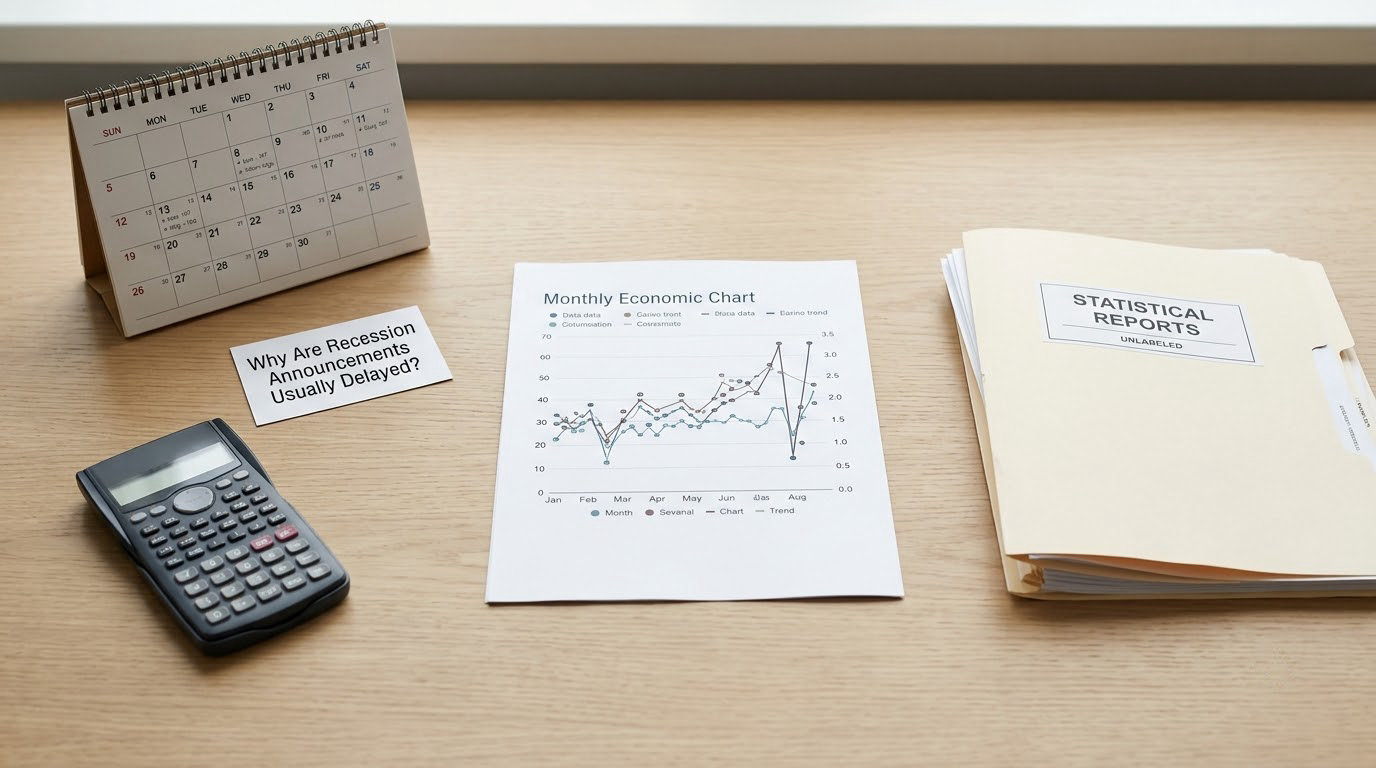
The delay is methodological. The committee is trying to identify a turning point with enough confidence that the date will not need to move, and that takes longer than waiting for the next headline.
Four things drive the lag. The first is the reporting cycle itself: monthly data arrive with their own publication delays, and quarterly output data arrive later still. The second is revision, since the first estimate of any quarter is a rough draft. The third is breadth, because a decline confined to one sector is not yet a recession, and the committee waits to see whether weakness spreads. The fourth is duration, because “more than a few months” cannot be confirmed until the months have passed.
A simple timeline helps. Conditions may begin weakening in one quarter. Analysts notice within weeks, using payrolls, claims and spending releases. But nothing is dated. The committee convenes and reviews, typically more than once, and eventually publishes a peak date that already lies in the past. The trough, if it has happened, gets its own announcement later.
Real-time warning tools exist, including the Sahm Rule developed by economist Claudia Sahm, which flags a recession when the unemployment rate rises enough above its recent low. It is a useful early signal for people who need to react now. It is not part of the official determination, and the committee does not use it as one.
What Happens After a Recession Is Declared?
A declaration records a historical judgment and informs analysis. It gives researchers, journalists and policymakers a shared reference point, and it shapes how every statistic that falls inside those months gets interpreted. It is why a period of weak growth is described as having occurred “during a recession” once the dates are set.
What a declaration does not do is notable. It does not cause the downturn, since the decline is already over by the time the peak is announced. It does not trigger any law, automatic stimulus package or emergency spending. It does not determine when the economy recovers, which is a separate decision about the trough. And it does not change anyone’s interest rate, because monetary policy runs on a much faster cadence than recession dating.
Timing matters when you read news about a downturn. A headline dated after a declaration refers to a period that began months earlier, so it does not tell you what conditions are like today.
Frequently Asked Questions
Who officially declares a recession in the United States?
The Business Cycle Dating Committee of the National Bureau of Economic Research makes the call. The NBER is a private nonprofit research organization, not a government agency, and its recession dates are a scholarly judgment rather than a legal action. The committee reviews monthly and quarterly federal statistics, then names the peak and trough months of a significant, broad decline in economic activity.
Is a recession officially declared by the U.S. government?
No. There is no federal law defining or declaring a recession, and no government office that issues one. The NBER committee that dates recessions is a private, nonpartisan research nonprofit. Its dates carry authority because economists and the media treat them as the reference standard, not because any statute requires it or because the president, Congress or the Federal Reserve has any role in the decision.
How long does it take to officially declare a recession?
It varies widely. The gap between the peak month and the public announcement has ranged from roughly four months to more than twenty months. The committee waits because early data get revised, because it wants to see weakness spread beyond one sector, and because the requirement that a decline last more than a few months cannot be confirmed until the months have passed. The end date is announced separately and later still.
Why can the official recession dates change?
They can be revised, though changes are uncommon and usually apply to the boundaries of a period rather than its existence. Dates move when new data revisions shift the picture the committee relied on, or when later information shows the decline began earlier or ended later than first judged. Because the committee names the trough only after activity has clearly turned, the end of a recession is the date most likely to be adjusted.
Can an economy still be in recession after GDP grows again?
Yes. A single positive GDP quarter does not end a recession. Quarterly output is volatile, heavily revised, and can turn up while the broader economy is still contracting. The committee ends a recession by identifying a trough, which means confirming that a significant, broad decline has finished and activity has stabilized. That judgment takes more evidence than one good quarter of output.
Conclusion
Knowing how a recession is officially declared comes down to three things to check whenever you see the word. First, the peak date the NBER assigned, since that is the official start. Second, how broad and how long the decline was, because a single weak quarter or a single weak sector is not a recession. Third, which authority and definition is in play, since a U.S. judgment call and a two-quarter rule in another country are not measuring the same thing.
Once those three are clear, the late announcement stops looking strange. The system is built to be sure rather than fast.