How to prepare an emergency kit for a hurricane comes down to one number: how many days you need to be self-sufficient. Most coastal households need three days for an evacuation, seven days if a hurricane warning may strand you at home, and a full two weeks if you live in a flood-prone area where resupply arrives late. The supplies themselves are ordinary. The planning is the work.
This guide walks through the categories that matter, the quantities to buy, where to store everything, and the mistakes people only notice afterward. Official guidance from FEMA at ready.gov, the American Red Cross and the CDC is woven in where it changes what you should pack. My own household runs the drill twice a year, and the two items we always forget first are fresh batteries and the manual can opener.
The Atlantic hurricane season runs June 1 through November 30, but the assembly work does not have to wait for June. A kit built in a calm week in spring is worth far more than one thrown together during a warning.
Table of Contents
- How to Prepare an Emergency Kit for a Hurricane: What You Need
- Step-by-Step: Build Your Hurricane Emergency Kit
- Step 1: How to Prepare an Emergency Kit for a Hurricane
- Step 2: Choose Containers and Locations
- Step 3: Stock Water, Food, and Daily Essentials
- Step 4: Add Lighting, Power, and Communication Tools
- Step 5: Pack Health, Hygiene, and Household Supplies
- Step 6: Protect Documents, Money, and Special Needs
- Step 7: Pack, Check, and Maintain the Kit
- Common Mistakes
- Frequently Asked Questions
- How long should a hurricane emergency kit last?
- What should I pack in a hurricane evacuation bag?
- How much water should each person have in an emergency kit?
- Do I need a generator for a hurricane emergency kit?
- What emergency supplies should I prepare for my pet?
- Conclusion
How to Prepare an Emergency Kit for a Hurricane: What You Need
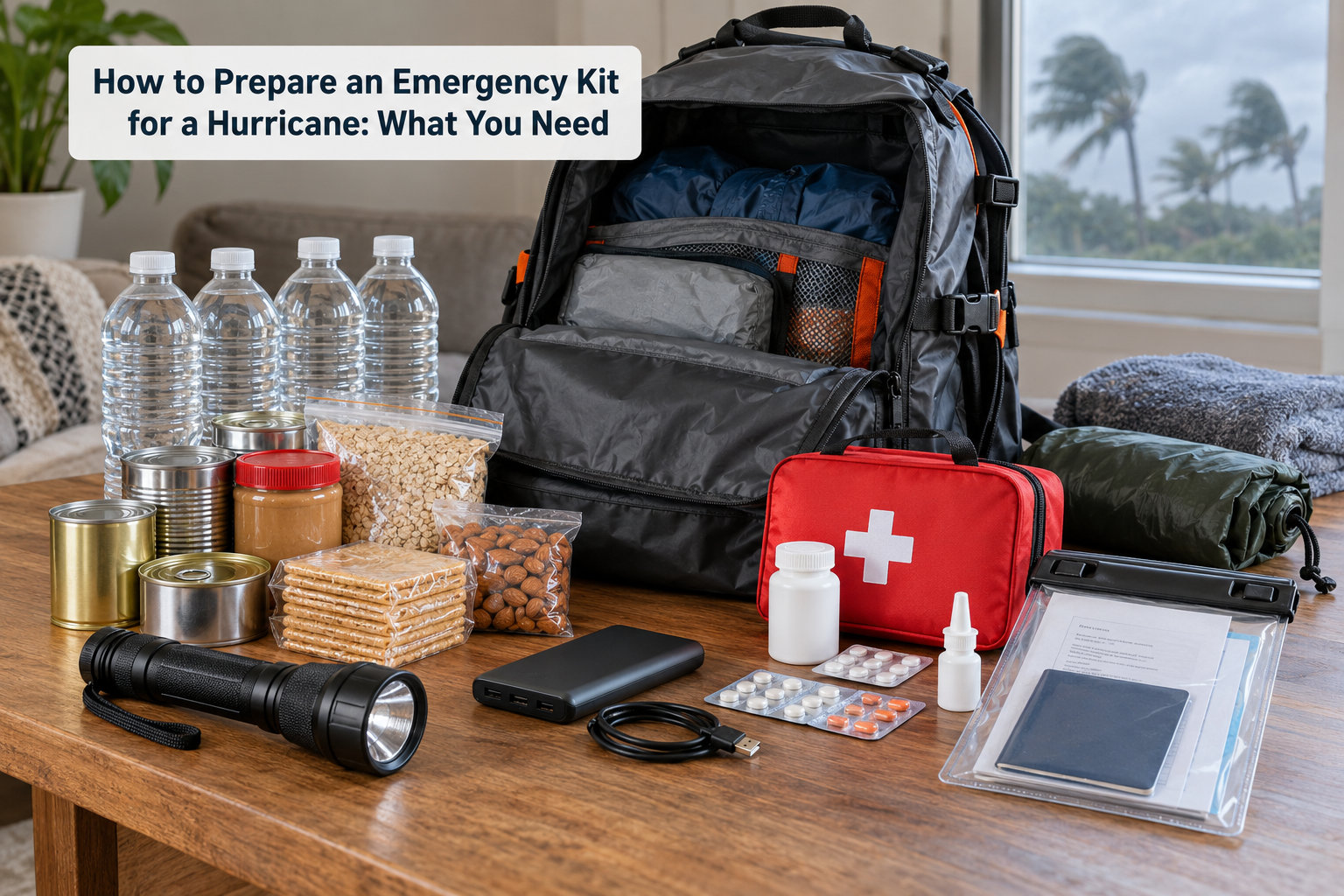
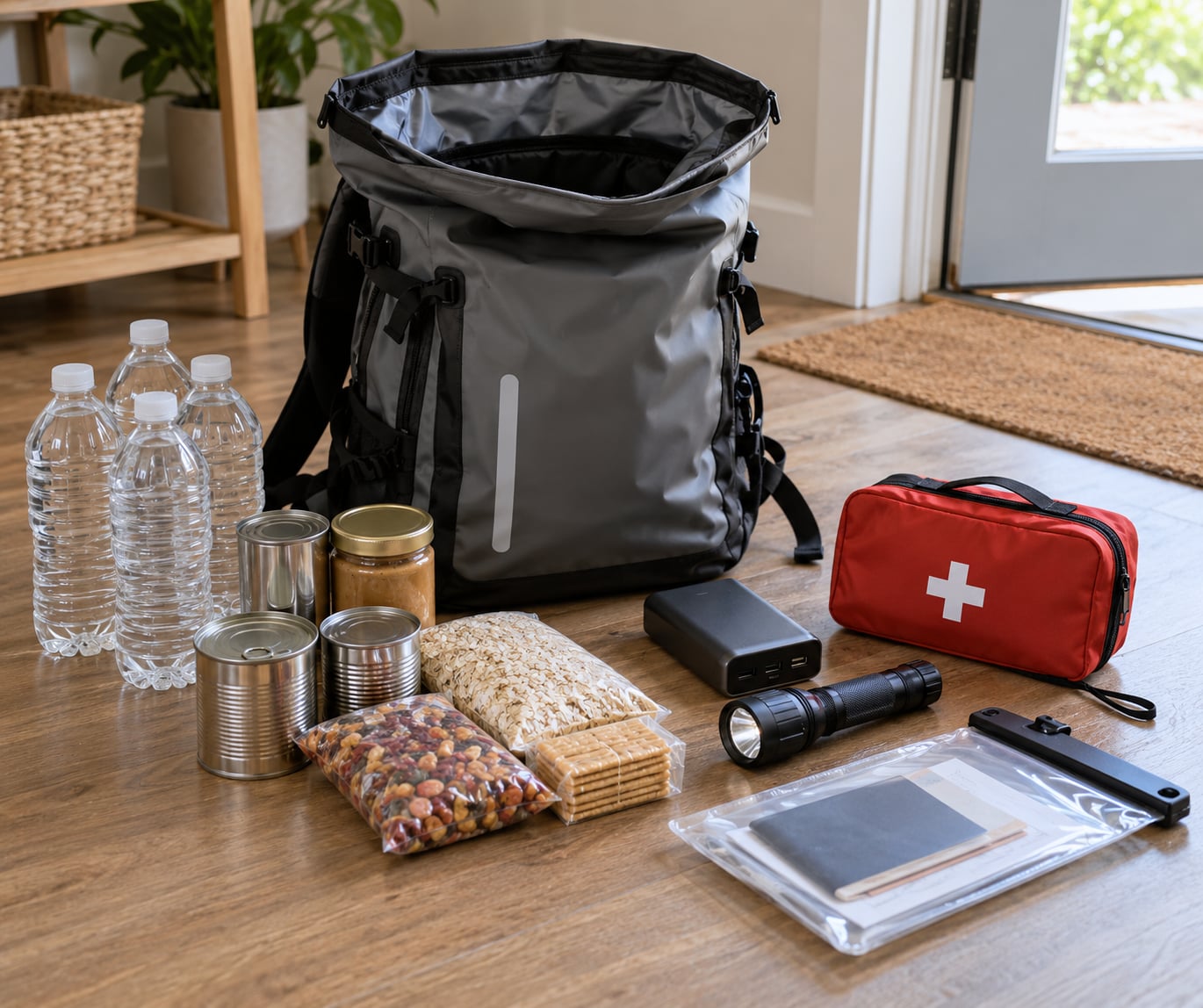
The most useful mental model is two kits, not one. A portable go-bag holds three days of supplies per person and sits by the front door or in the car, ready to grab. A larger shelter-in-place reserve holds two weeks of water, food, medicines and sanitation supplies, stored high and dry inside the home. If you evacuate, the go-bag is what travels with you; the reserve covers the case where you stay and the grid stays down.
Every kit needs these categories:
- Water for drinking, cooking, brushing teeth and flushing
- Shelf-stable food that needs no refrigerator, no cooking and no can opener
- Light and power such as flashlights, a hand-crank or battery-operated NOAA weather radio, and power banks
- First aid and medicines including a ready-to-use first-aid kit and every prescription refill
- Documents and cash sealed in a waterproof pouch
- Communication tools such as a whistle, charged phones and a battery or hand-crank radio
- Tools and sanitation including a manual can opener, heavy trash bags, duct tape, work gloves and hand sanitizer
- Weather protection such as ponchos, a change of clothes, sturdy shoes and N95 dust masks if your windows break
- Household-specific supplies for infants, older adults, mobility needs, powered medical equipment and pets
Two numbers drive everything else. The first is how many people the kit has to serve, including guests. The second is how long you might be on your own: a fast-moving storm with widespread damage can take more than a week before stores reopen, which is why the Red Cross and CDC both frame three days as the floor rather than the goal.
Step-by-Step: Build Your Hurricane Emergency Kit
Step 1: How to Prepare an Emergency Kit for a Hurricane
Start with decisions, not shopping. Check whether your zone sits in an evacuation area, and learn who issues your local mandatory evacuation orders, because that instruction outranks anything in a bag. Decide whether your household may need to leave, and for how long you would be away.
Then list the people. Count infants, children, older adults, anyone with a disability, anyone on daily prescription medicine, anyone who uses powered medical equipment, and every pet. For each, note what they need that an average adult does not: formula and diapers, a cane or walker, an insulin cooler, a service animal’s food and medication.
Write down the expected disruption. If a storm surge zone covers your street, plan for the worst case you can reasonably survive. If you are inland and the road out stays open, a three-day bag is honest. Follow evacuation orders when they come. A kit supports a decision, it does not replace one.
Step 2: Choose Containers and Locations
A go-bag should be a lightweight backpack or duffel per person, waterproof or packed in dry bags, with nothing loose inside. Keep it where you can reach it without passing through glass or standing up in the dark. Per-person bags matter: in a shelter or a crowded waiting room, a labeled bag you can identify instantly saves time.
A shelter-in-place reserve belongs in a lidded plastic bin stored on a high shelf, above floor level, in a closet or interior room that stays dry. Never on the ground floor of a building that can flood, and never in a garage where a hurricane can drive water in. Keep it out of sunlight and off concrete.
Label everything: the name of the person, the date the kit was assembled, and a date-sticker for anything that expires. Tape the inventory checklist inside the lid so the first person to open it knows what should be there. Keep it a bin, not an oversized suitcase; nobody can carry 30 pounds down four flights of stairs.
Step 3: Stock Water, Food, and Daily Essentials
Ready.gov and the CDC both use one gallon of water per person per day as the planning figure, covering drinking, cooking and sanitation. Multiply by your people and by your duration. A family of four self-supporting for a week needs about 28 gallons, and that weight is why water is often stored as several smaller jugs rather than one large container you cannot lift.
Food should need no power and ideally no tools. Choose ready-to-eat items such as tuna and salmon pouches, canned soups with pull tabs, nut butters, crackers, granola bars, dried fruit, shelf-stable milk, energy drinks and electrolyte packets. If you pack cans, include a manual can opener as a separate item, not tucked in the same box as the opener you might need to open the box.
Add regular-use items in usable multiples: enough coffee and tea, matches or a lighter, pet food, infant formula, and enough food for a pet’s normal serving every day you plan to cover. Do not skip familiar food. A stressed household eats what it recognizes, and unfamiliar meals become another thing to manage in a dark house.
One note on milk and fresh produce: they spoil without refrigeration. Treat them as bonus items, not core stock.
Step 4: Add Lighting, Power, and Communication Tools
Light comes before everything else. Pack two flashlights per person, spare batteries sized to fit, a headlamp that leaves your hands free, and glow sticks. A hand-crank radio is worth its weight for a household that has no reliable charging source, since a crank radio and a flashlight can both work without stored electricity.
For power, pack power banks already charged and a charging cable for each phone. A small solar charger is a reasonable backup, not a primary plan. Plan to charge devices once a day and turn airplane mode on. Solar and phone charging in a windowless room during a blackout is slower than people expect.
Never run a portable generator, propane burner, camping stove or charcoal grill inside an occupied home or garage. Carbon monoxide is odorless and lethal, and the leading cause of generator deaths is a unit run in a closed space or near an open window. The same applies to candles as a light source; a hurricane that arrives with no wind still arrives with a long night.
Add a whistle for each person, since it carries further than a shouting voice and costs almost nothing. If cell service fails, a satellite messenger is a genuine fallback, though it needs testing before the storm, not during.
Step 5: Pack Health, Hygiene, and Household Supplies
Start with a first-aid kit that is ready to use, not a collection of half-empty packets. Restock adhesive bandages, gauze, tape, antiseptic wipes, tweezers, scissors, blister care, pain reliever, antihistamine, antidiarrheal, oral rehydration salts, thermometer, disposable gloves and any rescue inhaler or epinephrine your family uses. Print a simple first-aid reference card and tape it inside the pouch.
Medicines: include at least the planned duration plus a buffer week, since pharmacies close early and refill times stretch. Keep a written list of drug names, doses, prescribers and pharmacy contact numbers, and photograph every label. If someone depends on refrigerated medicine such as insulin, ask the pharmacist for insulated cooling packs and gel packs, plus a thermometer, and confirm how long the product tolerates a warm room. Medication storage rules vary by product, so a pharmacist is the right person to ask rather than a forum post.
Hygiene matters more than expected. Bring hand sanitizer, soap, toothbrush and toothpaste, toilet paper, feminine hygiene products, baby wipes, diapers, a change of infant formula, heavy-duty garbage bags with ties, a bucket, and garbage cans for managing refuse. Add blankets, a change of clothes per person, ponchos, sturdy closed shoes, and a whistle you will actually be heard over.
Rotate expiration dates twice a year and replace anything used during the previous event. Most households keep expired medications for a decade, which is a safety habit worth breaking.
Step 6: Protect Documents, Money, and Special Needs
Gather identification, insurance records, deeds or lease documents, vehicle titles, immunization records, school and medical information, and a copy of your prescriptions. Put the originals plus photocopies in a waterproof pouch or zip bag, and scan everything to cloud storage or a phone that is charged and account-locked. Two locations matter because one can flood and one can die.
Bring small-denomination bills and coins. Card readers, ATMs and point-of-sale machines all need power, and small notes survive a cash machine being flooded or a shop that cannot make change. Include house and vehicle keys on a labeled ring with a spare set.
Then cover specific needs. Infants need formula, bottles, feeding supplies, diapers sized for the days covered, a nursing cover, and a small blanket. Children need familiar comfort items, school identification and a device with downloaded content, since a bored child in a dark house is a real logistics problem.
Older adults and anyone with mobility needs may need prescription refills, a backup battery for a powered wheelchair or oxygen concentrator, spare batteries and charger cords, a transfer board, a cane, extra socks, and a written list of physical limitations for shelter staff. Ask your local office of emergency management about special-needs registration and pet-friendly shelter locations in your county before season starts, while the lists are current.
Pets need food at their normal daily serving, fresh water, bowls, a leash, a carrier, waste bags, a microchip record and any medication. Never use human medication on an animal. A veterinarian can advise on what to keep on hand for a specific animal.
Step 7: Pack, Check, and Maintain the Kit
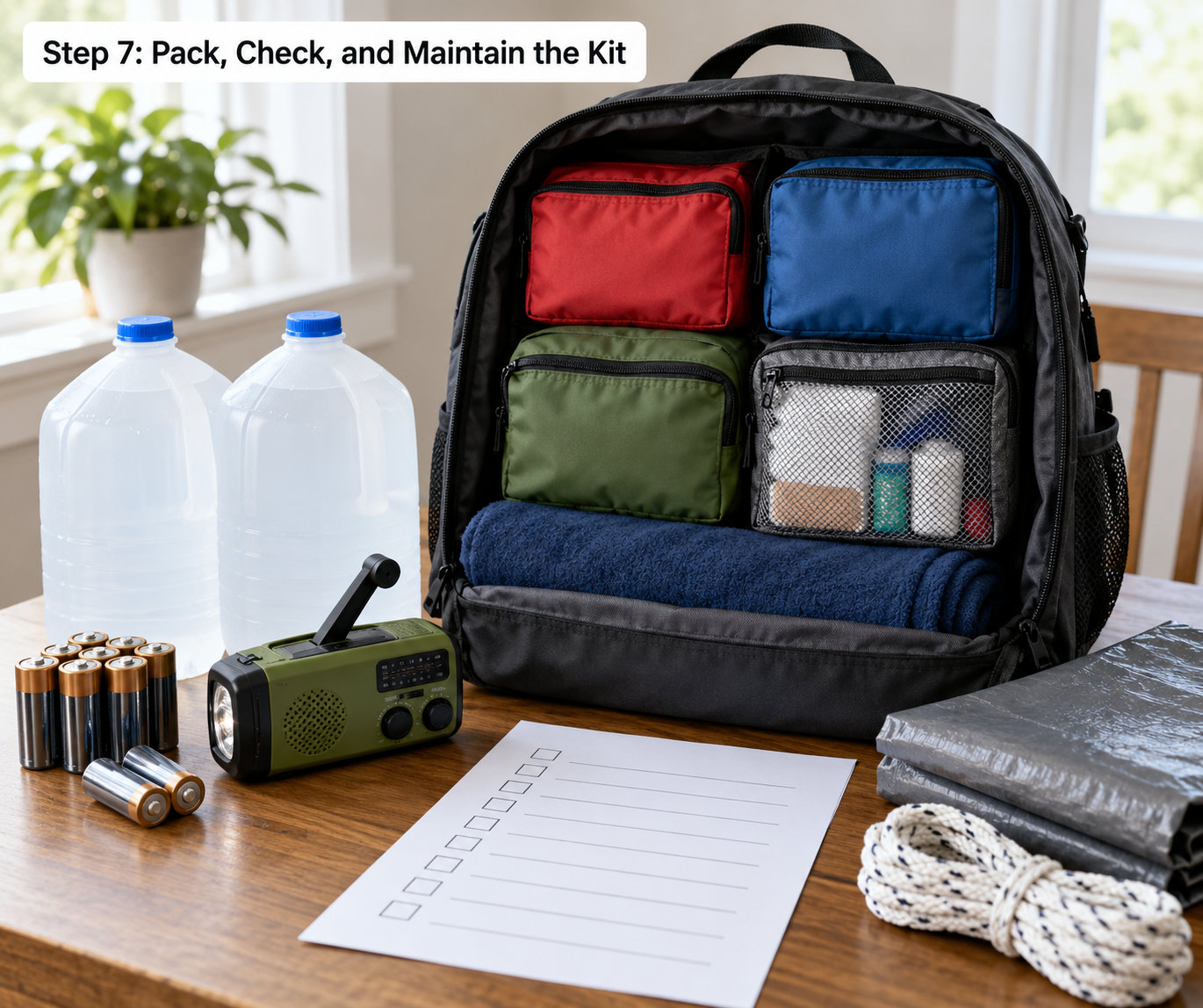
Pack in order of use. Heavy water on the bottom, food above it, then first aid and medicines near the top where you can reach them without unpacking everything. Use clear pouches per category so you can see what is missing without lifting anything. A printed inventory with quantities, expiry dates and a last-replaced stamp taped inside the lid turns a bin into a checklist.
When to refresh: replace batteries every six to twelve months and after any use, even partial use. Swap water at least annually, and check the printed date on the jug. Check food dates twice a year and rotate what you will use. Test flashlights, radios and power banks during those checks. Update documents when an address, insurer, prescription or phone number changes.
Run a ten-minute household review twice a year, ideally at the start of the season and in late spring. Walk the evacuation route with whoever might drive it, identify two alternate routes, and agree on one out-of-area contact everyone can reach by text. Do the shopping in stages across the season rather than on the day a warning is issued, when gas is scarce, aisles are crowded and nobody wants to stand in a line.
Common Mistakes
Starting during a warning. Correction: assemble gradually from week one. A half-built kit is better than none, and a shopping trip during landfall conditions is a safety risk.
Storing the reserve where it floods. Correction: high, dry, interior. A bin on the ground floor of a coastal building can be ruined before the water reaches your waist, and the water itself is never drinkable.
Too much of one thing, nothing of another. Correction: work from the category list, not from one shelf. Buying a fifth lantern while the medicines sit in a drawer on the counter is the classic version of this mistake.
Expired food and flat batteries. Correction: date-sticker everything and run the twice-yearly check.
Generators and propane indoors. Correction: outdoor use only, well away from doors and windows, with the manual in hand.
One generic kit for a household with real medical needs. Correction: build per person and add powered-equipment backups and medication cold-chain items with help from your pharmacist.
Assuming one size fits everyone. Correction: renters without a garage, commuters and pet owners each need their own additions.
Frequently Asked Questions
How long should a hurricane emergency kit last?
At least three days per person is the minimum, and it assumes you leave or reach a store quickly. Seven days is a more realistic target for most coastal households because power and water often take a week or longer to return. Plan for fourteen days if you are in a flood-prone area, depend on powered medical equipment, or live where resupply arrives slowly. Buy the food and medicine for the longer figure and keep the water in smaller containers you can carry in stages.
What should I pack in a hurricane evacuation bag?
Per person, pack three days of water, ready-to-eat food that needs no cooking, prescription medicines, a first-aid kit, a change of clothes, sturdy shoes, a flashlight with spare batteries, a power bank and charging cable, a whistle, small-denomination cash, copies of identification and insurance documents in a waterproof pouch, and basic hygiene items. Add infant, mobility or pet supplies as needed, and keep the bag by the exit.
How much water should each person have in an emergency kit?
Ready.gov and the CDC use one gallon per person per day, covering drinking, cooking and sanitation. Multiply by your household and by the number of days. A family of four preparing for one week needs about 28 gallons, which is heavy enough that most people store water in one-gallon jugs they can carry rather than in large containers they cannot lift. Add purification tablets or a boil method as backup.
Do I need a generator for a hurricane emergency kit?
A generator is never part of the kit itself, and it must never run inside a home, garage, basement or near an open window because of carbon monoxide. Households without a yard or with propane restrictions are better served by power banks, battery and hand-crank radios, LED lighting and a plan for keeping food cold, rather than by a generator they cannot store safely. Apartment residents often skip this entirely.
What emergency supplies should I prepare for my pet?
Pack enough of their normal food and fresh water for every day you are covering, plus bowls, a leash, a sturdy carrier, waste bags, a blanket, any prescription medication and a copy of microchip records with an up-to-date phone number. Public shelters often accept pets but space is limited, so include a carrier and keep ID on the animal. Ask your veterinarian about specific needs rather than substituting human medication.
Conclusion
Start tonight, not during a warning. Check whether your address sits in an evacuation zone, decide how many days your household could realistically manage alone, then build a three-day go-bag per person and a longer reserve bin stored high and dry. Water and ready-to-eat food first, then medicines, light, power and documents.
Then make it specific to your household, because a kit built for an average family fails the one that matters most. Check the kit twice a season, replace batteries and dated food, keep your pharmacist and veterinarian contacts in the pouch, and follow official evacuation and shelter instructions when they come.
Last reviewed: October 2026. Guidance follows FEMA and ready.gov, the American Red Cross, the CDC and the National Hurricane Center. Local emergency management offices publish the evacuation maps and shelter lists that apply to your area.