A court docket is the official running list of everything filed, scheduled, or decided in a case, kept by the clerk of court and usually viewable online for free. To read one, confirm the court and case number in the header, then scan the dated entries from the top down until you reach the filings you care about. Most of it takes about ten minutes once you know which fields matter. This guide is general information about public records, not legal advice, and procedures vary by court.
The reader who needs this most is often not a lawyer. It is the family member who opened a case record at midnight because someone they love has been arrested and the screen is full of codes. It is the small business owner who got served with something and wants to know what happens next. Once you know where to look and what the abbreviations mean, a docket stops being a wall of text and starts telling you the story of the case in order.
This version was checked against current practice in 2026.
Table of Contents
- What You Need Before You Open a Docket
- How to Read a Court Docket Step by Step
- Step 1: Find the correct case
- Step 2: Confirm the court and case type
- Step 3: Read the docket header
- Step 4: Understand dates and entry numbers
- Step 5: Interpret docket entries
- Step 6: Check hearings and deadlines
- Step 7: Follow the case status and next action
- Step 8: Save the information you need
- Common Mistakes That Lead to Bad Conclusions
- Frequently Asked Questions
- Is a court docket public?
- Does a docket entry prove what happened in a case?
- What does an entry of appearance mean on a court docket?
- Why do court dockets use so many abbreviations?
- How do I know if my court case is still open?
- When do I need certified records instead of the online docket?
- Start With the Court and Case Number, Not the Entries
What You Need Before You Open a Docket
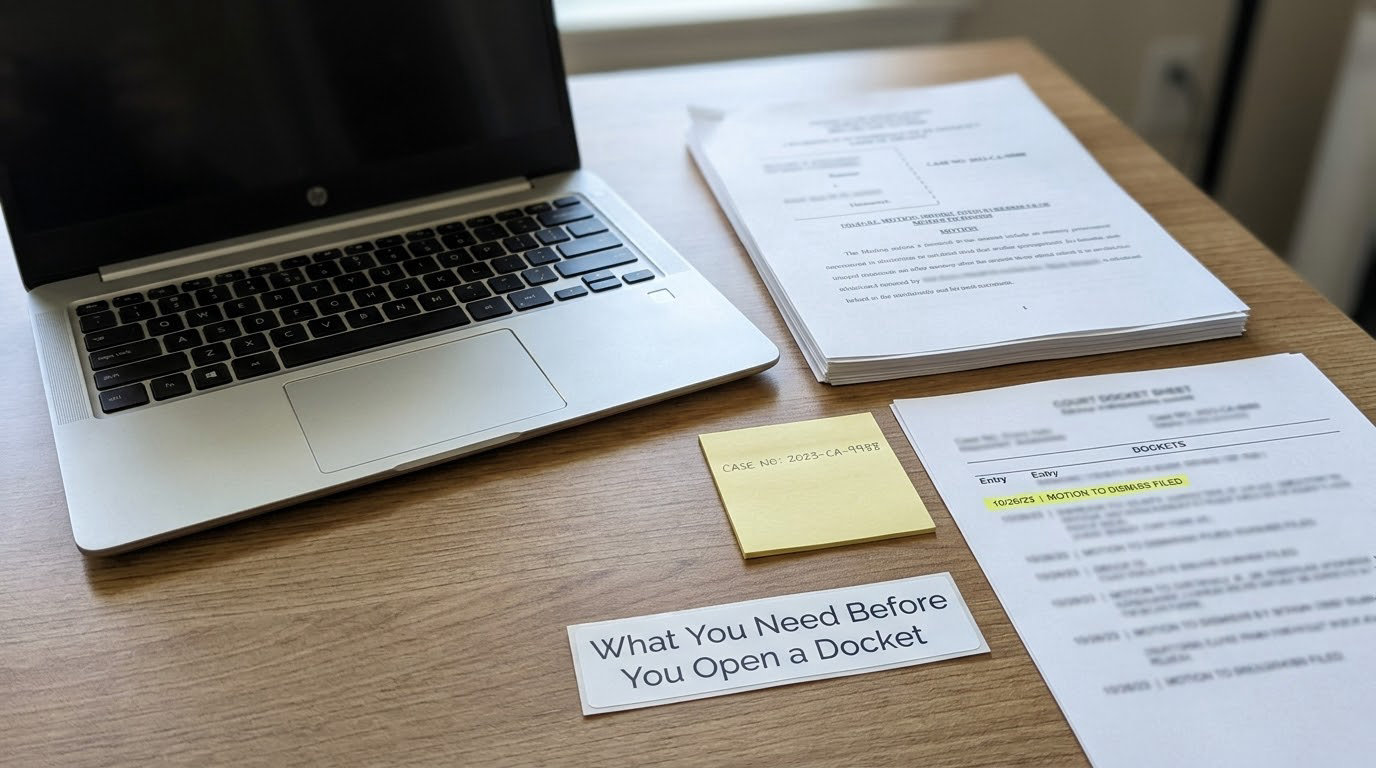
You need four things: access to the court’s website or docket platform, something to search with (a case name, a party name, or a docket number), the court and jurisdiction the case belongs to, and any papers you already received. The court papers matter more than people expect, because the header of a document usually names the court and the case number in the first few lines.
Access differs sharply by court. Federal cases run through CM/ECF, the federal courts’ electronic filing system, and are searched on PACER, the public access front end. State cases sit on state-run portals, and some counties put nothing useful online at all. Civil, criminal, family, juvenile, traffic, small claims and bankruptcy dockets each look different, and terminology changes from one state to the next.
Before typing anything, write down the court name and the case number if you have them. Searching the wrong court is the single most common reason a person concludes a case has vanished.
How to Read a Court Docket Step by Step
Step 1: Find the correct case
Search with the most specific identifier you have. A docket number is best because it is unique. Failing that, search the full case caption exactly as it appears on your paperwork, including first and last names, then use party name search if the site offers it.
Watch for look-alike cases. The same two people can have four cases in one county, and names get typed slightly differently across systems, so a search for “Jane Doe” may also return “Jane A. Doe.” Compare the county, the case type code and the filing year before you commit to a record. A case filed in 2019 and one filed in 2024 are very different stories even when the caption is identical.
Step 2: Confirm the court and case type
Read the court name, the county or district, the division, the case type and the filing date before you read a single entry. A docket sitting in the wrong court is a common false alarm, and a case type you misread will send you looking for hearings that were never scheduled.
Federal district case numbers follow a fairly consistent pattern across districts. State numbers vary more.
| Segment | What it means | Example |
|---|---|---|
| Court or division number | Identifies the court within its circuit or district group | 2 |
| Filing year | The year the case was opened, not the year of the events described | 23 |
| Case-type code | The type of case, usually in two or three letters | cv |
| Sequence number | The order in which the case was numbered, often resetting each year | 00456 |
So a federal number reading 2:23-cv-00456 points to case number 456 of the civil cases opened in 2023 in that court. A state number in a different format, such as a year followed by a case-type code and a sequence, carries the same three ideas: when it was filed, what kind of case it is, and its position in that year’s queue. Nobody’s scheme is universal, so read the legend your court publishes rather than assuming.
Common case-type letters include CV for civil, CR for criminal, DR for domestic relations or divorce, FK for family or juvenile, and J for civil judgment. Small claims and municipal courts often use plain numbers instead of letters.
Step 3: Read the docket header
The header block at the top tells you what kind of record you are holding. Look for the case caption, which is the title of the case listing the parties. In a civil case the plaintiff brings the suit against the defendant. In a criminal case the government, often written as a state or as People or Commonwealth, prosecutes a defendant. In family court you will see petitioner and respondent, and in appellate court appellant and appellee.
Next to the caption sit the docket number, the assigned judge, the court division and often the date the case was filed or the date of the most recent event. Older dockets also list the attorney of record with a bar number and contact details. If the judge name is the first thing you notice, use it as a filter, since some court systems let you search by judge and that is a fast way to confirm you are in the right place.
Step 4: Understand dates and entry numbers
Every row on a docket has a date and a number. The date is the filing or event date, and the number is that entry’s position in the case, counted from 1. Entry 1 is the first paper filed, usually the complaint or the petition or the criminal complaint in a case the police started.
Note the gap between the filing date and the event date. A motion filed on the 3rd and ruled on on the 21st produces two entries, not one, and the ruling is the second one. Deadlines also appear here rather than in the documents themselves, so if you are tracking your own case, this column is the one to check weekly.
Most online dockets list newest first, which puts entry 1 near the bottom of the page. Scrolling straight to the top gives you the current state of the case, and scrolling to the bottom gives you the beginning. Some courts let you reverse the sort. The paper version, called a docket sheet, is chronological and runs the other way.
Step 5: Interpret docket entries
A docket entry is a log line, not a narration of what happened in the room. It records that a document was filed on a date, described in a few words, sometimes with a link to view the document. This is where beginners over-read, so treat every line as a claim about paperwork, not about a decision.
The entry text is full of shorthand. The decoder below covers what you will meet most.
| Code | Plain-English meaning |
|---|---|
| CMPL, COMPL, PET | Complaint or petition filed, starting the case |
| SUMM | Summons issued, the paperwork formally served on the other side |
| ANSW, RSP | Answer or response filed by the opposing party |
| MOT | Motion, a formal request for the judge to do something |
| NOT, NOPI | Notice given to someone involved in the case |
| ORD | Order issued, a direction from the judge |
| RPRT | Report, often a presentence or investigation report |
| TRN, TRAN | Transcript of a hearing or trial |
| APP, APA | Appearance, a lawyer entering or exiting the case |
| JT, JUD, ENF | Judgment or final disposition of the case |
| SEAL, SEALED | Document hidden from public view by a court order |
| NAN | Not applicable, the entry does not apply to this case type |
| SEE | Pointer to a related entry, the detail lives elsewhere |
Newer federal entries also show a numeric event code, often seven digits, where the last two identify the event and the first one flags it as not publicly visible. When an entry reads as letters instead, the text after them tells you the same story in words.
An entry of appearance is worth pausing on, since it comes up constantly. It means a lawyer has told the court they are now representing a party, along with the service list they will accept. It says nothing about whether the case is going well.
Step 6: Check hearings and deadlines
Search the docket for terms like hearing, conference, trial, status, submission, response and order. A criminal docket will show arraignment, status conferences, pretrial conferences and sentencing dates. A civil docket will show scheduling conferences, motions and trial dates. Family dockets add case management conferences and evaluations.
Entries also carry date stamps, and a stamp like “deadline to respond” tells you when a paper is due rather than when something occurs. Remote appearances became routine after 2020, so look for a hearing type or a courtroom line that says remote, video or telephonic.
One caution matters here. A docket entry is not always the official notice to the parties. Courts frequently serve notice in ways that do not produce a distinct public line, and a self-represented party who relies only on the public docket can miss a deadline. If you are a party, confirm dates with the clerk of court or your own notices, and treat any date on a docket as a strong signal to check rather than the last word.
Step 7: Follow the case status and next action
An active case keeps generating entries. If the last entry is recent, expect more. If the newest entry is a judgment, a dismissal, an arbitration award, a settlement notice or a notice of appeal, the case in that court is finished, even though an appeal may carry it to a new docket elsewhere.
Closed cases often show a status of closed, archived or disposed, and some portals stop updating a case the moment it closes. A criminal case in one court may continue in a separate post-conviction or civil proceeding under a new number, so a single closed number does not mean nothing else is happening. Look for the next scheduled date in the last screenful of entries, and if the most recent line gives no clue, the case status field or the clerk’s office will.
Step 8: Save the information you need
Save the whole docket page, not a screenshot of the one line you care about. A print or PDF of the page plus the access date gives you a dated record of what the system showed, which matters if you need to show someone what was and was not on file.
Write down four things: the court, the full docket number, the date of the entry you are relying on, and any hearing date and courtroom. Then note the date you looked, because dockets change.
An online docket is a copy of a public record, not proof of anything. When you need an official copy, ask the clerk of court for certified records. You will usually pay a per-page fee, the request takes time, and courts frequently require an appointment. The clerk will also tell you what form to use and whether the court keeps records on paper or electronically, which affects turnaround. If you are acting for someone else, ask about the rules for third-party access, since not every record is open to anyone who asks.
Common Mistakes That Lead to Bad Conclusions
Searching the wrong court. A family case may sit in county family court while a related protection order sits in a state court, and federal civil cases share names with county cases. Fix: confirm the court on the caption of any paper you received, and check the county and district before you search. Lawyers on r/Ask_Lawyers repeatedly suggest starting with the free state database, then CourtListener and RECAP for federal records, and using PACER only when you need a district court.
Treating an entry as a ruling. A line saying a motion was filed does not mean the motion succeeded. Fix: look for a separate order or judgment entry dated after the motion.
Assuming a scheduled hearing happened. A docket can show a hearing date with no result entry, because the entry is simply not there yet, or the hearing continued. Fix: note the date, then check the docket again a few days later.
Confusing filing dates with event dates. Fix: read the date on each row rather than the filing date in the header.
Trusting abbreviations without decoding them. A line full of codes can look like a decision when it is a routine notice. Fix: work through the decoder table above before you interpret anything.
Reading a sealed or restricted record as missing. Some entries are hidden by court order, and juvenile and certain victim-related cases are not open at all. Fix: expect blanks, and ask the clerk what is sealed if you have a right to know.
Saving a single line instead of the record. Fix: capture the page, the date and the docket number together.
Habits worth building: check the header before the entries, read the last five entries first for current status, decode codes before you interpret them, and never treat a docket as proof of guilt, liability or outcome. On the forum side of the internet, the most common thread is a relative trying to make sense of a record after an arrest, and the same advice surfaces over and over, get the free state record first and read the entries as a filing log rather than a story.
Frequently Asked Questions
Is a court docket public?
Most case dockets are public records you can view online without a fee, through a court website, a state portal, or PACER for federal cases. Exceptions include sealed cases, juvenile proceedings, and some records involving victims or protected identities. Federally, PACER charges a small per-page fee with a quarterly cap, so costs stay low for ordinary lookups. Where a county publishes nothing online, the clerk of court still holds the record and can tell you how to request it.
Does a docket entry prove what happened in a case?
No. A docket entry records that a document was filed on a date, along with a short description. It does not summarize the contents, explain the judge’s reasoning, or confirm that an event took place as planned. To know what a filing argues or what an order decides, you need the document itself, which is usually linked from the entry or available from the clerk.
What does an entry of appearance mean on a court docket?
An entry of appearance is a notice that a lawyer has officially entered the case to represent a party, and it lists the service list where that lawyer will accept paperwork. After it is filed, the court and other parties generally send documents to that attorney rather than directly to the client. It is a routine administrative step, not a sign that the case is going well or badly.
Why do court dockets use so many abbreviations?
Docket systems are built for clerks processing hundreds of entries, so the descriptions are coded and abbreviated to fit standard fields. The same handful of codes repeats across millions of cases, which is why a decoder table is worth learning. Codes for motions, orders, notices, reports and appearances appear in most cases and are the ones you will see most often.
How do I know if my court case is still open?
Check the status field and the date of the newest entry. An active case keeps adding entries, often right up to a hearing. A closed case usually ends with a judgment, dismissal, settlement notice, or an order closing the case, and many portals mark it closed or archived. If the newest line is months old and no future date is scheduled, call the clerk of court to confirm the status before you assume anything.
When do I need certified records instead of the online docket?
Certified copies are needed when a third party requires an official document, such as a landlord, employer, immigration filing, or another court. The clerk stamps and certifies the pages, and courts charge a per-page fee, often with a small search or certification charge on top. The clerk’s office will tell you the form to use, whether an appointment is required, and how long it takes.
Start With the Court and Case Number, Not the Entries
Open the case with the court, the county or district and the full case number in hand, and confirm the header before reading anything else. Then scroll to the newest entries to see the current status, work backwards only as far as you need, and decode the codes as you go.
Read the result as a filing log, never as a verdict. Most dockets answer a narrower question than people hope for, which is simply what has been filed and what is scheduled. For anything that carries legal weight, talk to a licensed attorney or your court’s self-help center, and treat this guide as a way to read the paperwork rather than a substitute for advice.