
Business licensing works as a layered system. A federal agency licenses activities it regulates nationally, a state issues tax registrations and occupational licenses, and a county or city issues the general business license most people mean when they say the words. On top of those sit industry permits for health, fire, zoning, alcohol, signs and the environment.
Because every layer is run by a different office, one license almost never covers everything your business does. Understanding how business licenses work means knowing which of those layers applies to you, in what order, and what happens if you skip it. This guide walks through the whole lifecycle, updated for 2026.
This is general information about a regulatory process, not legal advice. Only the issuing agency in your jurisdiction can tell you definitively what applies to your business.
Table of Contents
- What Is a Business License and Why Does It Matter?
- How Business Licenses Work
- What Types of Business Licenses May Be Required?
- Which Government Agency Issues the License?
- What Documents and Information Do You Need to Apply?
- How to Get a Business License: A Step-by-Step Overview
- How Long Does a Business License Take and What Does It Cost?
- Do You Need to Renew or Update Your License?
- Common Business License Mistakes to Avoid
- Where to Check Requirements for Your Location
- Frequently Asked Questions
- How do business licenses work?
- Should I get a business license or LLC first?
- Do I need a business license to sell online?
- What happens if I operate without a license?
- Do I need a business license if my revenue is small?
- How long does a business license take and how much does it cost?
- Conclusion
What Is a Business License and Why Does It Matter?
A business license is official permission from a government agency to operate a particular kind of business in a particular place. It is not a qualification, and it usually says nothing about the quality of your work. It is a record that you registered, paid the fee and agreed to keep following local rules.
What makes it matter is what rides along with it. Most agencies tie the license to tax collection, inspections and renewal, so being unlicensed tends to unravel several other things at once: your sales tax registration, your business bank account, your lease, and your insurance. It can also pull you out of the liability protection you formed an LLC to get, because a business that is not properly registered may not be treated as a separate legal entity in a dispute.
The confusion starts early, because several different documents get called a business license. Here is how they separate.
| Document | Who issues it | What it does | Order |
|---|---|---|---|
| Entity formation (LLC, corporation, sole proprietorship) | Secretary of State or county clerk | Creates the legal entity and separates it from you personally | First |
| Employer Identification Number (EIN) | Internal Revenue Service | Federal tax identifier for the business | After formation |
| Doing business as (DBA) or fictitious business name | Secretary of State, county or city clerk | Registers the public-facing trade name | After the entity exists |
| General business license or business tax receipt | City or county clerk, sometimes the state revenue department | Permission to operate locally, usually paired with local tax registration | After the entity and EIN |
| Sales tax permit or seller’s permit | State Department of Revenue | Authorizes you to collect and remit sales tax | Before the first taxable sale |
| Occupational or professional license | State licensing board | Proves you qualify to practice a regulated trade | Before you offer that service |
| Permit (zoning, health, fire, building, sign) | Zoning office, building department, health department, fire marshal | Certifies a specific site, safety or health standard | Before opening or renovating |
One rule covers most of the confusion: get the entity and the EIN first. Agencies ask for both on the license application, and if you apply without them you usually reapply and pay the fee twice. The U.S. Small Business Administration publishes a state-by-state license guide that maps out which office handles which filing, which is a better starting point than a formation service landing page.
How Business Licenses Work
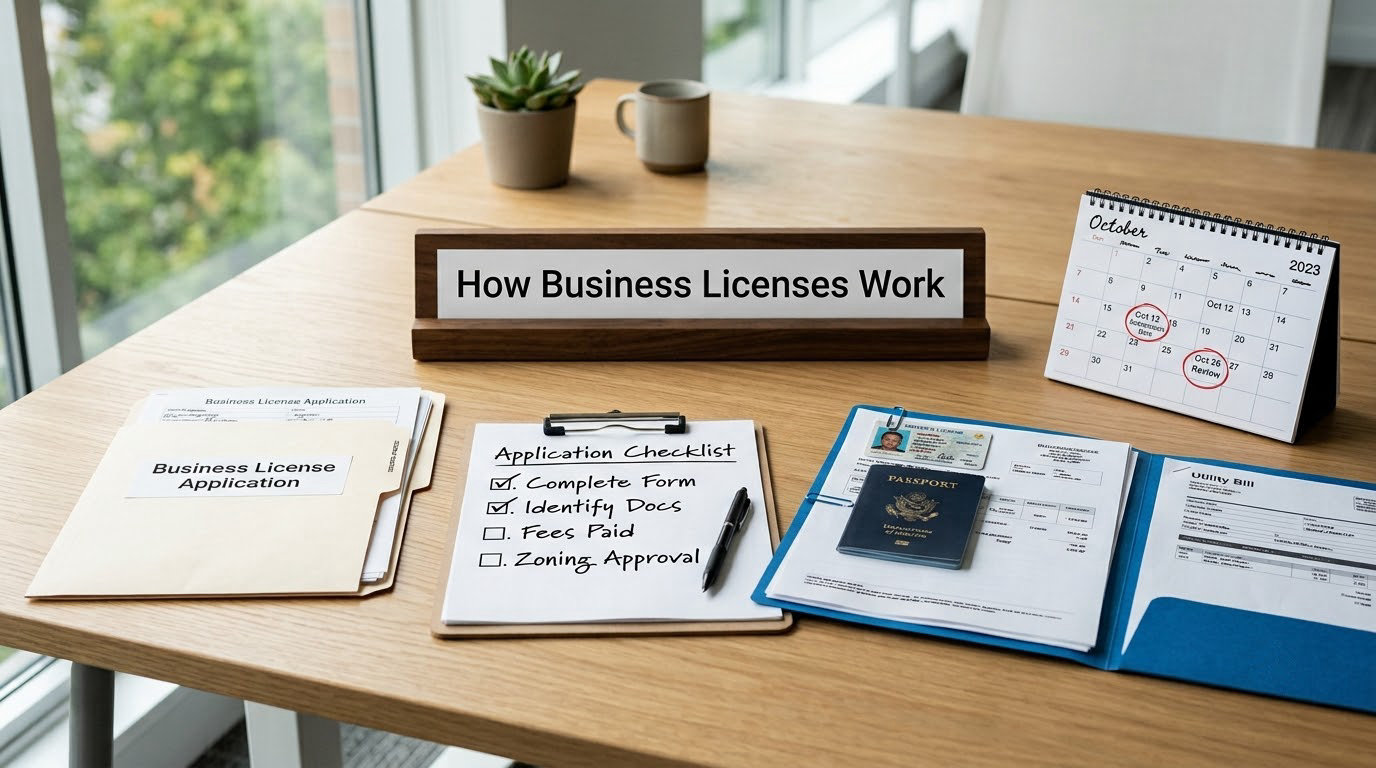
The licensing process runs in a fixed order: identify your activity, find the office with authority over it, submit an application, respond to questions, get approved, display or keep the documentation, renew on schedule, and update the license whenever your situation changes. Each license you hold repeats that cycle on its own clock.
Here is how the lifecycle works in practice.
Identify the activity. What you actually do decides which rules apply. Selling candles, cutting hair, serving food, pouring concrete and selling alcohol trigger completely different agencies, even if all five happen in the same strip mall.
Find the right jurisdiction. Jurisdiction is the government unit whose rules apply to you. Your city may license you, your county may license you, and your state may license a different piece of the same business. Some cities have no license requirement at all, which is why moving one neighborhood can change the answer.
Check whether you are exempt. Many jurisdictions exempt businesses below a revenue threshold, and the thresholds are specific rather than national. Tennessee, Colorado and Wyoming all use gross receipts tests, New Mexico triggers registration at a sales level, and Washington taxes business activity at a low income threshold. If you sit just under a line, read the statute wording rather than the summary, because the definitions of gross receipts differ.
Submit the application. Most local applications are short forms. The hard fields are usually your legal entity name, your tax ID, the physical address including square footage, and the names of owners or key stakeholders. Get those four things straight before you start.
Respond to questions and inspections. Agencies can ask for clarifying detail, and regulated activities can trigger a site visit. A food operation, a daycare and a fuel station are all likely to see an inspector; a consulting firm is not.
Receive approval and keep the proof. Your license, permit or tax registration certificate becomes a document you may need to display, and a document you will need when a landlord, a bank or an insurer asks.
Renew and update. Most local business licenses are annual and most tax registrations are periodic. A renewal that lapses is treated the same as never having had one, in most places.
What Types of Business Licenses May Be Required?
Six types cover nearly everything. A general business license is the local permission to operate and is frequently just a tax registration dressed in legal language. A professional or occupational license is issued by a state board for a regulated profession such as nursing, cosmetology, electrical work, plumbing or real estate. A sales tax license, called a seller’s permit in California and a transaction privilege tax license in Arizona, lets you collect sales tax. A federal license applies to nationally regulated activity, such as securities advice through the SEC, food and drug approvals through the FDA, radio and broadcast through the FCC, alcohol labeling through the TTB, firearms dealing through the ATF, and plant and animal matters through the USDA.
The fifth type is the health and environmental permit, issued by a county health department, a state environmental agency or an OSHA-linked safety program, depending on what you handle waste, water, food or air. The sixth is the special use and location permit: a liquor license, a zoning or conditional-use permit, a home occupation permit, a building permit, a certificate of occupancy, a fire permit, a sign permit, an amusement or lottery license, or a permit to store flammable materials. This last group is what people miss, and it is the group that shuts businesses down when it is skipped.
Which Government Agency Issues the License?
No single office issues business licenses. Authority is split by level and by subject matter, which is why the same business can hold three documents from three agencies and be fully compliant with all of them.
| Level | Typical agency | What it issues | Example |
|---|---|---|---|
| Federal | SEC, FDA, FCC, TTB, ATF, USDA, IRS | Licenses for nationally regulated activities and federal tax identification | A broker-dealer registering with the SEC |
| State | Department of Revenue, Secretary of State, state licensing boards, labor department | Sales tax registration, occupational licenses, business name registration, unemployment and workers’ compensation registration | A seller’s permit and a state cosmetology license |
| County | County clerk, county health department, county tax collector | The general business license or business tax receipt in many states, plus health and environmental permits | A business tax receipt in Florida or Georgia |
| City or town | City clerk, business license office, zoning board, building department, fire marshal | General business license, home occupation permit, zoning, building, fire and sign permits | A home occupation permit for a business run from a residence |
| Special district or authority | Alcohol control board, utility or transit authority, port or airport authority, school or hospital system | Narrow approvals attached to a specific site or product | A liquor license issued by a state alcohol control board |
Two naming quirks trip up searches. Alabama calls its state-level document a business privilege license, and Florida and Georgia locals often say business tax receipt rather than business license. Searching for the local term gets you to the right agency faster.
It also matters that some states issue no statewide general business license at all. Arizona and North Carolina are the commonly cited examples. That does not mean you are free to open anywhere in those states, because counties and cities inside them still license businesses, and North Carolina in particular layers hundreds of regulatory and occupational permits on top of local licensing.
What Documents and Information Do You Need to Apply?
Almost every application asks for the same core set. Business identity and structure: your exact legal name, the formation date, and your entity type. Ownership information: every owner or member, with the percentage each holds, and names of key stakeholders if the form asks. Tax information: your EIN, or the state tax ID number where the state issues one. Location details: the street address of every place of business, what the space is used for, and its square footage.
Beyond that, the requirements depend on the activity. Regulated professions ask for proof of qualifications, exam results, background checks, a bond and proof of insurance. Food service asks for a food manager or handler certification. Childcare asks for staff training records and a background-check roster. Construction asks for a trade card and insurance. Childcare, health and building permits usually add a zoning confirmation and a certificate of occupancy for the premises.
If you work from home, expect the application to describe residential space. A home occupation permit typically limits how much customer traffic you may generate, whether you can sign for goods at the door, and whether you can store inventory there. Deciding that before you apply saves a rejected filing.
How to Get a Business License: A Step-by-Step Overview
Start with the entity, then the EIN, then the licenses, in that order. The seven steps below are the order that avoids rework for most businesses.
1. Form the legal entity. Register the LLC, corporation or sole proprietorship with the Secretary of State or the county clerk, and adopt a name that is available.
2. Get the EIN. The IRS issues it free. Applying directly skips the fee that third-party formation services charge for the same number.
3. Register your trade name if it differs. File the doing business as, also called a fictitious business name, in the state or county where the business sits. Some offices restrict corporate suffixes in trade names unless your entity actually includes them.
4. Apply for the local general business license. Your city clerk or county clerk is the right desk. Bring the entity name, EIN, address, square footage and owner list.
5. Register for sales tax. File with your state Department of Revenue before the first taxable sale. For online sales, the trigger is economic nexus, which usually means hitting a sales or transaction threshold in that state or having physical presence there. The 2018 South Dakota v. Wayfair decision pushed nearly every state to require collection once a seller has enough activity in their state, even without a physical location.
6. Add industry permits and occupational licenses. This is the step people skip. Match your business type to what it needs.
| Business type | Usually needs |
|---|---|
| Marketplace seller of crafts or handmade goods | Home business registration in states that require one, sales tax registration once you pass the state threshold |
| Home baker or cottage food producer | Cottage food permit or home food operation approval from the state agriculture or health department, plus the local business license |
| General contractor | State trade license, general business license, tax registration, insurance, local permits |
| Restaurant or food truck | Health department permit, food handler certification, fire review, occupancy approval, local business license |
| Salon, barber or nail studio | Cosmetology or esthetics license for each technician, plus local business license and sales tax registration |
| Consultant or online service business | Local business license, state tax registration, EIN; a home occupation permit if clients visit |
| Childcare or daycare | State childcare license, background checks, staff training records, zoning approval, fire inspection |
7. Set the renewal reminders and post the license. Put the expiration date in a calendar the day the license arrives, and display it wherever the issuing office requires.
How Long Does a Business License Take and What Does It Cost?
Processing runs from a few days to several months. A straightforward city business license with no regulated activity is often approved in under a week. A sales tax registration may be issued in days but not take effect until a set future date. Anything involving a background check, an exam, a fire review or a public hearing runs much longer, and any license requiring a public notice period can add a month or more on its own.
On cost, the range is wide because there is no national fee. A small town that only registers a name and collects a local business tax charges a modest flat amount. A major city that combines licensing with a headcount-based privilege tax on gross receipts can run into the thousands, and the same business that costs a little in one city can cost several times that in a dense metro area, which is exactly why a business that moves or expands needs a fresh look at local figures. Budget for a state tax registration fee and an occupational license fee on top, plus a bond, insurance, exam prep and continuing education if your trade requires them. Those compliance costs usually cost more than the license itself.
One more cost people forget: the fix. Penalties, late fees and reinstatement charges are typically added on top of the original fee, and they are the reason a cheap application that gets filed in the wrong jurisdiction is not actually cheap.
Do You Need to Renew or Update Your License?
Yes, most of them. General business licenses usually run on an annual cycle, tax registrations renew on their own schedule, and occupational licenses typically need continuing education hours to renew. Agencies mail or email expiration notices, but the notice is not the deadline, and many places have no grace period at all.
Several changes trigger a new application instead of a renewal: moving to a different address or adding a second location, changing owners or converting from a sole proprietorship to an entity, adding a regulated activity such as alcohol or food service, remodeling or changing the use of the premises, and hiring staff when workers’ compensation or unemployment registration applies. Some cities treat a change of address as a brand-new license with a brand-new fee, even if the business itself never closed.
While you are checking this, confirm the posting rule. Some offices require the license displayed at the public place of business, others only require you keep it on file. Posting the wrong one, or posting an expired one, is an easy citation for an inspector.
Common Business License Mistakes to Avoid
Applying in the wrong jurisdiction. The fix is a two-minute check: ask your city clerk and your county clerk which of them licenses your type of business at your address. In a handful of cities the answer is neither.
Treating a general license as permission to practice a trade. A general business license tells the city you exist and that you paid the local business tax. It does not authorize plumbing, haircuts, medical care or electrical work. In Florida, for example, a contractor holding only a general license still needs a state trade license, and a general license never substitutes for permits on the job.
Starting work before approval. Rent signed, shelves stocked, doors open. An inspection can close a business on the spot, and some jurisdictions treat operating during an expired period as a separate violation from never applying.
Missing a revenue threshold because you were busy. Marketplace sellers and side hustles are the most common cases. The threshold is a legal line, not a suggestion, and the money above it is still yours to account for when you cross it.
Filing with inconsistent information. A typo in the entity name, a home address instead of the premises address, or a missing square footage field is the most common reason an application gets kicked back. Read the form twice before you pay the fee.
Letting a renewal lapse. Set a reminder 60 days out. Reinstatement after a lapse is slower and costlier than a renewal, and some jurisdictions treat the gap as unlicensed operation for the whole period.
Assuming one license covers another state. Your home-state license does not authorize you to sell into a state where you have nexus. Each state you owe tax or owe a license to handles that separately.
Where to Check Requirements for Your Location
Start at the source. The city or county business license portal answers what is local. The state Department of Revenue answers sales tax. The Secretary of State answers entity and trade name questions. The county health department answers food, waste and water questions, and the zoning or building department answers premises questions.
A few states have free guided tools that walk you through every filing in order, and they are the fastest route for a first-time owner: the Business Licensing Wizard in Washington, Business Xpress in Oregon, geauxBIZ in Louisiana, the Arizona Business Wizard, the West Virginia Startup Wizard and the Idaho Business Wizard. A handful of states also run a single site that issues occupational licenses rather than sending you to 40 separate boards.
Use unofficial summaries to orient yourself, not to decide. Search results for this topic are full of formation-service pages and SEO listicles that flatten fifty states into one sentence, and several of them get basic facts wrong about states that issue no general license. Confirm anything that matters on a government page before you pay a fee.
Finally, if you hire a contractor, verify them. Search their name in your state licensing board’s database, check the business entity record with the Secretary of State, ask for proof of insurance, and confirm the local license matches the address they will work at. License verification is free, and it takes a couple of minutes.
Frequently Asked Questions
How do business licenses work?
Business licensing works in layers. Federal agencies license nationally regulated activities such as securities, food, drugs, radio, alcohol and firearms. States issue sales tax registrations, occupational licenses and business name filings. Counties and cities issue the general business license or business tax receipt that most people mean, plus zoning, building, fire and health permits. Each layer runs on its own schedule, so one license rarely covers everything your business does.
Should I get a business license or LLC first?
Form the entity first, always. License applications ask for your legal name, formation date and EIN, and an application filed without them is usually rejected and refiled with a second fee. The working order is: register the LLC or sole proprietorship, get the free EIN from the IRS, file your trade name if it differs, then apply for local, state and industry licenses.
Do I need a business license to sell online?
Usually yes for the state you are based in, and often for other states too. Selling into a state where you have economic nexus, which usually means crossing a sales threshold or having physical presence there, obligates you to register and collect sales tax there. Since the 2018 Wayfair decision, most states require collection without a physical location. Rules still differ, so check the Department of Revenue in your home state first.
What happens if I operate without a license?
Penalties commonly stack up: fines that grow with every month, a citation on inspection, forced closure until you comply, and problems opening a business bank account or signing a lease. A contractor working without a trade license can be personally liable for the job. Unlicensed operation can also complicate insurance claims and weaken the liability separation an entity was meant to provide.
Do I need a business license if my revenue is small?
It depends on the threshold your state or city writes into its own code. Tennessee, Colorado and Wyoming test gross receipts, New Mexico uses a sales level, and Washington taxes business activity at a low income figure. The same side business that needs nothing in one state needs a registration in the next, so check the statute in your own jurisdiction rather than a national summary.
How long does a business license take and how much does it cost?
A plain local business license often comes through in under a week, while anything with a background check, exam, inspection or public hearing can take weeks or months. There is no national fee. A small town may charge a flat local business tax, while major cities that tax gross receipts by headcount can run into the thousands, and state tax registrations, bonds and occupational fees sit on top.
Conclusion
Start with four things this week. Write down what your business actually does, find the city or county clerk that licenses that activity at your address, gather your entity name, EIN, address and square footage, and check the state Department of Revenue for sales tax registration. Then work down the industry list for your trade.
Get the entity and the EIN in place before you file anything. That single ordering habit is what keeps the rest of how business licenses work from turning into a second round of fees.