Federal judges are nominated by the President of the United States and confirmed by a simple majority vote in the Senate. That is the whole constitutional rule, and it lives in Article II, Section 2, which directs the President to “nominate, and by and with the Advice and Consent of the Senate, appoint” judges of the Supreme Court and the inferior federal courts. A seat is filled only after a candidate clears a White House vetting process, a Senate Judiciary Committee hearing, a committee vote and a floor vote. Once confirmed, an Article III judge holds the office during good behaviour, which in practice means for life.
Most people first encounter this process through a Supreme Court fight, where the stakes are obvious. The quieter version plays out thousands of times a decade, filling seats on district courts and courts of appeals. Both versions follow the same machinery, and the machinery is stranger than the TV version suggests: the senators who represent the state where the seat sits have unusual power over who gets considered, and much of that power comes from custom rather than from any written rule.
This guide walks through that machinery stage by stage, then covers the questions people actually ask. Who chooses the candidates in the first place? What happens when a senator simply refuses to move a nominee along? Can a president remove a judge who keeps issuing rulings the White House hates? Those answers sit in the Constitution, the Senate’s own rules and about two centuries of unwritten practice, and they are rarely explained in the same place.
Table of Contents
- How Federal Judges Are Appointed: The Process at a Glance
- The step-by-step pipeline for how federal judges are appointed
- Who Appoints Federal Judges?
- Article III judges are different from Article I judges
- What Qualifications Do Federal Judges Need?
- How Does the President Choose a Judicial Nominee?
- Where candidates actually come from
- What vetting happens before the Senate hears anything
- What Happens During Senate Confirmation?
- What a hearing actually looks like
- The blue slip, and what survives of it
- How the vote threshold changed in 2013 and 2017
- What holding over a nominee means
- How long each stage actually takes
- How Are Federal Judges Assigned to Courts?
- How Does a Federal Judge Maintain Independence?
- What a president cannot do to a sitting judge
- How Federal Judges Are Appointed: Common Misunderstandings
- Frequently Asked Questions
- Can a president fire a federal judge?
- Can the President overrule a federal judge?
- Can the President appoint federal judges without Senate approval?
- Who can override a federal judge?
- How long do federal judges serve?
- Are state judges elected or appointed?
- Conclusion
How Federal Judges Are Appointed: The Process at a Glance
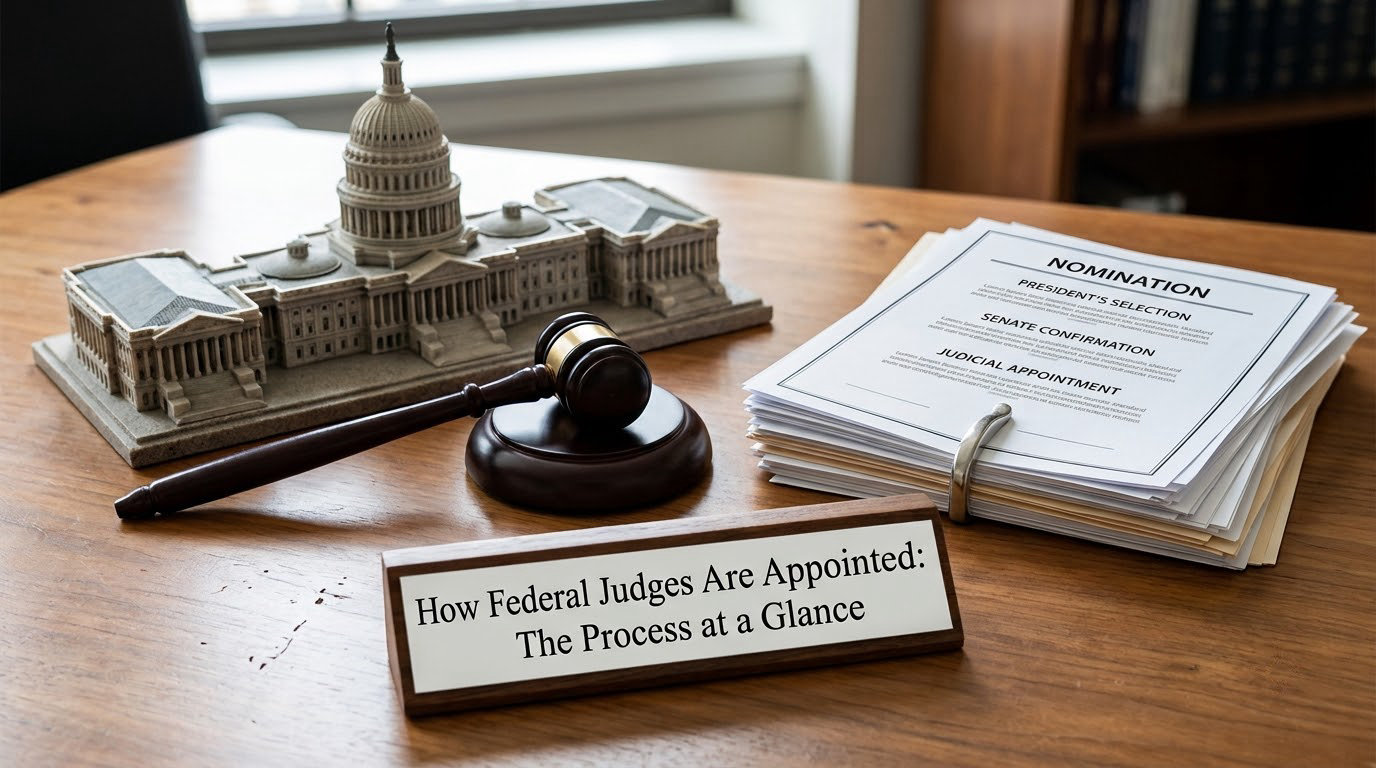
The Appointments Clause puts two actors in charge of every Article III appointment. The President chooses the nominee. The Senate decides whether to give its advice and consent. Neither branch can complete the job alone, and the Judiciary itself appoints nobody, even though it administers the courts once the seat is filled.
The step-by-step pipeline for how federal judges are appointed
- Identify the vacancy, caused by a death, retirement, or a move to senior status.
- Gather recommendations, traditionally from the state’s judicial nominating commission and home-state senators.
- Choose a nominee and complete White House vetting, including a background investigation and financial disclosure review.
- Submit the nomination to the Senate in writing.
- Answer the Senate Judiciary Committee Questionnaire and clear the committee’s 28-day review rule.
- Attend a public hearing and a closed executive session, then answer written questions submitted for the record.
- Pass a Senate Judiciary Committee vote, where the blue slip can still sink a district court nominee.
- Clear a cloture vote and a floor vote by simple majority.
- Receive a signed presidential commission and take the judicial oath.
Steps one through nine routinely take more than a year, and contested nominations have stretched past two. The Federal Judicial Center tracks the timing stage by stage, and the spread between a smooth district court seat and a stalled Supreme Court seat is enormous.
That wait is not evenly distributed across the country, and the reason is a rule most readers have never heard of. Federal statutes let a judge take senior status once they are at least 65 and have served at least 15 years, and courts informally follow a shorthand called the Rule of 80, meaning age plus years of service. Under that shorthand, a 70-year-old judge with 12 years on the bench is not expected to move to senior status yet, while a 68-year-old with 15 years can leave immediately. Because senior status decisions are made by individual judges, and because the ages of judges cluster by the era in which they were appointed, whole states can go long stretches without an available district court seat. A vacancy that stays open is a vacancy a president cannot fill.
Different courts run the same pipeline at different speeds, with different thresholds. Here is the comparison most people are looking for.
| Judicial office | Nominated by | Confirmed or appointed by | Term | Debate time before a floor vote |
|---|---|---|---|---|
| Supreme Court justice | President | Senate, simple majority | Good behaviour | 30 hours |
| Court of appeals judge | President | Senate, simple majority | Good behaviour | 30 hours |
| District court judge | President | Senate, simple majority | Good behaviour | 2 hours |
| Magistrate judge | Senior district court judge | District court, no Senate vote | 8 years, one renewal | Not applicable |
| Bankruptcy judge | President | Senate, simple majority | 14 years, no renewal | Not applicable |
Only the first three are constitutional Article III judges serving during good behaviour. A magistrate judge is appointed under 28 U.S.C. 631 by the chief district judge with the consent of a senior district judge, and a bankruptcy judge is nominated by the President and confirmed by the Senate for a fixed 14-year term under 11 U.S.C. 322. Many people who assume every federal judge was appointed by the President are forgetting the magistrate seats entirely.
Who Appoints Federal Judges?
The President nominates. The Senate confirms. That division is what the Appointments Clause requires, and the quote in Article II, Section 2 is direct: the President “shall nominate, and by and with the Advice and Consent of the Senate, shall appoint” federal judges.
The custom of senatorial courtesy gives the two senators from the state in which the seat sits a practical veto over who gets considered for district court seats. A nominee that a home-state senator declines to recommend has historically had no realistic path forward, regardless of how much the White House wants the seat filled. Forum discussions on r/law and r/politics tend to land on this same surprise: the people controlling an empty district judgeship are usually the state’s own senators, not the White House.
The Judicial Conference of the United States and the administrative office of each court run the courts day to day, assign cases and manage senior judges, but they appoint no judges and no Article III vacancies. Federal judges are also not elected. Voters in the United States choose the president and the Senate, and those two actors are the only ones who can put a person on the Article III bench.
Article III judges are different from Article I judges
Article I of the Constitution creates Congress and gives it power to vest certain judicial officers in the courts of the District of Columbia and in the territories. Those judges are appointed in a different way, and they do not hold life tenure. Bankruptcy judges sit in a category of their own, appointed by the President with Senate advice and consent but limited to a single 14-year term, with no renewal.
What Qualifications Do Federal Judges Need?
The Constitution itself sets almost no bar. It does not require a nominee to be a lawyer, to hold a degree, to be a certain age, or even to be a citizen. That absence surprises people, and it is worth being blunt about it: the only citizenship requirement in the appointment process sits in federal statute, not in the constitutional text.
Statute fills some of the gap. Under 28 U.S.C. 44, a court of appeals judge must have been admitted to practice in the highest court of a state for at least seven years, must have been actively in practice for at least seven years before appointment, and cannot be related within the third degree to a judge of the same court. Article III district court judges must be citizens of the United States, must be admitted to practice, must reside in the district, and must have good moral character.
By the time an actual nomination is announced, the informal standards are far stricter than the legal minimum. In practice the pool is overwhelmingly lawyers, and it is heavily weighted toward appellate clerkships, federal prosecutor experience, large-firm litigation and public interest work. No rule requires that weighting, but it shapes the bench more than most people expect.
How Does the President Choose a Judicial Nominee?
The Constitution does not say. The search that follows a vacancy is guided by state law, Senate custom and a White House review process that varies by administration, and understanding where candidates come from explains a surprising amount about who ends up on the bench.
Where candidates actually come from
Most states maintain a judicial nominating commission under state statute. A state judicial nominating commission screens applicants, conducts structured interviews and sends a short list of names to the state’s senators, and in most states the commission has to clear a supermajority vote before a name leaves the building. A handful of states, including New Hampshire and New York, have historically used advisory panels that make recommendations without the same binding force. The practical result is that home-state senators usually start the search with a list they helped build, and the President picks from a field that has already been narrowed.
That is the part of the process most explainers skip, and it is also the part that draws the most discussion on forums. Users on r/politics and r/law describe it as the main check on presidential power over the bench, and they are right about the effect even if the mechanism is conventional rather than legal. A state can change its own law to open the door, though almost none have, and doing so tends to require votes the president’s party would rather spend elsewhere.
Once a name is on the list, the Senate Judiciary Committee’s own screening also matters, though that comes later. The White House also works from a broader list, which is where judicial philosophy, geographic and demographic balance, and prior litigation record tend to enter the discussion.
What vetting happens before the Senate hears anything
A nominee who reaches the nomination stage has usually cleared a considerable amount of work. The White House runs a background investigation through the FBI, reviews financial disclosure forms for conflicts and debts, and examines past writings, speeches and legal positions. Any conflicts involving a client, a case or an investment get dealt with, frequently by a divestment or a recusal commitment, before the nomination is announced rather than after.
The American Bar Association’s Standing Committee on Federal Judiciary publishes a rating after interviewing the nominee and reviewing the record: Well Qualified, Qualified or Not Qualified. The rating is not binding on any senator, and confirmations have gone ahead of Not Qualified ratings. But since the committee began publishing an annual public report, the ratings have landed overwhelmingly in the top two columns, which is useful context and not much of a filter in practice.
What Happens During Senate Confirmation?
Confirmation is the longest stage, and it is the stage where politics is most visible. The nomination is referred to the Senate Judiciary Committee, and from there it moves through a fixed sequence of hearings, a committee vote, a cloture vote and a floor vote.
What a hearing actually looks like
Before the public hearing, the nominee completes the Senate Judiciary Committee Questionnaire, a document running several hundred pages and covering finances, prior cases, political activity, judicial philosophy, writings and personal history. Committee rules bar a public hearing from being scheduled until 28 days after the questionnaire is received, unless the committee waives that waiting period, and a waiving is common for Supreme Court nominees facing time pressure.
The public hearing then runs a few hours, and the questions are the visible part. After it, the committee holds an executive session in closed chamber, typically for a short period, so senators can ask whatever they would not ask on camera. Written questions for the record follow, and the answers get published alongside the hearing transcript, which is where the most substantive testimony usually turns up.
Then the committee votes. A favourable recommendation moves the nomination to the Senate floor.
The blue slip, and what survives of it
A blue slip is a formal objection raised by a home-state senator during committee consideration. Historically, the blue slip was procedural courtesy: a nominee it covered would not be reported out of committee by an unfavourable vote. The practice was abolished for court of appeals nominees in 2017, and the Congressional Research Service documents the split that followed. For district court nominees, the blue slip has remained in use in practice, and a nominee opposed by a home-state senator still cannot get a committee vote. This is a custom, not a rule with a statute behind it, which is exactly why its current status is a frequent source of confusion and why readers on forums are rarely given a straight answer to whether it is still required. It is not required. It is used.
How the vote threshold changed in 2013 and 2017
Until 2013, the filibuster meant a 60-vote threshold to end debate on a judicial nominee. A bipartisan agreement that year capped debate at 30 hours for circuit and Supreme Court nominees and two hours for district court nominees, which is where those two numbers in the table above come from. In 2017, the Senate agreed to allow cloture on most nominations with 51 votes, so a simple majority now ends debate and a simple majority confirms.
Supreme Court nominations were handled separately for several years, and the vice president’s tie-breaking vote in the Senate was restored to the threshold rules in 2021. Confirmations have since become routine once a committee has reported a nominee favourably, though the days when a nomination stalled indefinitely on the floor are not entirely a memory.
What holding over a nominee means
Senators also have a quieter tool. A nominee whose hearing has happened can simply sit indefinitely, be referred to a subcommittee that never meets, or be quietly dropped when the president leaves office. No senator has to state a reason, and the nominee gets no notice. Forum commenters describe this as the most frustrating part of the system, and it is the reason a well-qualified candidate can wait years for a vote that simply never arrives.
How long each stage actually takes
Timing varies more than most people expect, and the split is mainly between courts. An uncontested district court nomination that clears every checkpoint on schedule runs in roughly three to four months from announcement to commission. Circuit court nominees usually take longer, commonly four to six months, because appellate seats are more closely watched and more often contested at committee stage. Supreme Court nominations are the outlier, where a smooth confirmation has run about two to three months and a contested one has consumed most of a year or more.
Those are the smooth figures. The tail is what dominates political attention, because a nomination can sit for a year after the hearing with no public event at all, and the delays that get measured are the ones where a senator has decided to wait. A useful way to think about it: the visible parts of the process, the hearing and the vote, are the short parts, and the invisible parts, the questionnaire review, the vetting and the waiting for a senator to move, are where the time goes.
How Are Federal Judges Assigned to Courts?
A confirmed judge receives a signed commission from the President, takes the oath of office, and then begins handling the cases the court assigns. For a district judge, that assignment is handled by the court’s chief judge under a statutory caseload system, which balances senior judges, newly appointed judges and the overall age of the docket.
On the courts of appeals, all active judges of a circuit normally hear the same cases. A panel of three decides most appeals, drawn from the circuit on a rotation, with senior judges who have opted into regular service sitting on the same panels as everyone else. Judges can also be assigned outside their own circuit, a practice that has been used in close presidential elections to keep particular appellate judges off specific cases, and both the Supreme Court and the Judicial Conference use cross-circuit assignments regularly.
The reason cases move is that federal judges are not assigned to individual cases by the President, and a president cannot move a judge to another court, demote a judge, or take a case away from them. The seat is the office. Which judge hears which file is determined inside the judiciary.
How Does a Federal Judge Maintain Independence?
Independence is built from three protections in the Constitution and the statutes. Article III, Section 1 fixes the term: judges of the Supreme Court and inferior courts hold their offices during good behaviour, and may be removed only by impeachment. The Constitution also sets compensation so judges cannot be punished through salary. And Article II’s Recess Appointments Clause lets a president fill a vacancy temporarily if the Senate is not in session, but such a commission expires at the end of the next session, so a temporary appointee cannot hold the seat once the Senate returns.
Those protections come with obligations. Judges must recuse themselves in cases where they have a conflict, must not use the office for private gain, and remain bound by the federal code of judicial conduct. Compensation cannot be reduced during a judge’s term. What the protections do not do is make a judge unaccountable, and the limits are narrow: only Congress can impeach, and impeachment takes a simple majority in the House and a two-thirds vote in the Senate.
What a president cannot do to a sitting judge
These four questions come up more than any other part of the topic, and the answers are short enough that it is worth putting them in one place.
A president cannot fire a federal judge. The only removal route is impeachment, and no president has ever impeached a federal judge. A president cannot overrule a judge’s ruling in an individual case, either. The executive branch has no supervisory power over the federal courts, so a decision in a case involving a federal agency can be challenged in that agency’s own court or on appeal, but not reversed by the White House.
Congress is the one branch that can change the legal ground under a judge. It writes the statutes that bind the courts, and only Congress can change a statute. A judge can still rule that a statute is unconstitutional, and the response to that is appellate review, not a phone call from the executive branch.
A president also cannot appoint an Article III judge without Senate confirmation, with one narrow exception. Under the Recess Appointments Clause, a vacancy that exists when the Senate is not in session may be filled by a temporary appointment that expires at the end of the Senate’s next session. The Supreme Court has narrowed how expansively that clause can be read, and a nominee who would face a difficult confirmation does not become an easy one by waiting for recess.
Nobody outside the Senate can remove a nominee from the confirmation queue either. If a majority of senators is willing to confirm, the nominee is confirmed, regardless of what either home-state senator thinks. That is the practical limit of senatorial courtesy, and it is a real limit.
How Federal Judges Are Appointed: Common Misunderstandings
Five things come up so often that they are worth correcting in one place.
Federal judges are elected. They are not. Voters elect the president and the Senate, and those two branches make judicial appointments. Some state judges are elected, which is probably where the confusion starts, and in a number of states a substantial share of judgeships are filled that way. A federal Article III seat has never been decided by a popular vote.
Nominated, appointed and confirmed are the same thing. They are three different steps. A nominee is a person the President has selected. Confirmation is the Senate’s advice and consent. Appointment is the President’s signature on the commission, and it is the step that actually puts the judge in office.
A president can appoint judges to the Supreme Court without the Senate. Not as a practical matter. The Recess Appointments Clause allows a temporary appointment during a Senate recess, but that commission expires at the end of the next session, and a contested nominee faces the same Senate after it returns.
Senators can block any nominee they dislike. The blue slip has not applied to court of appeals nominees since 2017, and it works mainly as a filter at the recommendation stage for district court seats rather than as a formal veto at the vote. It is also a custom, not a law, which is why its status is described differently by different sources.
A confirmed judge must have been recommended by the President. For district court seats in most states, the recommendation comes from the state’s judicial nominating commission and the home-state senators. The President chooses from a shortlist, and that choice is real, but the field is not open to anyone who decides to apply.
One more myth is worth a line, because it comes up in nearly every comment thread. Federal judges do not serve a fixed term and do not face periodic reelection. They serve during good behaviour, which is why vacancies, not elections, are the mechanism that brings a new name forward.
Frequently Asked Questions
Can a president fire a federal judge?
No. Article III judges hold their offices during good behaviour and can be removed only through impeachment, which requires a simple majority in the House and a two-thirds vote in the Senate. A president cannot reassign a judge, reduce a judge’s pay, or ask a judge to step down. No president has ever impeached a federal judge.
Can the President overrule a federal judge?
No. The executive branch has no supervisory authority over the federal courts, so it cannot reverse an individual ruling. A decision involving a federal agency can be challenged in that agency’s own court or on appeal, and Congress can change the statute a judge applied. Only the courts themselves decide whether a ruling was right.
Can the President appoint federal judges without Senate approval?
There is one narrow exception. Under the Recess Appointments Clause in Article II, Section 2, a president may make temporary appointments while the Senate is not in session, and that commission expires at the end of the Senate’s next session. In practice the exception almost never produces a lasting appointment for a contested seat.
Who can override a federal judge?
A higher court can, on appeal. District court decisions are reviewed by a court of appeals, and appellate decisions by the Supreme Court. Beyond that, the only mechanism for removing a judge is impeachment. The president has no power over an individual ruling, and Congress can change the law but cannot reverse a specific decision.
How long do federal judges serve?
Article III judges serve during good behaviour, which in practice means until death, resignation or removal. Many step back on senior status instead, staying available to hear cases part time once they are at least 65 and have served at least 15 years. Magistrate judges serve eight-year terms, and bankruptcy judges serve a single 14-year term.
Are state judges elected or appointed?
It varies by state. Many state trial court judges are elected, and appellate judges in some states are elected too, while other states fill every judgeship by appointment to the legislature or to the governor. Federal judges are never elected. The president nominates them and the Senate confirms them, and voters have no direct role in a federal appointment.
Conclusion
Understanding how federal judges are appointed takes about ninety seconds: a vacancy opens, the state’s nominating commission and senators screen candidates, the President nominates one, the Senate Judiciary Committee holds a hearing and votes, the full Senate confirms by simple majority, and the President signs the commission. Everything layered on top of that, the vetting, the questionnaire, the blue slip, the filibuster rules and the waiting, is political practice built on a constitutional skeleton. If you want to follow it in real time, pick a pending nomination and read its committee questionnaire and hearing transcript, because that is where the real information sits.