To compare grocery prices without an app, pick 15 to 20 items you buy most weeks, write down the price and the package size at two or three nearby stores, then divide the price by the quantity to get a unit price. That single division is the whole trick. Everything else is just collecting the numbers, and most of those numbers are already printed on the shelf tag or sitting in the weekly ad.
The reason this matters is that the gap between nearby stores is real and it is wide. Consumer Reports and Kiplinger’s have both put the same basket at 25 to 40 percent apart depending on the chain. In February 2026 the Oregonian tracked 20 staple items across eight stores and found a 76 percent spread between the cheapest and the dearest. A national answer to “which store is cheapest” is basically useless, because the answer changes by city, by season and by aisle. Your own basket, priced this week, is the only comparison that holds up.
Table of Contents
- What You Need
- How to Compare Grocery Prices Without an App: Step by Step
- Create a Comparable Product List
- How to Find Grocery Prices Without an App
- Calculate the Unit Price
- Compare the Real Cost of the Basket
- Confirm the Price at the Store
- Common Mistakes
- Frequently Asked Questions
- Is there an app where you can compare grocery store prices?
- What is the best website to compare supermarket prices?
- How do you compare unit prices?
- Are printed store flyers reliable for comparing prices?
- What do I do when the price at the register is wrong?
- Conclusion
What You Need
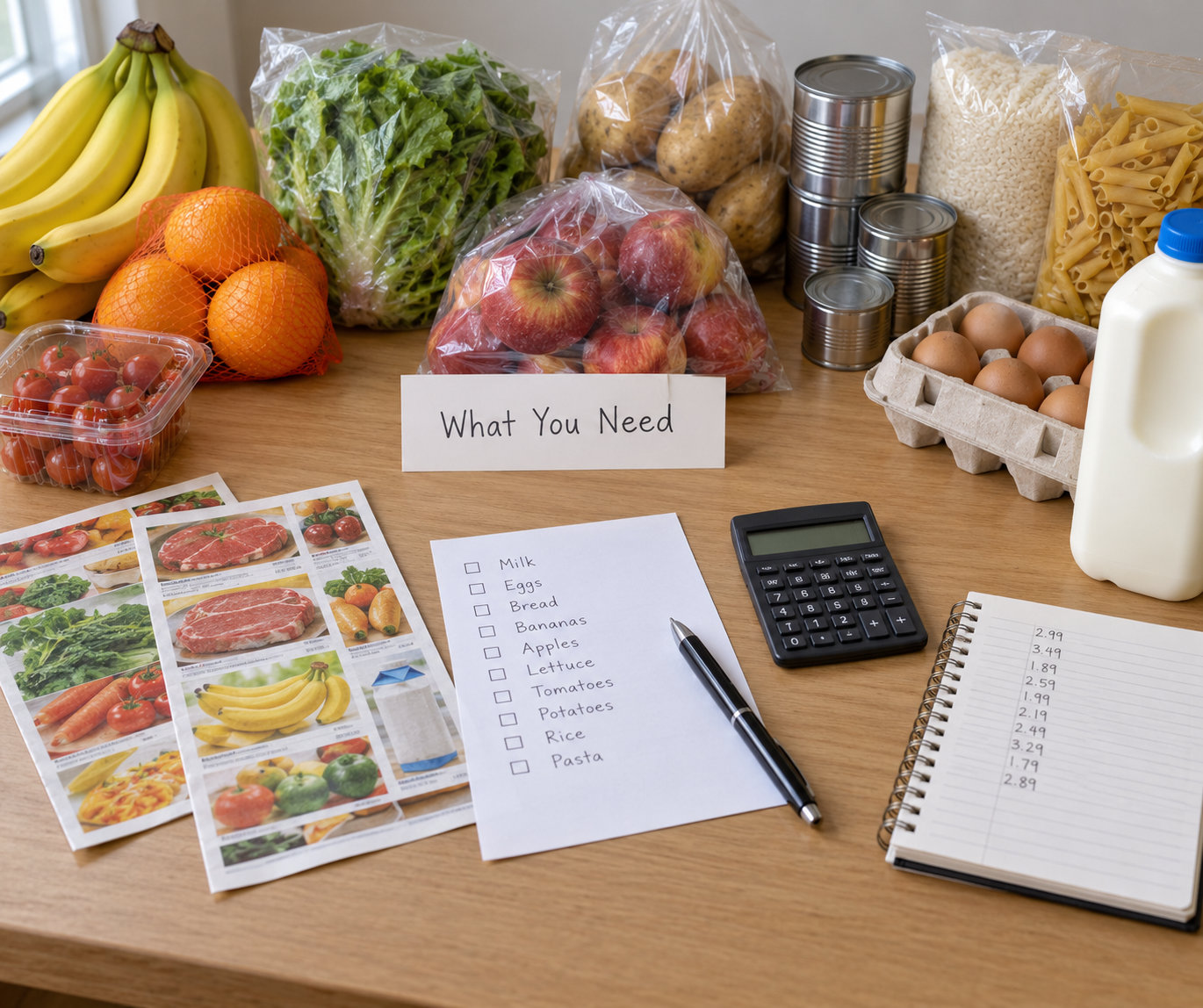
None of this requires a smartphone, a spreadsheet, or an account. Here is the full kit.
- A shopping list limited to the staples you actually repeat: milk, eggs, chicken breast, rice, coffee, olive oil, breakfast cereal, canned tomatoes, pasta, butter.
- A fixed set of products — exact brand, exact size, exact variant — decided before you look at any price.
- Price sources: the printed weekly ad or circular from each store, the store’s website opened in a browser, the shelf tags and unit price labels in the aisle, and your own receipts from past trips.
- A notebook or a single sheet of paper with four columns: item, shelf price, package size, price per unit. A pencil beats a pen because the numbers get crossed out and rewritten.
- A calculator, and the one on your phone works fine if you have one. Division is the only arithmetic this requires.
- Access to price, size and unit price information for every item on the list. One missing item and your basket total is wrong.
If you have no smartphone at all, the paper kit is the whole system. A notebook of 20 staple prices, maintained once a week, beats anything you would have looked up on a phone in the aisle anyway.
How to Compare Grocery Prices Without an App: Step by Step
Here is the routine in short form. Collect prices for your fixed 20 items at each store from flyers or websites, convert every one to a price per ounce, pound, fluid ounce or count, total each basket, subtract the cost of the extra trip, then verify the shelf tag before you pay. Fifteen minutes of setup, two minutes in the aisle per store. It works with no app, no sign-up, and no smartphone.
Create a Comparable Product List
Write the list before you check a single price, and hold every variable still: same brand, same size, same variant, same grade. Comparing a store-brand spaghetti to a national-brand spaghetti tells you nothing useful, because the price gap has nothing to do with the store.
Pick items that repeat on your list and that get discounted, which means skipping fresh produce and anything you buy once a month. Twenty items is the sweet spot. Ten is too thin to reveal which store is cheaper overall, and forty is a Saturday morning project you will abandon. The Oregonian used exactly 20 and got a clean, publishable result; there is nothing magical about the number, it is simply large enough to average out one-off differences.
How to Find Grocery Prices Without an App
Six sources, in rough order of how much they cost you to use: the printed weekly ad, the store’s website in a browser, the shelf tag, your own receipt history, a phone call to the store, and a cash-back browser extension that loads at checkout without being installed.
| Method | What you need | Setup time | Accuracy | Best for |
|---|---|---|---|---|
| Printed weekly ad | A copy or a neighbour’s | Free, 10 minutes | High for the week | Planning a menu around what is on special |
| Store website in a browser | Desktop or phone browser | Free, 15 minutes | Medium to high | Comparing three stores at once |
| Shelf tag and unit price label | Eyes | Free, in store | Highest, but only in store | Confirming before you buy |
| Your own receipts | A folder or a shoebox | Free, ongoing | Exact for what you paid | Your personal price baseline |
| Phone call to the store | A phone, no smartphone needed | Free, 2 minutes | Medium | One item, one store, no internet |
| Cash-back browser extension | A browser | Free, 2 minutes | Variable | Online pickup and delivery orders |
Whatever the source, write four things next to every price: the date you saw it, the store, whether it is a sale or the everyday price, and any condition attached — loyalty card, digital coupon, membership, quantity limit. A sale price without its conditions is not a price, it is a rumour.
Store websites are better than most people expect for this. Open one tab per store, enter your zip code once, and work down the same 20-item list. Prices there usually match the shelf, and they are easier to compare than a page of dense flyer columns. The two places they will not match are pickup orders and delivery, which routinely carry a service fee and a tip field, and loyalty prices, which only appear once you sign in.
Calculate the Unit Price
The formula is one line: unit price equals shelf price divided by total quantity in the package. Choose one reference unit per category and never mix them — ounces for dry goods, fluid ounces for liquids, count for eggs or bars. US law requires stores to post that unit price on the shelf tag, and most chains do it in small print at the bottom of the label. It is the single most useful number in the aisle and almost nobody reads it.
| Item | Shelf price | Package size | Price per ounce |
|---|---|---|---|
| Cereal, large box | 5.49 | 20.3 oz | about 27 cents/oz |
| Cereal, small box | 4.29 | 12.5 oz | about 34 cents/oz |
| Cereal, store brand | 3.79 | 18.0 oz | about 21 cents/oz |
That worked example is where shrinkflation shows up. When a manufacturer shrinks a package from 20.3 ounces to 18 ounces and keeps the sticker price at 5.49, the price per ounce jumps from 27 to 31 cents with no new sale, no new label, and nothing to notice at the register. You cannot catch that without a baseline, and a baseline is exactly what a paper price book gives you.
Unit price beats sticker price whenever sizes differ, which is most of the time in the packaged aisles. It is also the number to use for anything you buy in bulk. Store brands are the extreme case: a private-label version cannot be matched against a national brand on anything but unit price, since no tool can line up two products with no shared barcode or shared recipe.
Compare the Real Cost of the Basket
Now total each store. Multiply price per unit by the quantity you would actually buy, sum all 20 lines, and you have a basket total that is directly comparable. Do the same for the second store and take the difference. That gap is the gross saving.
Then price the trip. A drive of eight miles each way at an average of 24 miles per gallon and 3.80 a gallon costs roughly 2.50 in fuel, and an hour of your Saturday is not free either. If the gap on a full basket is under about 8 percent, the second store is not paying you to make the drive. If it is 20 percent or more, the trip repays itself and then some.
This is the step most published comparisons skip. A 15 percent saving sounds good until you realise it requires two trips instead of one and one of them is 40 minutes away. Split shopping is a real strategy for large households with a big monthly shop; for a single basket of perishables it is usually a loss.
Confirm the Price at the Store
Everything you wrote down is a claim until the shelf tag agrees with it. Match the barcode and the size on the shelf, not the front of the box — the front is marketing, the tag is the contract.
Then check the fine print you recorded earlier. Ask about any promotion you expected and did not get, and if there is a digital coupon, pull it up before you reach the register rather than afterwards. Keep the receipt even when everything is right: most chains will refund a scanning error or honour a displayed promotion if you raise it before you leave the store, and every receipt is a free data point for next week’s comparison.
Common Mistakes
- Comparing different package sizes as if they were the same product. Fix: convert to a unit price before you decide anything. A 24 ounce bottle and a 32 ounce bottle at similar sticker prices are not similar purchases.
- Ignoring the unit price printed on the shelf tag. Fix: read the bottom line of the label first. It converts the whole aisle into comparable numbers and takes about four seconds.
- Mixing sale prices with everyday prices in the same column. Fix: use two columns, or mark every sale price with an S. Comparing one store’s everyday price against another’s temporary promotion tells you which week you shopped, not which store is cheaper.
- Treating a promotion as permanent. Fix: record the date and check the price again in two weeks before you plan a shop around it. Prices move; a price book with dates in it is worth ten times one without.
- Overlooking differences in date, ripeness or quality. Fix: treat produce and bakery items as separate products. Comparing a bruised tray discount to a full-fee item is not a comparison.
- Forgetting membership, minimum spend and delivery fees. Fix: add the annual cost of any membership to the totals before you conclude anything, and treat pickup fees and tips as part of the price of that basket.
- Forgetting what the extra trip costs. Fix: do the subtraction described above before you drive anywhere.
One balance note, because the query deserves an honest answer rather than a victory lap. If you shop at six stores and want a single screen that shows all six at once, an app does one thing better than a notebook: it holds the whole picture. Its limit is coverage and data. Store brands cannot be matched, pickup prices differ from shelf prices, and outside the countries those tools were built for, regional chains simply are not in them. If your region has no working option, or you have no smartphone, the paper method is not a consolation prize. It is the reliable one.
Frequently Asked Questions
Is there an app where you can compare grocery store prices?
Yes, several exist, and they work by pulling prices from retailer websites and weekly ads, or by reading your receipts. None of them is necessary for a correct comparison. Pick 15 to 20 items you buy most weeks, note the price and package size at two or three nearby stores, then divide price by quantity. That gives you the unit price, which is the number every one of those tools ends up calculating anyway.
What is the best website to compare supermarket prices?
There is no single national website that covers every chain in every region, so the honest answer is to use each store’s own site in a browser, one tab per store, with your basket list beside them. Add your local newspaper’s weekly ad archive for printed circular prices. Regional coverage is exactly where comparison apps fall short, which is why a manual basket usually beats them outside major metros.
How do you compare unit prices?
Divide the shelf price by the total quantity in the package, then compare the same reference unit across stores. Pick one unit and hold it: ounces for dry goods, fluid ounces for liquids, count for eggs or bars. A 20.3 ounce box of cereal at 5.49 works out to about 27 cents an ounce, so a 12.5 ounce box at 4.29 is roughly 34 cents an ounce and the bigger box is the better buy.
Are printed store flyers reliable for comparing prices?
Mostly, with two caveats. A flyer price is dated, applies to specific sizes, and often requires a loyalty card or digital coupon that is not automatic at the register. Read the fine print for the qualifying size, the quantity limit and the dates. Treat the flyer as a shopping plan rather than a receipt, then confirm the shelf tag in the aisle before you commit the whole basket to that store.
What do I do when the price at the register is wrong?
Ask for the difference before you leave the store. Most chains correct a scanning error or honour a promotion that was displayed and not applied, and it is far easier to sort out while you are still at the till with the goods in the basket. Keep the receipt, note the shelf tag if you photographed it, and write the corrected figure into your price book so your averages stay accurate.
Conclusion
Start with one week and twenty items. Collect the price and the package size from two nearby stores, divide each price by the quantity, and write the unit price in your notebook. Total both baskets, subtract the cost of the extra trip, and shop the cheaper one. Before you pay, check the shelf tag matches what you wrote down and keep the receipt.
Repeat it next week with the same twenty items. After a month the notebook has done something no single flyer can: it shows you your own lowest price, which is the only figure that tells you whether a sale is worth driving across town for.