Most food expiration dates are a manufacturer’s guess at when quality drops, not a safety cutoff. Knowing how to read a food expiration date means checking the wording first, then the format, then the food itself — because a “sell by” date and a “use by” date mean very different things. It takes about two minutes per item, and it works whether you’re standing in a grocery aisle or sorting leftovers at home.
The confusion has a real cost. A widely cited consumer survey found that a large share of shoppers throw away food that is still perfectly edible, and university extension services such as Illinois Extension point to date-label misunderstanding as a leading cause. Meanwhile the foods people keep past their dates are often the ones that genuinely shouldn’t be kept. Both errors come from the same habit: treating every printed date as a safety deadline.
Here’s the process I use, and it has held up whether the food is a yogurt cup from three weeks ago or a tin of beans in the back of the pantry. Get the package in your hand, find the wording rather than the number, work out what kind of date it is, confirm the storage, then look at the food. Give it two minutes.
Table of Contents
- What You Need Before You Judge a Date
- Step-by-Step: How to Read Any Food Expiration Date
- 1. Check the date wording first
- 2. Decode the date format and any printed code
- 3. Confirm the storage conditions
- 4. Inspect the food before eating it
- Common Mistakes When Reading Food Dates
- Frequently Asked Questions
- What does a food expiration date mean?
- Is food unsafe after its best-by date?
- Can I eat food that is past its use-by date?
- Does a frozen food expiration date still matter after freezing?
- How should I store food so its printed date remains accurate?
- When should I throw away food after a date has passed?
- Conclusion: Start With the Word, Not the Number
What You Need Before You Judge a Date
Four things decide whether a printed date means anything, and you need all four before you decide to keep or bin the item.
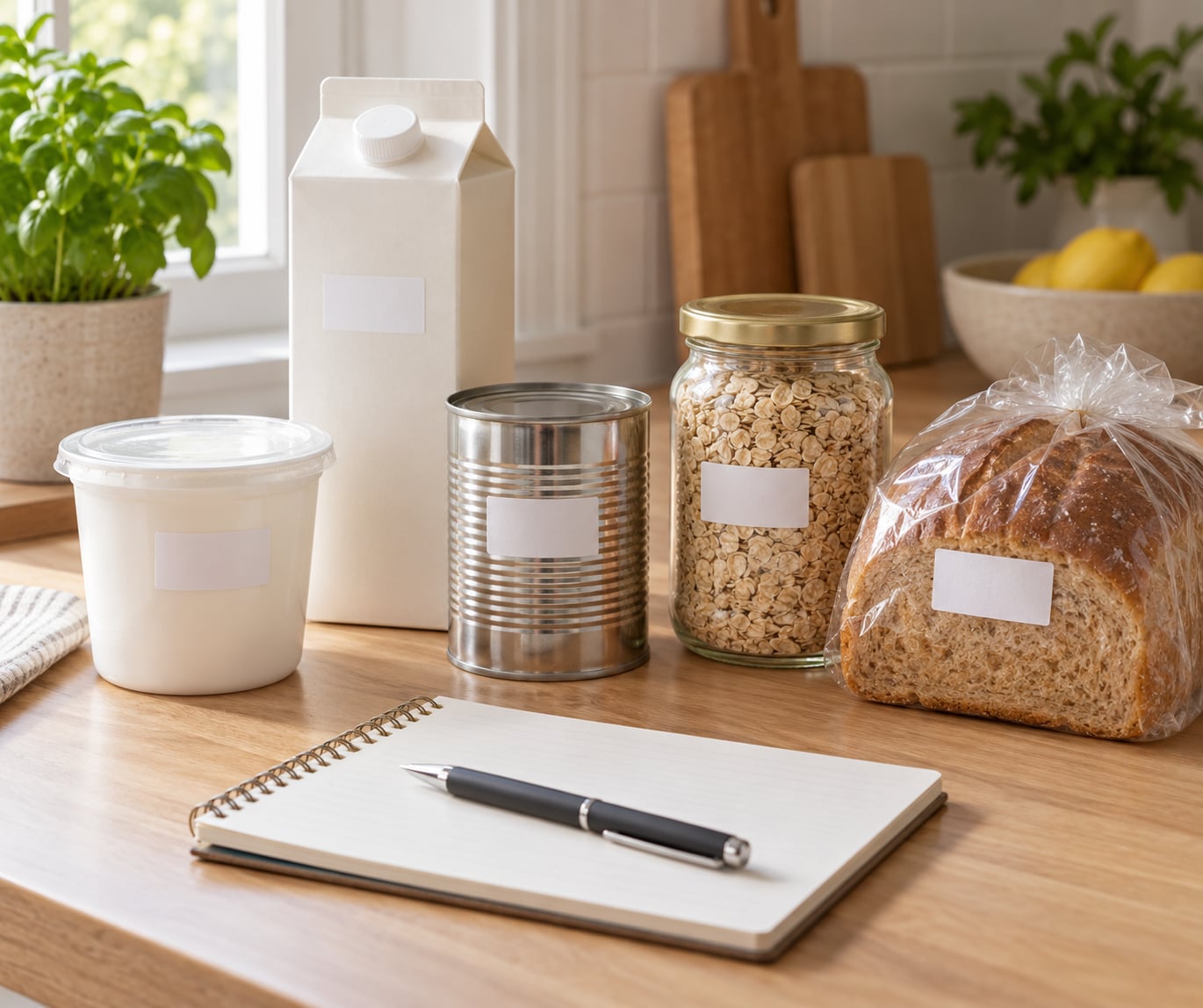
The package itself. Keep the container in your hand. Dated codes on the lid, side panel, or bottom of a tub can be different from the label on the shelf edge, and a retailer’s own sticker date is worth less than the manufacturer’s.
The wording around the date. “Best by,” “sell by,” “use by,” “expires,” “display until,” and a bare code with no words all carry different weight. That wording is the single most informative thing on the label.
The storage history. Printed dates assume the food was kept the way the label says. Two hours on a warm car seat or a transfer to the pantry shelf instead of the fridge voids the calculation completely.
The food type. Shelf-stable canned beans and refrigerated deli meat both carry dates, but they are not in the same conversation. Know which category you’re dealing with: dairy, meat and poultry, seafood, eggs, pantry staples, canned goods, or baked goods.
Step-by-Step: How to Read Any Food Expiration Date
1. Check the date wording first
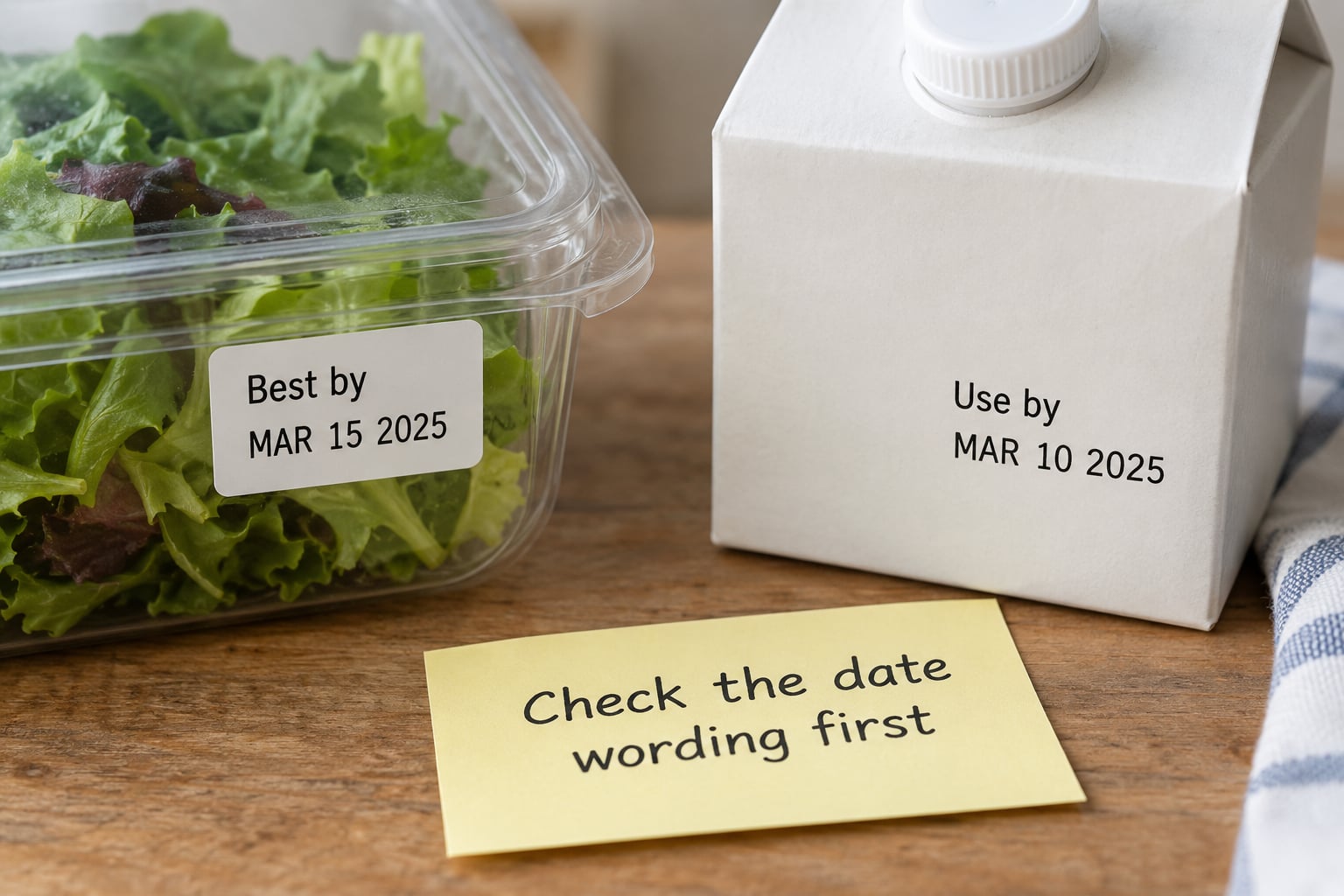
Read the words before the numbers, because the words decide what the numbers mean.
- Sell by — a retailer instruction. It tells the store when to pull the item off the shelf, not you when to stop eating it.
- Best by / best if used by — a quality suggestion. Past it, the food may taste flatter or lose texture, but nothing about it turns dangerous.
- Use by — a stronger wording, still usually about peak quality for most foods, except in the cases below.
- Expires on / expiration date — the rare label that does signal safety. In the US, the main federally regulated category is infant formula.
- Freeze by — the date after which freezing preserves quality best; the food itself is usually fine.
- Display until — purely about retail shelf placement.
- A bare code with no words — usually a pack or lot code for manufacturer tracking, not a deadline for you.
This is the open dating versus closed dating split. Open dating means a consumer-facing calendar date printed on the food. Closed dating means a numeric code tied to production and lot records. On shelf-stable items, closed dating codes are traceability tools for recalls, and the more you read them as deadlines, the more waste you create.
2. Decode the date format and any printed code
Next, work out how the numbers are ordered. US packaging typically uses month first, so 04/10/2026 is October 4. Most of Europe, and a lot of imported product, uses day first, so 04/10/2026 means April 10. When a number is 12 or below and appears in both positions, you genuinely cannot tell from the number alone — look for a spelled-out month, a weekday, or the country of origin.
If the label carries three digits instead of a date, you are probably looking at a Julian date: a day-of-year code running from 001 to 365, where 150 means June 30 in a non-leap year. Plenty of forum questions involve packages printed as a code like “L23145T09:30”, where the first letter is the plant, the numbers are the Julian day, and the rest is line, time and batch detail. Manufacturers are not obliged to publish the key, so the honest move is to look the code up on the manufacturer’s own site or call the number on the label rather than guess.
A lot or batch code on canned goods does something different: it tells the manufacturer which run a can came from, so the plant can trace it if there is a recall. It is not a best-by date, and cans with old lot codes are routinely eaten without trouble.
3. Confirm the storage conditions
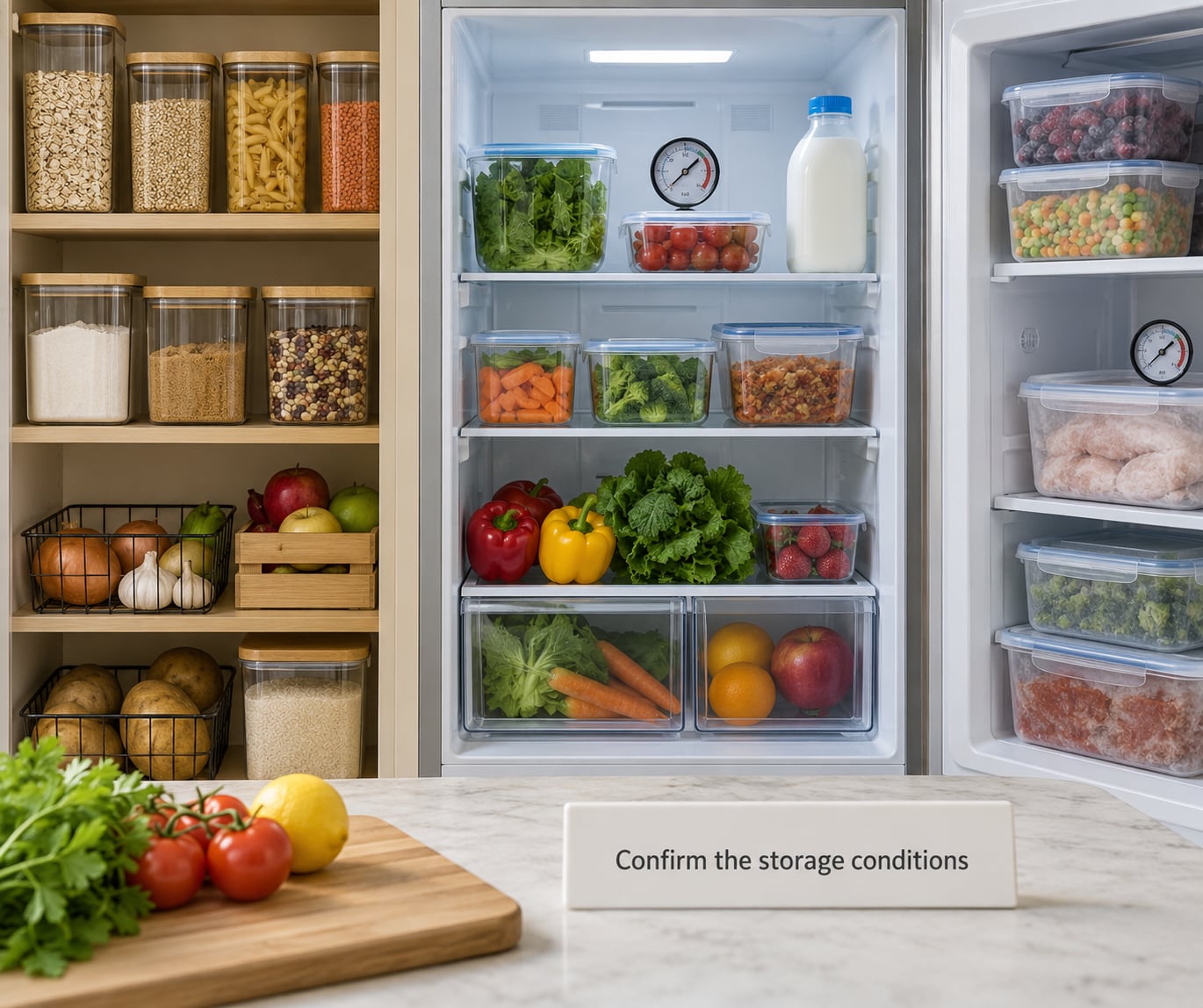
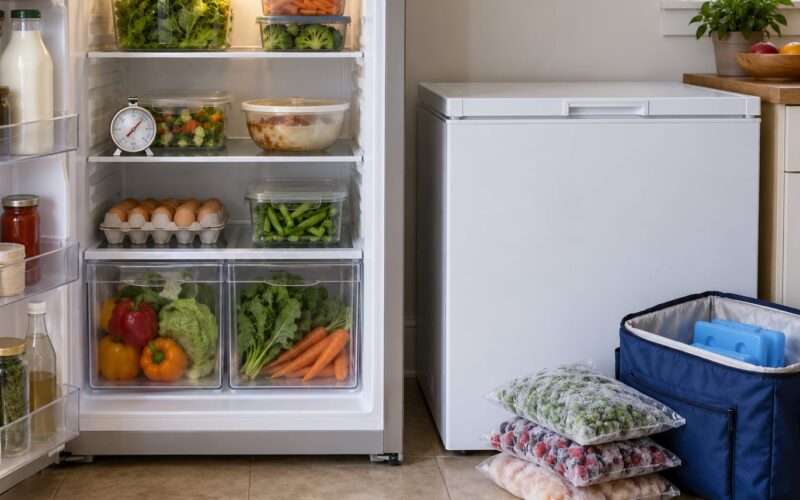
The printed date assumes one set of conditions. Your fridge needs to stay at or below 40°F (4°C), the freezer at 0°F (-18°C), and a sealed, dry, dark pantry. Once food leaves that, the date stops describing it.
Some dates are conditional rather than absolute. Frozen dough, whipped cream, and ice cream often read “use within X days of thawing”, because the clock starts when it leaves the freezer rather than when it was frozen. Fresh deli slices and opened hot dogs carry a “use within 3 to 5 days after opening” instruction that matters more than the date printed on the wrapper.
Two more details that quietly cost shelf life. Cold spots in the fridge are usually the door shelves, so park milk and leftovers on an interior shelf rather than in the door. And never freeze food that has already sat out for two hours or more, because freezing stops growth but does not reverse it.
4. Inspect the food before eating it
After wording, format and storage, the food itself gets the final vote. Look, then smell, and only then decide.
Check package integrity first. A bulging, leaking, hissing or badly rusted can is a discard regardless of the date; the swelling means gas is being produced inside. Same for jars with a broken seal, swollen lids, or food that has crept up the sides of the glass.
On visible signs: fuzzy or patchy mold on soft, moist food such as yogurt, cottage cheese, bread and deli meats means throwing the whole item away. Small hard cheese and firm produce can often be cut back an inch around the spot, since the mold hyphae generally do not run far past what you can see. In every case, one of these rules wins over the date: if it smells off, looks wrong, or the package is compromised, it goes.
Use a float test for eggs. Put the egg in a bowl of water: a fresh egg sinks and lies flat, an older one sinks but stands upright, and a very old one floats on the surface. Floating means the air cell has grown large enough that the egg has lost moisture and protein — the USDA treats floating eggs as untrustworthy and recommends discarding them.
Never taste food to test it. That is how botulism and listeria cases happen, and the illness is far more serious than the food was worth.
When cooking, temperature closes the loop: poultry to 165°F (74°C), ground meat to 160°F (71°C), and whole cuts and fish to 145°F (63°C), measured with a thermometer in the thickest part rather than guessed from color.
Common Mistakes When Reading Food Dates
Treating every date as a safety cutoff. Sell-by and best-by dates are quality statements. Only infant formula, and a small set of products under specific regulation, carry federally enforced expiration dates. Keeping food because of a best-by date is fine; keeping food that smells wrong because of one is not.
Reading 04/10 as October when it is April. Imported goods from day-first countries invert the order, and a reversed date can move an item’s life by months in either direction. If the product is imported and both numbers are 12 or lower, check the words next to them.
Treating a lot or Julian code as a use-by date. Those codes exist for traceability and production tracking. They tell you when and where something was made, not when it stops being edible.
Discarding good food on the date alone. Most of the waste attributed to date labels comes from throwing food at the printed date rather than when it actually turns. Shelf-stable pantry items — dried beans, rice, pasta, uncooked grains, honey, salt, sugar, vinegar, and unopened canned goods with intact seams — are all routinely used well past a date that only ever described quality.
Freezing to “reset” the clock. Freezing does not make spoiled food safe. It also does not restore quality that is already gone, so a food that was past its peak before the freezer will come out past its peak.
Tasting to find out. There is no safe small amount to test with when botulism or listeria is the concern. Skip the test and skip the food.
Two habits close most of the gap. The USDA FoodKeeper app stores recommended storage times by food type, which is genuinely useful once a package is gone and you are left with a container of cooked rice. And buying the amount you will actually eat in four days, then topping up on the next shop, beats any storage trick.
Frequently Asked Questions
What does a food expiration date mean?
On most packaged food, the printed date is the manufacturer’s estimate of when quality drops, based on how that food behaves under ideal storage. Only infant formula has a federally regulated expiration date in the US. A best-by date is a quality suggestion, a sell-by date is a retailer instruction, and a pack or lot code exists for recall traceability rather than for your kitchen.
Is food unsafe after its best-by date?
Usually not. Past a best-by date, food may lose flavor, texture, or color, but it does not become dangerous by default. The exception is food that has spoiled independently of the date, such as something left warm for hours or a can that is bulging. Those go regardless of what the label says, so check the package and use your nose.
Can I eat food that is past its use-by date?
For most foods, yes, if the package is intact and the food smells, looks, and tastes normal. Use-by wording on ordinary packaged foods is usually about peak quality. Treat it as a firm limit for infant formula, and be conservative with deli meats, soft cheeses, prepared salads, and refrigerated seafood, where Listeria is a real concern. Ask a clinician for advice on food risks for babies, older adults, or anyone immunocompromised.
Does a frozen food expiration date still matter after freezing?
A freeze-by date tells you the point after which freezing will not preserve quality as well, so frozen food is best eaten before it. Once frozen, food is safe indefinitely at 0°F or below. The important limit is thawing: frozen food is safe to refreeze after thawing in the refrigerator, but food left to thaw on the counter should be cooked and never refrozen.
How should I store food so its printed date remains accurate?
Follow the package conditions the date was calculated from: refrigerator at 40°F or below, freezer at 0°F, and a cool, dry, dark pantry. Put perishable items on interior shelves rather than in the door, use airtight containers for opened packages, and refrigerate leftovers within two hours. If your storage cannot match those conditions, the printed date is only a rough guide.
When should I throw away food after a date has passed?
Discard it when the package is compromised (bulging, leaking, rusted through, or a broken jar seal), when visible mold covers soft moist food, when it smells sour, ammoniated, or just wrong, or when the date was federally regulated, as with infant formula. Beyond that, a passed best-by date alone is not a reason to bin something. When in doubt, throw it out and do not taste to find out.
Conclusion: Start With the Word, Not the Number
If you do one thing differently, read the wording before the digits next time you pick up a package. “Sell by” and “best by” are quality signals you can safely work around; “use by” deserves real respect on refrigerated meat, soft cheese, prepared salads, and anything for an infant; and an actual expiration date means what it says. Then let the food itself — the seal, the smell, the look — have the last word. That is how you stop wasting good food without ever guessing about safety.