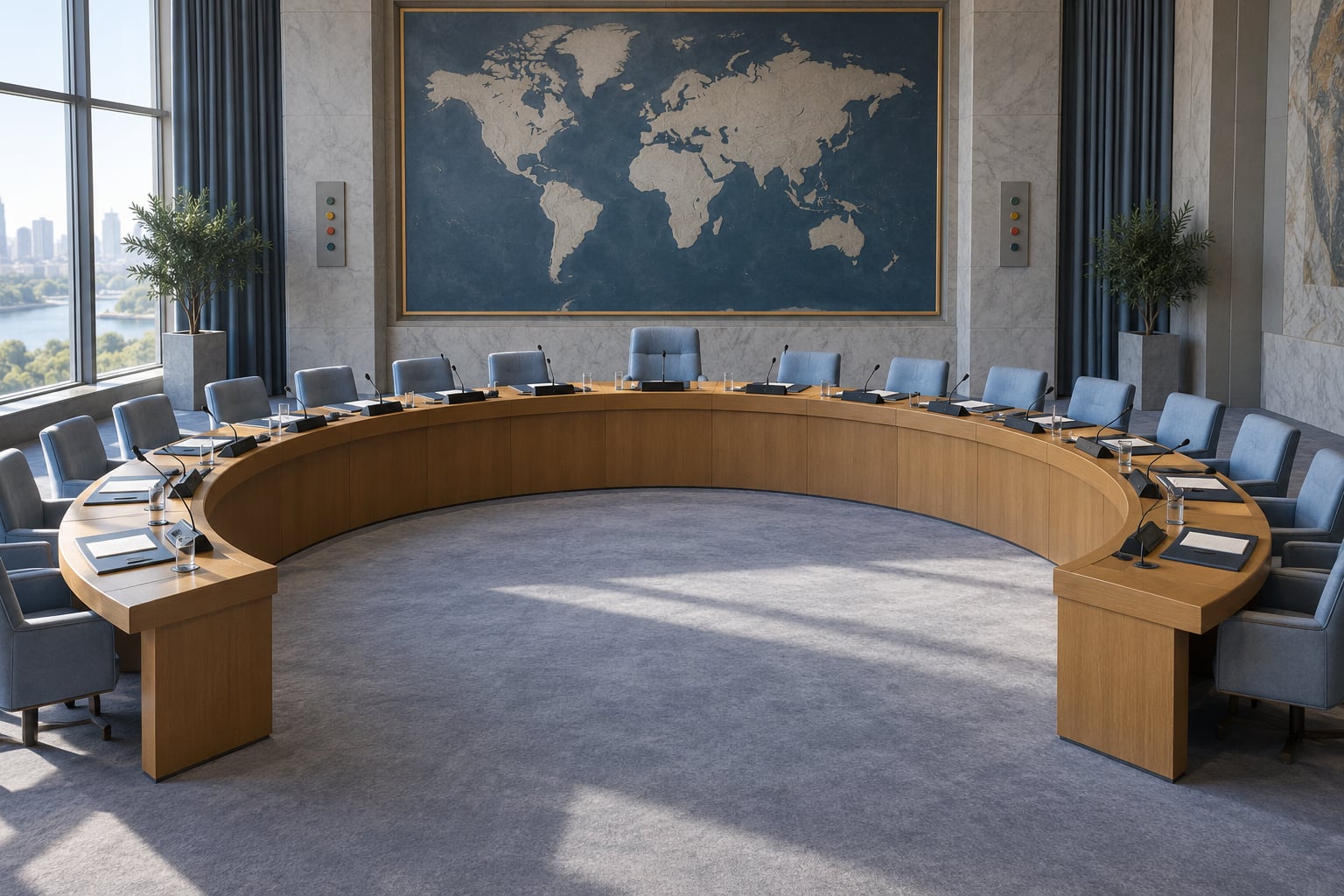
The United Nations Security Council is one of six principal organs of the United Nations, and the only one with primary responsibility for maintaining international peace and security. It has 15 members, and unlike any other UN body its decisions bind all 193 member states.
Understanding how the United Nations Security Council works comes down to three things: who sits on it, how a crisis turns into a vote, and what a single permanent member can do to stop that vote. The rest is machinery, and the machinery is more interesting than most official summaries admit.
Here is the walkthrough, from the moment a conflict reaches the Council chamber to the sanctions committee that monitors compliance six months later.
Table of Contents
- What Is the United Nations Security Council?
- How the United Nations Security Council Works
- The pipeline: how a crisis becomes a resolution
- Who Sits on the Security Council?
- How Are the Council’s Members and Voting Rules Set?
- How Does Voting on a Security Council Resolution Work?
- Why Does the Veto Matter?
- What Powers Can the Security Council Use?
- How Does the Council Respond to War and Humanitarian Crises?
- How Does the United Nations Security Council Work in a Real Meeting?
- What Can the Security Council Not Do?
- Why Does Security Council Decision-Making Often Stall?
- Frequently Asked Questions
- How many votes are needed to pass a United Nations Security Council resolution?
- Can any member of the Security Council veto a decision?
- What is the difference between abstaining and vetoing a resolution?
- Does the Security Council have its own military force?
- Can the Security Council impose mandatory sanctions on a country?
- Conclusion
What Is the United Nations Security Council?
The Council is the UN organ that decides whether a situation anywhere in the world counts as a threat to international peace and security. That sounds modest. It is the most consequential power inside the organisation, because it is the only body that can issue binding instructions to every sovereign state at once.
Its authority comes from Chapter VII of the UN Charter, the same chapter that allows the Council to authorise the use of force. Nothing else in the UN system can do that. The General Assembly can pass resolutions, the International Court can issue judgments, the Secretary-General can propose plans, but only the Council can tell a member state what it must do and expect compliance.
Three things follow from that. First, the Council decides the international agenda on security matters, because agenda-setting is power. Second, it cannot act at all when its five permanent members are locked in confrontation, since no other organ can step in. Third, its record is a mix: capable when the great powers agree, close to powerless when they do not.
How the United Nations Security Council Works
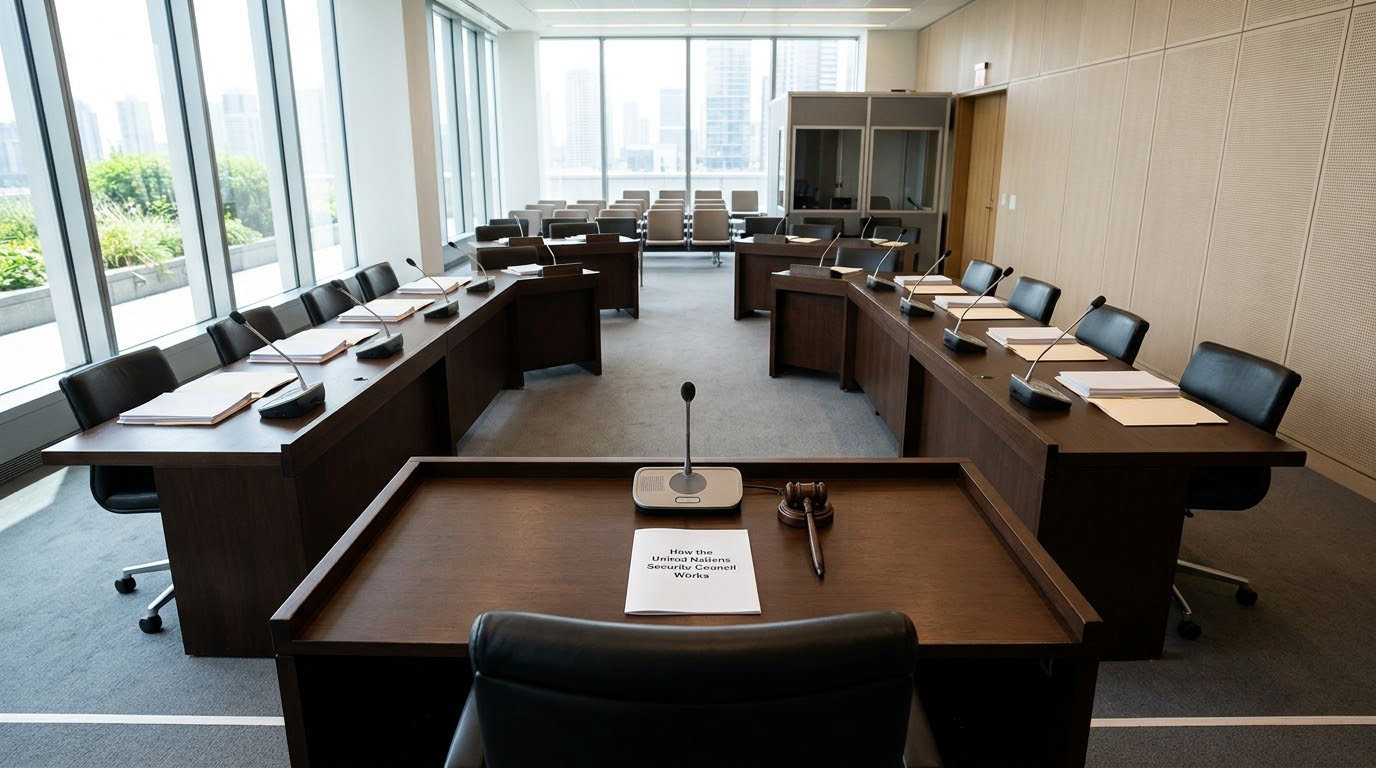
The Security Council works through a repeating cycle: a threat is raised, members gather evidence, they negotiate privately, someone drafts text, the Council votes, and then it tracks what happens next. Most of the real work happens before anyone votes, in consultations that never appear on the public record.
The Council has no fixed session schedule. It sits in the chamber at Headquarters in New York when a matter requires it, and every member keeps a permanent mission to the UN with a delegate available at any hour. A crisis can therefore reach the Council the same day it breaks.
The pipeline: how a crisis becomes a resolution
- A member state or the Secretary-General brings a complaint or a threat to the Council’s attention.
- Briefings are held, usually in private first, to establish what is actually happening on the ground.
- Members hold informal consultations to agree on what they can live with before any text exists.
- A penholder, the member leading a file, drafts a resolution and negotiates its wording line by line.
- The draft goes to a formal vote, where nine affirmative votes and concurring permanent votes are required.
- If a permanent member objects, the draft dies and the Council often issues a presidential statement instead.
- If adopted, the resolution sets out binding rules, a mandate, a deadline and a reporting requirement.
- Sanctions committees, the Secretariat and peace operations then implement it and report back to the Council.
Consultations vastly outnumber public meetings. In 2012 the Council held 160 consultations against 16 private meetings and 9 public meetings; in 2016 it held 150 consultations against 19 private and 68 public. A public meeting is often less a debate than a public confirmation of a deal already settled in a side room.
Speed is possible when the membership wants it. Resolution 1373, the framework for counter-terrorism obligations that every member now operates under, was adopted in a five-minute meeting with no debate at all.
Who Sits on the Security Council?
Fifteen countries sit on the Security Council at any one time: five permanent members and ten elected members serving two-year terms, which cannot be served consecutively by the same state.
The five permanent members, known as the P5, are China, France, Russia, the United Kingdom and the United States. They hold their seats because of a 1945 bargain struck among the wartime Allies, and France was included as a European buffer against a dominant Soviet Union or a resurgent Germany. That origin still shapes who is inside the room today.
The ten elected members are distributed by regional group rather than by population: three from Africa, two from Asia-Pacific, two from Latin America and the Caribbean, two from Western European and Other States, and one from Eastern Europe. The African Group also holds a rotating Arab seat, with the presidency rotating annually between African and Arab members.
Representation matters more than it looks. When a state sits on the Council, its own conflicts are handled by fifteen delegations instead of 193, which changes the tone of the debate entirely.
| Permanent member | Veto status | Standing since |
|---|---|---|
| China | Holds a veto; can block any substantive resolution | 1971, replacing the Republic of China (Taiwan) seat |
| France | Holds a veto | 1945 founding member |
| Russia | Holds a veto | 1945 founding member, as the Soviet Union until 1991 |
| United Kingdom | Holds a veto | 1945 founding member |
| United States | Holds a veto | 1945 founding member |
How Are the Council’s Members and Voting Rules Set?
The ten elected seats are filled by the General Assembly, which votes on each seat separately and needs a two-thirds majority of those present and voting to elect a candidate. Candidates are put forward by regional groups in advance, so the vote ratifies a regional deal more often than it settles a contest on the merits.
Regional groups also negotiate internally, and that negotiation can take months. The real bargaining over who fills the African Group’s three seats happens in Addis Ababa or between missions, long before anything reaches the General Assembly floor.
In June 2026 the General Assembly elected Austria, Portugal, Zimbabwe, Kyrgyzstan and Trinidad and Tobago to serve two-year terms beginning in 2027.
Voting rules come from Article 27 of the Charter. Each member has one vote, and decisions on procedural matters need nine affirmative votes with no veto available. Decisions on all other matters need nine affirmative votes and, critically, the concurring votes of every permanent member. The distinction between procedural and substantive is not academic: it decides whether a veto exists at all.
How Does Voting on a Security Council Resolution Work?
Nine of the fifteen members must vote in favour, and on substantive matters every permanent member must also vote in favour, not merely abstain. That is why ten or eleven votes in favour can still produce a failed resolution.
| Type of matter | Votes needed | Permanent members |
|---|---|---|
| Substantive (resolutions on conflicts, sanctions, force) | 9 affirmative | Concurring votes of all five required |
| Procedural (agenda, procedure, meeting invitations) | 9 affirmative | No veto available |
| Abstention by a permanent member | Does not block | Treated as no vote against, not a concurring vote |
| Negative vote by a permanent member | Blocks adoption | This is the formal veto |
| Negative vote by an elected member | Does not block | Only matters if the nine-vote threshold also fails |
A double-negative vote, where nine members vote in favour and the tenth elected member votes against, still passes. The permanent members’ votes carry weight precisely because the other ten can only ever supply votes, never withhold a decisive one.
Why Does the Veto Matter?
Only the P5 can veto, and only on substantive matters. One negative vote from China, France, Russia, the United Kingdom or the United States kills a resolution on the spot, and no vote count can bring it back.
Three things that look similar are not. A veto is a negative vote recorded in the minutes. An abstention is not a veto: a permanent member that abstains on a substantive resolution is treated as having not exercised its vote, so the text can still pass. A pocket veto happens before the vote, when a permanent member simply declares in private consultation that it will kill the draft, so no text is ever put to a chamber and no veto is ever recorded.
The pocket veto is the more common of the three and the reason formal veto counts understate how often the Council is blocked. A draft that dies in a consultation room leaves no official mark at all.
Veto use is heavily lopsided. As of August 2026 the United States had cast roughly 95 vetoes and Russia and its Soviet predecessor roughly 162, while France and the United Kingdom have not vetoed since 1989.
Two limits on the veto matter. It blocks a vote, never a discussion; the Council will argue about any crisis whether or not it can act. And it cannot be overridden: no General Assembly vote can overrule a veto on a substantive matter. It can, however, force the argument into public view, which is where the veto initiative comes in.
What Powers Can the Security Council Use?
The Council’s powers run from talking to fighting, and it usually climbs the ladder one rung at a time. Most files never go past the first rungs.
- Diplomacy and mediation. Sending a special envoy, offering the good offices of the Secretary-General, or pressing a ceasefire through consultations. Non-binding, but it is where most value sits.
- Presidential statements and agreed letters. A weaker form of decision adopted by consensus, used when members want to denounce something without voting on it.
- Sanctions under Article 41. Arms embargoes, asset freezes, travel bans and trade restrictions. A sanctions committee monitors compliance, and a panel of experts tracks evasion.
- Investigations and inspections. The Council can demand documents and reporting from states, and has used subsidiary bodies to examine alleged violations.
- Referrals to the International Criminal Court. It can refer a situation in a country or a named individual to the ICC, which is what happened over Darfur in 2005.
- Authorisation of force under Article 42. Authorising member states or a regional organisation to use military force, which is what unlocked operations in Iraq in 2003 and Libya in 2011.
One crisis often triggers several of these at once. Sanctions were imposed on Myanmar’s military government, referred to the ICC, and paired with a monitoring mechanism, all through separate Council decisions.
How Does the Council Respond to War and Humanitarian Crises?
When fighting breaks out, the Council’s first move is almost always to hear briefings. Briefings can be public, in private, or in an Arria-formula meeting, an informal session where a figure outside the Council, often a survivor or an expert, gives the Council what official briefings tend to leave out.
Where it goes next depends on the Charter route taken. Under Chapter VI the Council recommends measures; recommendations are not binding. Under Chapter VII it determines that a threat to the peace exists, which unlocks binding action including sanctions and authorised force. Deciding between the two is itself political, and choosing the softer route keeps the legal commitments lighter.
Humanitarian crises tend to generate a smaller set of instruments: a demand for a ceasefire or humanitarian pause, a mandate for a peacekeeping mission focused on protecting civilians, and reporting requirements attached to both.
One point is often missed. Peacekeeping troops are contributed by member states and commanded by their own governments in the field, under a Chief of Mission appointed by the Secretary-General. The Council authorises and mandates the mission; it does not command it.
How Does the United Nations Security Council Work in a Real Meeting?
A typical public session runs in a familiar order. The presidency, which rotates monthly among the fifteen members, opens the meeting and sets the agenda under Rule 19 of the Provisional Rules of Procedure. The Secretariat briefs first, then members speak, then the Council votes, often on a single draft text negotiated days earlier in consultations.
Behind the public session, the Presidency decides who speaks and for how long, which items reach the agenda, and when to hold consultations instead of a vote. The presidency is a real if modest office: agenda-setting gives any member a platform, but it cannot create a consensus that does not exist.
| Term | Meaning in practice |
|---|---|
| Penholder | The member that leads a file and drafts the main resolution, giving it negotiating leverage |
| Informal consultations | Closed-door sessions where the real bargaining happens and no text exists yet |
| Pocket veto | Blocking a draft in consultation, so no vote takes place and no veto is recorded |
| Substantive matter | Anything other than procedure; a veto is available here |
| Arria-formula meeting | Informal briefing by an outside figure, open to any Council member |
| Sanctions committee | A subsidiary body monitoring a specific sanctions regime |
| Blue helmet | A uniformed UN peacekeeper serving under a Council mandate |
After adoption, the follow-up is mechanical and easy to miss: a deadline is set, a reporting body is named, and the file returns to the Council’s agenda on a fixed date whether or not anything has improved.
What Can the Security Council Not Do?
The Council cannot legislate for the world in the way a national parliament does. A resolution binds member states, but it depends on those states and on the Council’s own members to comply, and breaching one usually carries no penalty beyond diplomacy.
It cannot command any country’s domestic policy, cannot reach a verdict on a crime, and cannot overrule a veto. It also cannot function when its permanent members disagree sharply about the dispute at hand, which is precisely when its powers would matter most.
When the Council is stuck, other organs pick up limited pieces. The General Assembly can debate any question and can force a public Council meeting within ten working days of a veto under the veto initiative adopted in 2022. The International Court of Justice settles legal disputes between states. The ICC prosecutes individuals. The Secretariat and the Department of Peace Operations run the machinery. None of them can replace the Council when it is blocked.
Why Does Security Council Decision-Making Often Stall?
Paralysis usually has one of a few causes, and they often stack. The most common is a conflict of interest: when a permanent member is a party to the dispute, it cannot accept any decision that exposes it, and it does not need the veto because the mere threat of one keeps the draft from being tabled.
Urgency works against the Council too. It has no permanent secretariat with the power to act, and it needs several weeks of consultations to build a coalition. Crises move faster than that. The Council also tends to be selective, engaging actively in some conflicts and not others for reasons that have little to do with the humanitarian scale.
Regional rivalries harden positions before sessions begin. India and Pakistan, Israel and its neighbours, and the Russia-Ukraine confrontation all reach the Council already frozen.
Enforcement is the quieter problem. Sanctions regimes depend on member states policing borders and freezing assets, and those states have their own incentives not to. Peacekeeping mandates outlast the political will behind them, which is how missions end up protecting the sides they were meant to separate.
None of this makes the Council irrelevant. It authorised operations in Liberia, Sierra Leone, Timor-Leste, Haiti and elsewhere; it built the sanctions architecture that isolated apartheid South Africa; it referred Darfur to the ICC. Where it works, nothing else in the UN system can substitute.
Frequently Asked Questions
How many votes are needed to pass a United Nations Security Council resolution?
Nine of the fifteen members must vote in favour. On procedural matters that is all that is required, and no veto is available. On substantive matters, covering conflicts, sanctions and the use of force, the nine affirmative votes must include a concurring vote from every one of the five permanent members. A permanent member that abstains does not block the text, because under Article 27 it is treated as not voting on the substantive question at all.
Can any member of the Security Council veto a decision?
Only the five permanent members can veto: China, France, Russia, the United Kingdom and the United States. A negative vote from any one of them on a substantive matter kills the resolution, and no voting arithmetic can bring it back. Elected members cannot veto. They can vote against freely, and if nine members still vote in favour the text passes. Vetoes are also unavailable on purely procedural questions such as agenda items or meeting invitations.
What is the difference between abstaining and vetoing a resolution?
A veto is a negative vote, entered into the record, which blocks adoption. An abstention is silence, and on a substantive matter it is treated as not exercising a vote at all, so the resolution can still pass with nine affirmative votes. This matters because some permanent members have built a habit of abstaining rather than vetoing, allowing texts they dislike to pass. A third mechanism, the pocket veto, blocks a draft before any vote is scheduled, so no vote and no veto ever appear in public.
Does the Security Council have its own military force?
No. The Council has no standing army, no air force and no troops it commands directly. It can establish a peacekeeping mission and set its mandate, size and rules of engagement, but the personnel are contributed by member states and stay under their own national command in the field, with the Secretary-General’s appointed Chief of Mission coordinating. Its military power comes from Chapter VII authority to authorise member states or regional organisations to use force, as it did for Iraq in 2003 and Libya in 2011.
Can the Security Council impose mandatory sanctions on a country?
Yes, once it determines under Chapter VII that a situation constitutes a threat to international peace and security. It can then require measures including arms embargoes, asset freezes, travel bans and restrictions on trade, which every member state must implement. It also establishes a sanctions committee to monitor compliance and can appoint a panel of experts to track evasion. Sanctions cannot be lifted or amended without a further Council decision, which makes them genuinely binding in a way that General Assembly recommendations are not.
Conclusion
The Security Council is a political institution with legal teeth: fifteen members, nine votes needed on substantive matters, concurring votes required from the five permanent members, and no enforcement machinery of its own beyond what member states supply.
Start with two distinctions and the rest follows. Procedural decisions need nine votes and cannot be vetoed; substantive decisions need nine votes plus the permanent members. And the Council operates more like a negotiation table than a legislature, with the decisive conversations happening before any text is ever put to a vote. Once that is clear, the veto stops looking like a mysterious blockage and starts looking like what it is: five states in 1945 deciding they needed a brake.