People mix these two up constantly, usually because television puts them in the same room. A grand jury decides whether there is probable cause to charge someone with a crime. A trial jury decides whether that person is guilty, and it must do so beyond a reasonable doubt. Below is how a grand jury differs from a trial jury on the things that actually change a case: who sits in the room, what evidence is allowed, whether anyone can watch, how the vote is counted, and what the outcome means.
This is general information about how the United States justice system works. Rules differ by state and between state and federal courts, and nothing here is legal advice for your situation.
Table of Contents
- How a Grand Jury Differs from a Trial Jury at a Glance
- What Does a Grand Jury Do?
- What Does a Trial Jury Do?
- How Are Grand Jury and Trial Jury Members Chosen?
- What Evidence Does Each Jury Hear?
- What Decision Does Each Jury Make?
- Are Grand Juries Secret and Trial Juries Public?
- Which Jury Matters More in a Criminal Case?
- Which Should You Choose?
- Frequently Asked Questions
- Why would a case go straight to the grand jury?
- Can I tell people that I am serving on a grand jury?
- Do you get paid more for grand jury duty than for trial jury duty?
- Can a judge overrule a grand jury?
- What standard of proof does each jury use?
- How hard is it to get a grand jury indictment?
How a Grand Jury Differs from a Trial Jury at a Glance
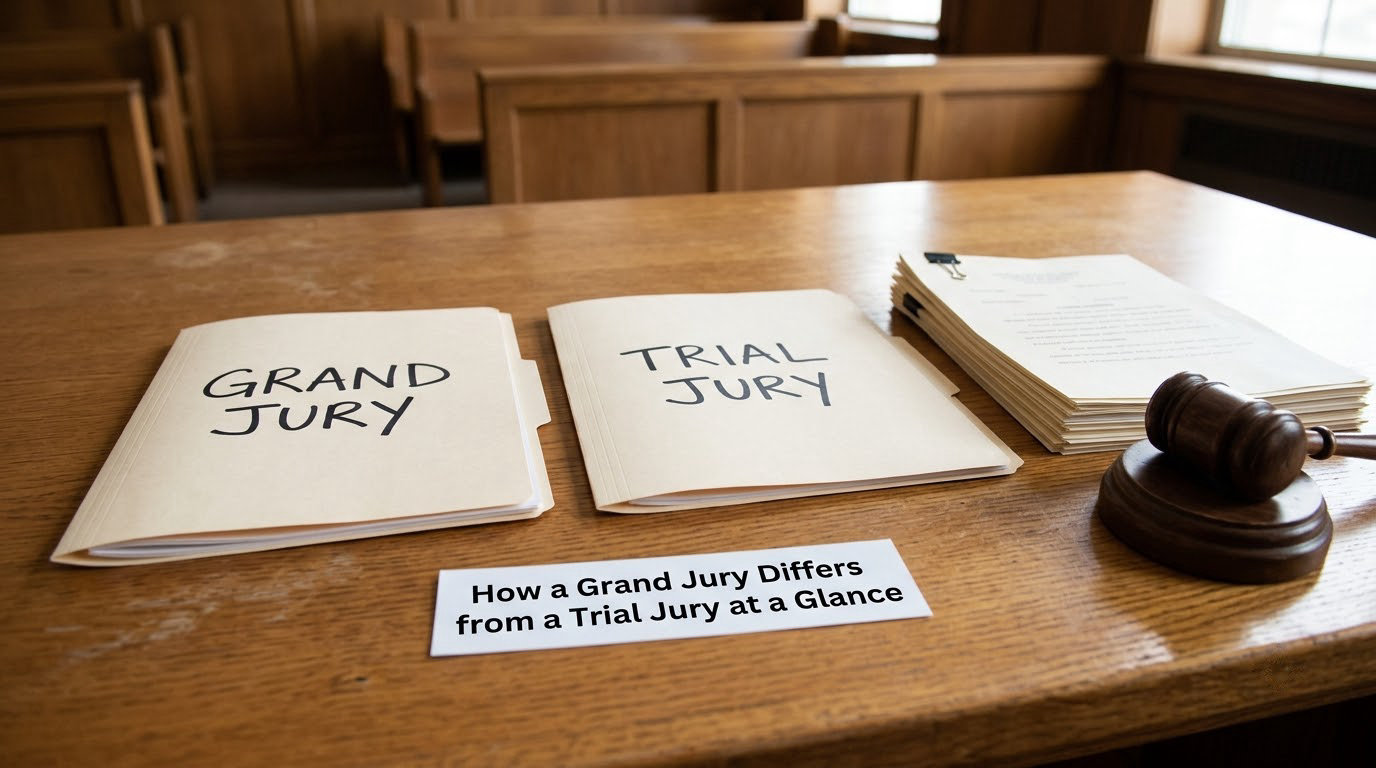
Here is the whole comparison on one page.
| Category | Grand Jury | Trial Jury |
|---|---|---|
| Purpose | Investigates and decides whether to issue an indictment | Decides whether the defendant is guilty or not guilty |
| Standard of proof | Probable cause | Beyond a reasonable doubt |
| Number of members | 16 to 23 in federal court; commonly 12 to 23 in state courts | 6 to 12, usually 12 plus alternates |
| Who is present | Jurors, foreperson, prosecutor, court staff. No defendant, no defense attorney, no judge usually | Jurors, judge, prosecutor, defense attorney, defendant, witnesses, courtroom staff |
| Evidence rules | No formal rules of evidence. Almost anything may be shown, including illegally obtained evidence | Rules of Evidence apply. Hearsay and illegally obtained evidence are often excluded |
| Public access | Secret. Transcripts sealed under Rule 6(e) | Open. Constitutional right to a public criminal trial |
| Vote needed | A majority or a superior majority, depending on state statute | Unanimous for conviction or acquittal in federal court and in most states |
| How often they meet | A few sessions a month across a term of about six to twelve months | Every court day for the length of the trial, usually one to three weeks |
| Outcome | True bill (indictment) or no bill | Guilty or not guilty verdict, then sentencing in federal court and most states |
The single most useful line to remember: the grand jury asks whether there is enough reason to charge someone. The trial jury asks whether the evidence proves it.
What Does a Grand Jury Do?
A grand jury is a body of private citizens sworn in by a court to decide whether there is probable cause to indict someone for a felony or certain other serious crimes.
A prosecutor presents the evidence, and in most states the prosecutor alone controls what the grand jury hears. Grand jurors may question witnesses directly, which is something trial jurors almost never get to do. After each witness, the jurors discuss and vote on the evidence.
Two votes matter. A majority vote produces a true bill, meaning the grand jury returns a written indictment that formally charges the person. A vote against produces a no bill, and the matter ends there. People call this outcome a no true bill.
Grand juries also do investigative work that never reaches a courtroom. They can approve search warrants, subpoena witnesses and records, and review ongoing police investigations. In a few states, in-custody deaths are referred to a grand jury because there is no other body that can investigate them.
One structural detail that surprises people: the defendant has no right to be present, and no defense attorney sits in the room. In a few states the law lets a defendant submit a written statement, but the prosecution still runs the presentation. That one-sided setup is the main reason grand jury procedure is more forgiving than trial procedure.
What Does a Trial Jury Do?
A trial jury, usually called a petit jury, hears the evidence in an open courtroom and decides whether the prosecution proved the charge beyond a reasonable doubt.
The process is much more structured. Prospective jurors fill out a questionnaire, then sit through voir dire, where the defense attorney and the judge question them directly and the defense can strike jurors. Once the panel is seated, the prosecutor presents its case, the defense responds, and the jury deliberates privately.
Conviction requires unanimity in federal court under Rule 29 of the Federal Rules of Criminal Procedure, and most states require it too, including for acquittal. If the jurors cannot agree, the result is a hung jury, which produces a mistrial and lets the prosecutor retry the case or drop it. Jurors who split often report that one holdout is the whole story.
Trial juries also handle civil cases. In a civil trial there is no guilt, only liability, and in many states the jury decides damages as well. That is a separate job from the criminal guilt question and it is worth keeping distinct when people say a jury decided a case.
In federal court and most states, sentencing happens after the verdict, usually by the judge. Some states still let the jury fix the sentence, a practice called a jury-fixed sentence.
How Are Grand Jury and Trial Jury Members Chosen?
Both panels are drawn from the same local source lists, so a person who receives one summons could well receive the other one a year later.
Selection typically starts with voter registration rolls, driver license and ID records, and sometimes tax or welfare lists. Courts screen out anyone with a felony conviction, though the rules on which convictions disqualify vary. The court then sends questionnaires, pulls names into the jury pool, and randomly assigns people to panels.
A federal grand jury has 16 to 23 members and up to a handful of alternates, and 18 U.S.C. 1861 governs the term and exemptions. State grand juries commonly run 12 to 23. A trial jury usually seats 12 with two alternates, though some states seat fewer. Jurors pick a foreperson, who is a working juror rather than a supervisor, and that person is the only one who formally reports the jury’s action to the judge.
Grand jurors are not challenged by anyone. The defense has no attorney in the room to object to the panel, and prosecutors rarely seek to remove individual grand jurors. Trial jurors are the opposite: defense lawyers routinely use peremptory challenges to remove jurors without giving a reason, and for-cause challenges to remove anyone who cannot be fair.
On practical workload, grand jury service sounds long but is often light. Jurors report having a handful of scheduled days spread across a long term, while a petit assignment is often a single day or a compact three-to-five-day trial. Grand jurors are occasionally moved onto petit panels when the court needs them, and one commonly reported surprise is how much lighter the caseload feels than the word grand implies.
What Evidence Does Each Jury Hear?
Grand juries operate without formal rules of evidence. There is no motion to suppress in front of them and no judge ruling on what is admissible.
The practical effect is large. Hearsay, opinion, documents without authentication and illegally obtained evidence can all be presented to a grand jury. Defense attorneys have long argued this makes an indictment easy to obtain, and the argument has never been fully settled. Federal prosecutors are bound by a Department of Justice policy requiring disclosure of evidence favoring the defense, and courts in several jurisdictions treat that as an enforceable duty, but it is a policy and a line of case law rather than a single national statute.
A trial jury hears a small fraction of that material. Motions in limine and motions to suppress are argued before the judge, who applies the Rules of Evidence. Hearsay is generally excluded unless an exception applies, and evidence obtained in violation of the Fourth or Fifth Amendment is often suppressed entirely.
Grand jurors can also hear witnesses the defense never sees. Some jurisdictions let a witness submit a written statement or appear by recorded video, which is a routine procedure in grand jury practice and a striking difference from a courtroom where a witness is examined live in front of twelve people.
What both bodies share is this: they decide based only on what is presented to them, and in neither room can a juror conduct their own investigation.
What Decision Does Each Jury Make?
The grand jury returns an indictment or nothing at all. The trial jury returns a verdict of guilty or not guilty.
The proof standards sit far apart. Probable cause is a low bar: enough information to support a reasonable belief that someone committed an offense. A prosecutor may rely on an eyewitness account, a confession, physical evidence or an informant’s statement without any of it being tested in court. Beyond a reasonable doubt, by contrast, asks the jury to be convinced that every element of the charge has been proven, and that the only remaining doubt is one a careful person might still have.
Voting thresholds reflect those different jobs. An indictment typically needs a majority of the grand jury or a superior majority set by statute, something like 16 of 19 or 18 of 23. A conviction needs unanimity.
What an indictment does and does not mean is worth stating plainly. An indictment is a charging document. It says a prosecutor convinced enough grand jurors that charges were warranted. It is not a finding that the defendant did anything, and people are routinely indicted and later acquitted, dismissed, or never tried. Being indicted is serious, because a public criminal case now exists and the defendant’s life changes in practical ways. It is not a conviction.
Two things about the grand jury’s decision surprise people. A prosecutor is not bound by a no bill; the same evidence can be presented again to a second grand jury or to a court. And a judge cannot reverse a grand jury simply for reaching the wrong conclusion, though a defective indictment can be quashed and some states let a judge examine the integrity of the process itself.
Are Grand Juries Secret and Trial Juries Public?
Grand jury proceedings are secret by design, and federal law is explicit about it. Rule 6(e) of the Federal Rules of Criminal Procedure seals the record, and 18 U.S.C. 1866 requires grand jurors to keep matters secret. No cameras, no observers, no public gallery.
The reasoning is that a secret process lets witnesses be protected, lets the prosecutor test a case before committing to it publicly, and keeps a grand jury from appearing to be a second trial. The cost is that a person can be indicted in a proceeding the public never sees.
That secrecy is not absolute. Grand jury records are routinely unsealed by judges, sometimes years later. In Louisville, records from grand juries related to the killing of Breonna Taylor were unsealed by a federal judge in 2020, and the released transcripts let the public read prosecutor statements that had not been available while the case was pending. Federal law also recognizes exceptions for disclosure to law enforcement, and courts have ruled on when personal information can be shared.
Trial juries get the opposite treatment. The Sixth Amendment guarantees a public criminal trial, the courtroom doors stay open, and cameras are often allowed, which is why trials generate live broadcasts and grand jury rooms never do.
Jurors themselves are bound differently. Grand jurors sign confidentiality obligations and can face serious consequences for disclosing what happened, and the practical effect is that many cannot tell their family that they served, let alone what they heard. Trial jurors are generally released from the courtroom once deliberation ends, though they can be instructed to keep deliberations private forever.
Which Jury Matters More in a Criminal Case?
Neither wins. They answer different questions at different stages, and a case usually involves both.
The sequence runs like this: an investigation, then grand jury service if charges need approval, then an indictment, then arraignment where the defendant hears the charges and enters a plea, then discovery where the defense requests evidence, then trial, then verdict, then sentencing. For a serious federal white-collar case, this process can run for years. For a simple misdemeanor, it can be over in a matter of weeks.
Some cases never see a grand jury at all. Misdemeanors are usually charged by a written complaint or an information rather than by indictment. A prosecutor can present evidence directly to a court clerk instead of a grand jury, and a defendant can waive indictment. A handful of states use a preliminary hearing before a judge in place of a grand jury, and many states use both, sometimes to let a defense lawyer question witnesses before the decision is made.
What a no bill means depends on the reason. It can end the case outright, or the prosecutor can bring the same charge again, or simply let the statute of limitations run out.
If you received a grand jury summons, the practical steps are short. Read the summons for the court and the term dates, request a postponement for a real hardship rather than a conflict, and ask the jury office whether service is mandatory in your jurisdiction, since it is in many federal districts. Do not research the matter you are summoned about, and do not discuss it. Anyone with a specific concern should talk to a lawyer rather than rely on general information.
Which Should You Choose?
Choose the grand jury process when the real question is whether charges should be filed at all. That is the situation in the early stages of a serious case, in a review of an officer-involved shooting, or when someone has heard a case may go before a grand jury and wants to understand what happens next.
Choose the trial jury when the question is whether a person is guilty. That is where the defense puts its evidence, where the Rules of Evidence apply and where a verdict carries legal consequences.
For prospective jurors, choose neither in the sense of choosing a role. Grand jury service is longer but lighter and confidential. Petit jury service is shorter, public and far more demanding per day.
For anyone charged with a felony, the practical answer is that both bodies matter enormously, and the grand jury comes first. Understanding the sequence is often the first step in knowing when a lawyer becomes necessary.
One note on pay. Federal grand jurors and petit jurors are paid the same daily rate set by the court, and states vary widely, so a grand juror with a long term is not necessarily paid more per day than a juror serving one week.
General information only. Court procedures, jury sizes and vote thresholds vary by state and between state and federal courts, and this is not legal advice.
Frequently Asked Questions
Why would a case go straight to the grand jury?
A case goes to a grand jury when a prosecutor needs a court-issued indictment to begin a serious felony prosecution, or when an investigation needs a body to approve warrants, subpoenas or testimony under seal. Federal law generally requires an indictment for felonies, and many states require one for the most serious crimes. A case may also be referred to a grand jury to investigate a death in custody or an unusual set of facts.
Can I tell people that I am serving on a grand jury?
Usually not in any detail. Grand jurors are sworn to secrecy under Rule 6(e) of the Federal Rules of Criminal Procedure and 18 U.S.C. 1866, and disclosing what happened inside the room can carry legal consequences. In practice many grand jurors cannot even tell family members that they were selected. If you need to disclose service for scheduling or an employer, ask the court clerk what you are permitted to say.
Do you get paid more for grand jury duty than for trial jury duty?
In federal court, no. Grand jurors and petit jurors receive the same daily rate set by the court, though the total differs because grand jury service is spread across more weeks. State courts set their own amounts and they vary widely by state, and some jurisdictions pay nothing beyond a small daily stipend. Your summons or the court clerk can tell you the exact rate where you were summoned.
Can a judge overrule a grand jury?
A judge cannot reverse a grand jury simply for reaching the wrong conclusion, because the grand jury is the body charged with deciding probable cause. A judge can quash an indictment that is legally defective, and a few states let a judge examine the integrity of the process itself for reasons such as misconduct or improper conduct. A prosecutor is also not required to accept a no bill and may present the same evidence again.
What standard of proof does each jury use?
A grand jury decides whether there is probable cause, a low standard meaning enough credible information to support a reasonable belief that a crime was committed. A trial jury must be convinced beyond a reasonable doubt, which is the highest standard any legal system uses and which requires that every element of the charge be proven. Probable cause is why an indictment happens quickly and why an indictment is not evidence of guilt.
How hard is it to get a grand jury indictment?
It is easier than most people expect. Grand juries apply no formal rules of evidence, hear only what the prosecutor presents, and usually vote by majority rather than unanimity, and there is no defense attorney in the room to object. Indictments are regularly returned in cases that later end in dismissal or acquittal. That gap between charging and conviction is the reason the standard at the second stage is so much higher.
Start with the two standards, because every other difference follows from them. The grand jury decides whether charges should be filed, in secret, on a low standard of proof, and its only output is an indictment. The trial jury decides guilt in public, under formal evidence rules, and its output is a verdict. Anyone with a live case should talk to a lawyer, since which stage a case sits at changes what is worth doing next.