To check for a boil water advisory, go straight to the official site of the water utility or city that serves your address, look for its alerts or service interruption page, and search your full street address on the affected-area map. Then confirm whether the notice says in effect or lifted before you drink anything from the tap. The whole check takes about two minutes, and no federal agency runs it for you.
That last point trips people up. There is no national boil advisory website, and there never will be. Advisories are issued locally, by your water utility, water district or municipal water department, and confirmed by your state health department or state environmental agency. Last reviewed October 2026, using guidance from the CDC and the EPA.
If a notice is active where you live, you bring tap water to a full rolling boil for one minute before drinking it, cooking with it or brushing your teeth. Bottled water works too. Three minutes is the rule above 6,500 feet. Your local notice always wins over anything written here.
Table of Contents
- What You Need
- Step-by-Step: How to Check for a Boil Water Advisory
- 1. Check Your Local Water Utility Website
- 2. Search Your Full Address or Service Area
- 3. Verify the Notice and Its Effective Area
- 4. Follow the Notice’s Water-Safety Instructions
- 5. Protect Taps, Ice, Food, and Drinking Water
- 6. Confirm When the Advisory Has Been Lifted
- Common Mistakes
- Frequently Asked Questions
- How long should you boil water during a boil water advisory?
- Does boiling water remove chemicals or bacteria?
- Can I use bottled water or a home filter during a boil water advisory?
- What should parents do for babies and formula during a boil water advisory?
- How do I find out whether the advisory applies to my neighborhood?
- When is a boil water advisory considered lifted?
- Conclusion
What You Need
Four things. Grab them first and the rest of the process is quick.
- A phone or computer with internet access. A utility’s live advisory page is the authoritative source. A printed notice from two weeks ago is not.
- Your full service address. Street number, street name and city. Advisories are drawn around water main breaks, so they usually follow a few blocks or one pressure zone, not a whole city.
- The name of your water provider. It is printed on your water bill, and most often it ends in “Water Authority,” “Water District,” “Water Department” or “Utilities.” Small towns often buy water from a nearby system, so the bill matters more than the town name.
- A backup source of safe water. Bottled water, jugged water or a supply you can boil. People rarely think about this until the notice is already on the news.
If you live at a second home, in an RV, or on a private well, hold that thought. Those cases are handled differently, and the note at the end of Step 2 covers all three.
Step-by-Step: How to Check for a Boil Water Advisory
1. Check Your Local Water Utility Website
Search for the name of your water provider plus “water quality alert” or “boil water advisory.” The result you want sits on a government or utility domain: something ending in .gov, .us, or the provider’s own site.
Skip sponsored results. A filter company or a plumber ranking above your actual utility is not a coincidence, and their page will be written to sell you something.
On the utility’s site, look for a link labeled Alerts, Water Quality, Service Interruptions, Boil Water Notice or News. This is the single page worth bookmarking, because it is where lifted notices get posted too. You confirm it worked when you find a page with a timestamp on it.
No luck? If your search only turns up a retailer selling bottled water, your provider’s name is probably wrong or slightly different from what you’d guess. Use the name on your bill.
2. Search Your Full Address or Service Area
Many utility sites have an address lookup or an interactive map of pressure zones and current advisories. Type in your complete service address. A true address lookup is more reliable than a city name search, because two neighborhoods in the same city can sit in different zones.
Some utilities give a zone number rather than an address. If your bill lists a service or account number for water, put that in first. It maps you to the exact pressure zone the notice will describe.
What a good result looks like: either a clear statement that no advisory is active for your address, or a notice with your area inside the affected boundary. What confuses people is seeing a shaded advisory zone on the map that does not include their block, then assuming no notice exists at all. If the map shows advisories nearby but nothing for you, your area is covered, and the map is your confirmation.
Worth knowing before you go further: advisories apply to public water systems only. If you are on a private well, an advisory from your city’s utility has nothing to do with your supply. If you are traveling or checking on a rental or second home, use the utility that serves that property, not your usual one.
3. Verify the Notice and Its Effective Area
Notices come in a few flavors, and mixing them up causes most of the confusion.
| Notice type | What it means | What you do |
|---|---|---|
| Preliminary or precautionary | A problem occurred, but no contamination has been confirmed yet | Boil or use bottled water until the notice changes |
| Required boil water advisory | Contamination risk is confirmed or highly likely | Boil one minute at a rolling boil, or use bottled water |
| Do not drink or do not use | Boiling will not make the water safe, so boiling is not the remedy | Use bottled water for drinking, cooking and ice until further notice |
| Advisory lifted or all clear | Samples came back clean and the state agency approved the return | Flush the system, discard old ice, resume normal use |
Now match four details against your own situation: the affected boundary on the map, the reason it was issued, the date and time it started, and any stated end time. Ignore the stated end time for planning purposes, because it is an estimate, not a deadline.
Common reasons include a water main break, a loss of water pressure that let contaminants in, flooding, a treatment plant problem, a power outage affecting treatment, or planned maintenance. The reason tells you how cautious to be, but it does not change the instruction. Follow the instruction your notice gives.
To confirm you read it right, say it back in one sentence: this notice covers my address, it started at this time, and I must boil for one minute or use bottled water until an all-clear is posted. If that sentence is hard to write, you have the wrong notice.
4. Follow the Notice’s Water-Safety Instructions
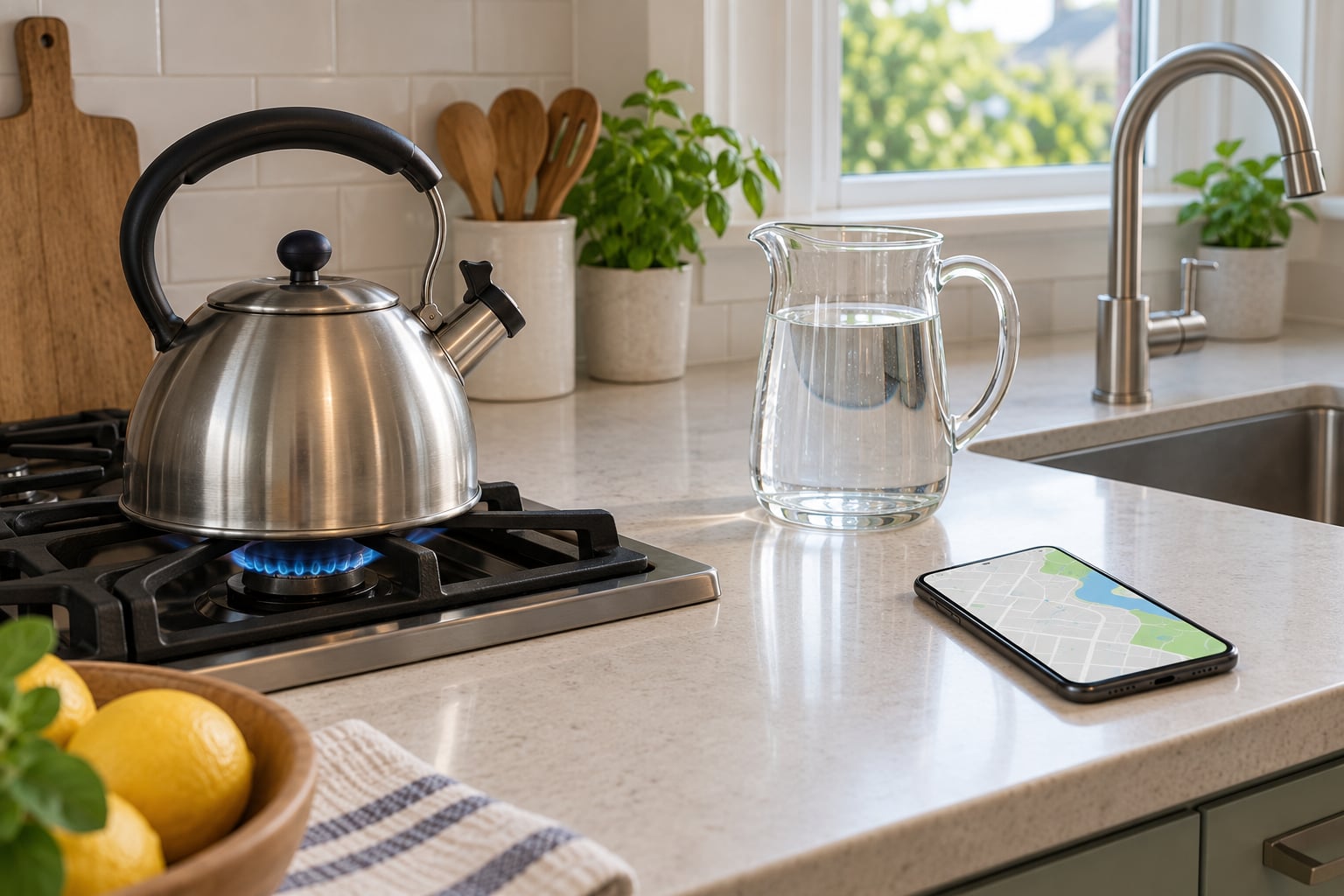
Boil water until it reaches a full rolling boil, meaning big bubbles breaking the surface continuously, and keep it there for one minute. Start the clock when the rolling boil begins, not when you turn the burner on.
At elevations above 6,500 feet, boil for three minutes instead, because water boils cooler at altitude and needs longer to reach the same temperature. If you lose track of time, boiling two minutes is safer than boiling one minute at a high-elevation home.
Let the water cool naturally, then store it in a clean, covered container. Boiled water keeps for a few days in a sealed container, which is why most people boil a kettle’s worth and refrigerate it rather than boiling a glass each time.
Bottled water is the standard substitute, and it is the better choice for infants, pregnant people, older adults and anyone with a weakened immune system. A home filter is trickier. Boiling kills germs, so a filter that is only rated for taste and chlorine does not make contaminated water safe, and most household filters are not certified for bacterial removal. Use a filter only if your local notice says you can. That instruction controls.
Boiling is a temporary measure, not a substitute for fixing whatever caused the advisory. Tasting the water tells you nothing useful. Water carrying dangerous bacteria can look, smell and taste completely normal.
5. Protect Taps, Ice, Food, and Drinking Water
Once a notice is active, the work is mostly in the kitchen. Households get into trouble with ice, formula and dental hygiene, because those are easy to forget.
- Drinking and cooking. Boiled or bottled water only, until the lift.
- Ice. Discard everything in the freezer and the automatic ice maker that was made during the advisory. Do not eat ice from a restaurant or a gas station fountain.
- Brushing teeth. Use boiled or bottled water, or a glass of boiled water you keep aside for the routine.
- Washing produce. No tap water on raw fruits and vegetables. Use bottled water, then refrigerate produce that does not need cooking before eating.
- Infant formula. Use safe water for all preparation, following the CDC’s guidance to use ready-to-feed formula when boiled water is hard to come by.
- Handwashing. Wash with soap and safe water if you can. If you are stuck on tap water, use an alcohol-based sanitizer afterward and keep it away from small children.
- Pets. Give them bottled or boiled and cooled water for bowls and drinking.
Adults can generally shower, because advisories target ingestion rather than skin contact. The exceptions matter more: sponge-bath infants and young children instead of running a bath or shower, and take extra care if anyone in the household has a compromised immune system.
Laundry, washing dishes and cleaning are fine. Run the dishwasher on its sanitizing or high-heat cycle, not the normal or eco cycle, which may not get hot enough.
Flush your household taps only if the notice tells you to. Running taps for several minutes during an active advisory wastes water and can pull more contaminated water into the house.
If your job involves food service, childcare or health care, the rules are stricter than for a household. The state health department and your licensing body will expect you to notify them and follow written procedures, not improvise.
6. Confirm When the Advisory Has Been Lifted
Residents get more upset about the ending than the beginning. An estimated end time passes, the pressure comes back, and people assume it is over. It usually is not.
Lifting a notice takes two rounds of clean samples. The utility tests the water for bacteria indicators such as total coliform and E. coli, and for residual chlorine, twice in separate rounds. Only after both rounds come back clean does the state health department or environmental agency authorize the lift. That testing routinely takes a day or more after pressure is restored, so there is a real gap where water is back and the notice is still up. That gap is normal.
Keep checking the same official channel until you see an explicit cancellation, all-clear or lifted notice with a date on it. Do not treat a neighbor’s social post as the ending, even though it is often the fastest confirmation you will see. Treat it as a prompt to go verify.
A page that looks stale can cut either way: sometimes the notice is still active and nobody updated the page, sometimes it was lifted hours ago and the posting lagged. When you cannot tell, call the utility’s 24-hour emergency line and ask directly whether the advisory is still in effect for your address. That call is the tiebreaker.
Once it is lifted, run cold taps for about five minutes to flush the lines, flush the refrigerator and dispenser lines, discard any ice made during the advisory, and flush or replace your filter cartridges if the notice or your utility says to.
If you drank the water while the advisory was active, most people’s exposure is a one-time small amount, and the risk is low. Symptoms of a waterborne illness typically show up within a day or two as diarrhea, vomiting, nausea or stomach cramps. Drink safe water, rest, and contact a doctor or urgent care if you cannot keep fluids down, if symptoms are severe, or if you care for an infant, an older adult or someone immunocompromised.
Common Mistakes
Believing a social media repost instead of checking the source. Facebook posts get shared and reshared long after an area is back to normal, and they frequently name the wrong street or a neighboring town. Use them as a prompt, not a conclusion. The official page beats a screenshot every time.
Boiling water that already touched a sink or a pot. If the container was rinsed in a sink under a running tap, or the pot was washed with unboiled tap water, you have recontaminated it. Rinse with bottled or already-boiled water, or use a clean pot you boiled water in from the start.
Treating a household filter as a permanent fix. Standard carbon and taste filters do nothing against bacteria, and some can let them through while removing the chlorine smell that would otherwise warn you. Boil or buy bottled water until the notice is lifted.
Forgetting the ice, the water heater and the formula. Ice is the most common accident because it was made days ago. Treat any ice made during the advisory as unsafe, including cubes from a cooler.
Assuming the next neighborhood is fine. Advisory boundaries follow pressure zones and main breaks, not intuition. Two blocks can differ. If you are checking an address other than your own, ask the provider that serves that property.
Waiting for an alert that never came. The most common complaint in local resident forums is a street where one household got a text and the neighbor found out from a neighbor. Sign up for the utility’s SMS and email alerts while nothing is wrong, so the next notice reaches you automatically. It takes two minutes and it is the single most useful thing on this page.
Taking the estimated end time as the all-clear. Water pressure returning is not the same as the notice being lifted. Wait for the written cancellation.
A few habits from the CDC and local health departments help in the moment. Boil, do not simmer, because a simmer is not hot enough to kill germs. Let water cool in a covered container rather than adding cold water to hot. Keep safe water available for anyone in the house who cannot boil for themselves, and check on elderly neighbors, who are the group most likely to be missed by every notification channel.
Frequently Asked Questions
How long should you boil water during a boil water advisory?
Bring tap water to a full rolling boil and keep it boiling for one minute, starting your timer when the bubbles break the surface continuously. At elevations above 6,500 feet, boil for three minutes instead. If you lose track of the time, two minutes at sea level is safer than one. Let the water cool naturally in a clean covered container rather than mixing it with cold water.
Does boiling water remove chemicals or bacteria?
Boiling reliably kills bacteria, viruses and parasites, which is what a boil water advisory is designed to address. It does not remove chemicals, heavy metals, fuel or many industrial contaminants, and it can concentrate them as water evaporates. That is why a do not drink notice is different: boiling cannot fix it, so you must use bottled water instead. Follow whatever category your local notice falls into.
Can I use bottled water or a home filter during a boil water advisory?
Bottled water is the accepted substitute whenever boiling is impractical, and it is the safer pick for babies, pregnant people, older adults and anyone immunocompromised. A home filter only counts if the local notice says so. Standard carbon and taste filters are not certified for bacterial removal, so they do not make advisory water safe. Boiling is meant to be temporary, not a replacement for repairing the system.
What should parents do for babies and formula during a boil water advisory?
Prepare all infant formula with boiled and cooled water or bottled water, including the water used to rinse bottles. Ready-to-feed formula avoids the preparation problem entirely when safe water is hard to find. Give babies sponge baths instead of running water. Caregivers who wash their hands with tap water should follow with alcohol-based sanitizer, kept well away from small children.
How do I find out whether the advisory applies to my neighborhood?
Identify the utility serving your exact address, open its alerts page, and enter your full street address or service zone into its advisory lookup or map. Compare the shaded boundary against your location, then check the notice for its start time and whether it says in effect or lifted. A zone number printed on your water bill often maps more precisely than a city name, and advisories follow pressure zones rather than city limits.
When is a boil water advisory considered lifted?
Only when the state health department or environmental agency approves it, after two separate rounds of clean samples from the utility, testing for bacteria indicators like total coliform and E. coli and for residual chlorine. Water pressure returning does not mean the advisory is over. Look for an explicit lifted or all-clear notice with a date on the utility’s page, and when the page is ambiguous, call the utility’s 24-hour line.
Conclusion
Open the official website of the water utility or city that serves your address, search your full street address on its alerts page or advisory map, and read whether the notice is currently in effect or has been lifted. If it is active, boil tap water for one minute at a full rolling boil, three minutes above 6,500 feet, or use bottled water until the written all-clear appears.
Before you need it, sign up for that utility’s SMS and email alerts. That is the fix for the complaint we hear most often from residents, and it takes two minutes while everything is fine.
This page gives general guidance based on CDC and EPA recommendations. Your local utility’s instructions always take priority over anything here.