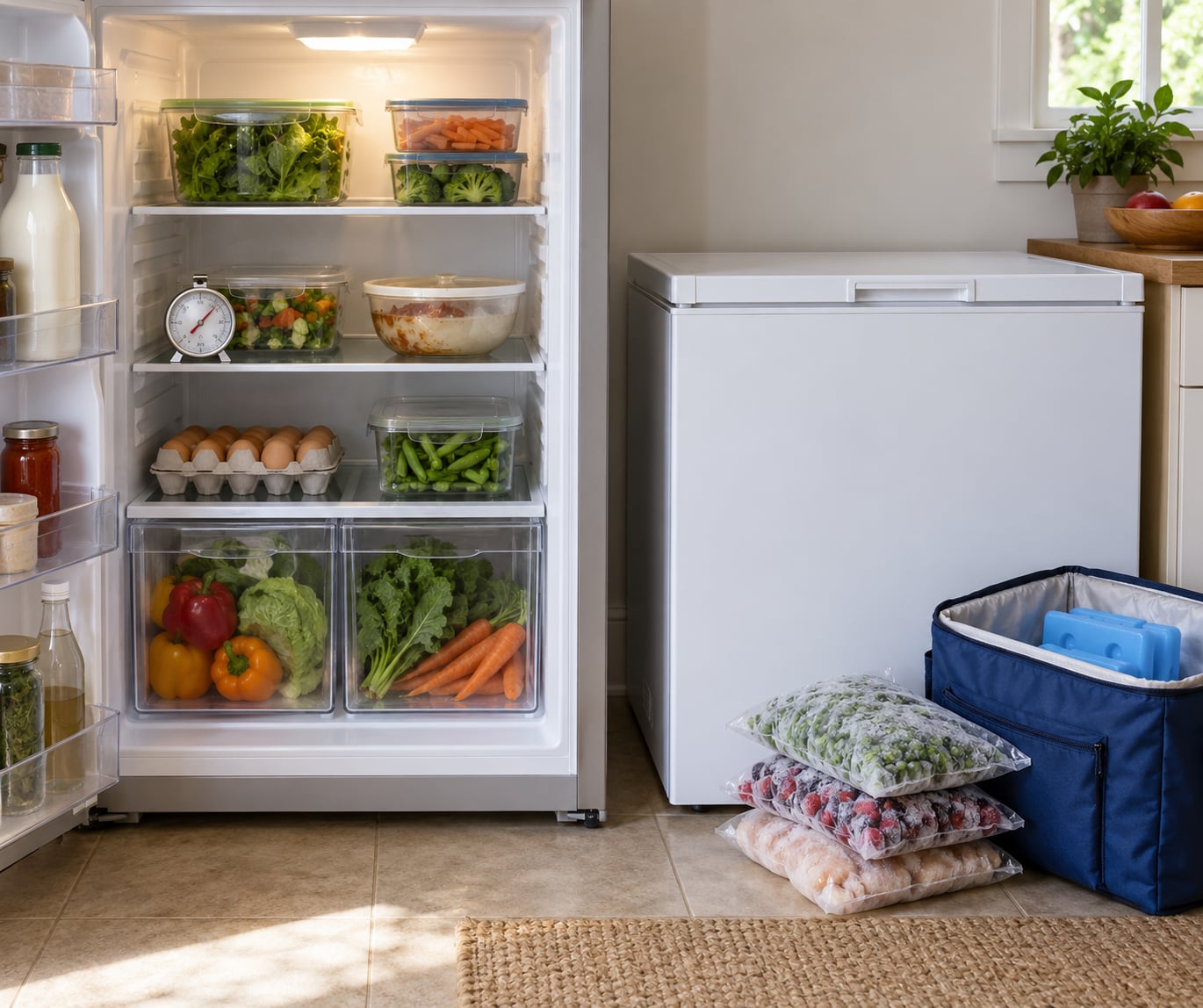
What food is safe to eat after a power outage comes down to time and temperature. An unopened refrigerator keeps food cold for roughly four hours, and a full freezer holds safe temperatures for about 48 hours. Perishable food that sat above 40°F (4°C) for more than four of those hours gets tossed, no matter how it looks or smells.
I have gone through this with my own fridge more than once, and the mistake is almost always the same: people wait for a sign of spoilage before they decide. Bacteria do not announce themselves, and a clean-looking container of chicken can carry enough organisms to put someone in the hospital.
Here is the order of operations, based on USDA and FoodSafety.gov guidance, for deciding what food is safe to eat after a power outage in your home.
Table of Contents
- What You Need
- Step-by-Step
- 1. Confirm How Long the Power Was Out
- 2. Keep the Refrigerator Closed and Measure Its Temperature
- 3. Decide Which Refrigerated Foods to Keep
- 4. Assess Frozen Food After the Outage
- 5. Check the Food, Smell and Appearance
- Common Mistakes
- Frequently Asked Questions
- How long is food good in the fridge without power?
- Can I refreeze food that thawed during a power outage?
- How do I check my refrigerator temperature without a thermometer?
- What should I do with cooked food and reheated meals?
- Do canned and shelf-stable foods go bad in a power outage?
- Conclusion
What You Need
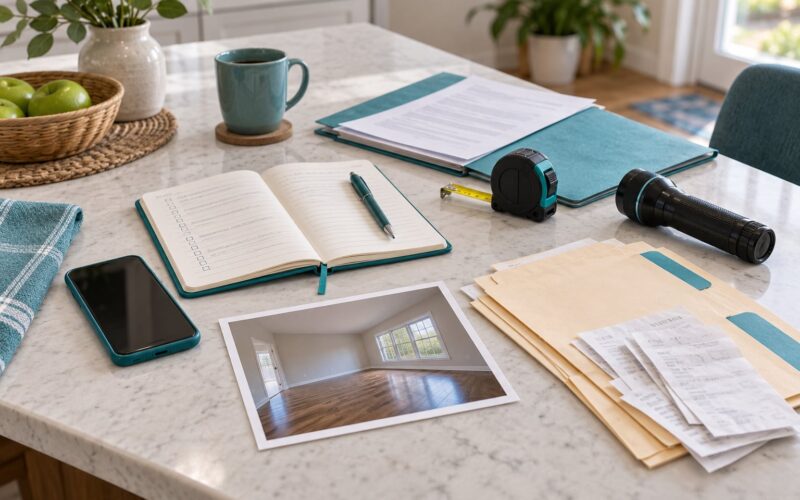
You need very little to do this properly, but you need it before the power comes back on, because once the compressor restarts you lose your chance to make an informed call.
- An appliance thermometer for the refrigerator, ideally one that records the high and low readings over time so you can see what happened overnight.
- A food thermometer for checking internal temperatures, not just surface readings.
- Bottled drinking water, kept outside the fridge, in case the tap water is affected by flooding or a boil-water advisory.
- Ice, frozen gel packs, or frozen water bottles to keep a cooler at 40°F or below.
- An insulated cooler with enough capacity for the perishables you intend to rescue.
- A notebook or phone to record when the power went out, when it came back, and any temperature readings you take.
Group your frozen items together and put them in the coldest part of the freezer, the back. Freezing water bottles ahead of time gives you a block of ice that lasts far longer than loose cubes.
Step-by-Step
1. Confirm How Long the Power Was Out
Start with the elapsed time, because every other decision depends on it. A full, closed refrigerator generally holds 40°F or below for about four hours. A half-full one loses its cold faster, since there is less thermal mass holding the temperature steady.
If you were not at home, the utility or your landlord can tell you when service started and was restored. Assume the worst case if nobody can confirm it.
Note that a cold garage or a cold day outside does not substitute for a working fridge. This comes up repeatedly on food-safety forums, and FoodSafety.gov treats the appliance reading, not the weather, as the deciding factor.
2. Keep the Refrigerator Closed and Measure Its Temperature
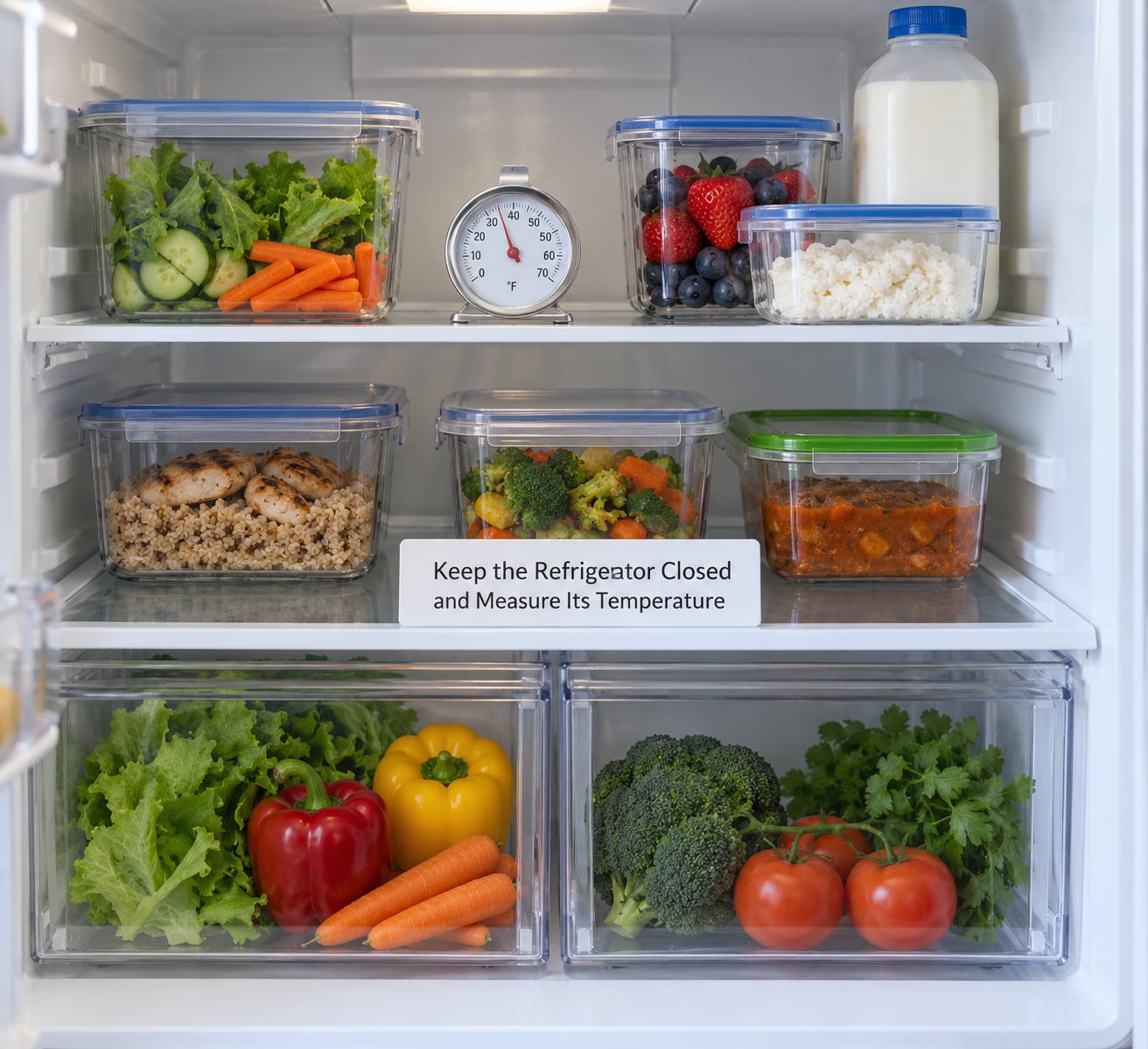
Resist the urge to open the door and look. Every opening lets cold air escape and warm air in, and a fully opened door can drop the internal temperature noticeably in a short window. If the outage is ongoing, group the items you plan to eat first and move them to the cooler with ice before opening anything else.
Read the thermometer from the middle of the refrigerator rather than the door shelf, which is the warmest spot. A reading at or below 40°F means perishable food is safe. Above 40°F, you start counting hours.
3. Decide Which Refrigerated Foods to Keep
If the refrigerator stayed at or below 40°F the whole time, keep the perishable food and move on. If it went above 40°F for more than four hours, discard it.
Meat, poultry, seafood, cooked food, cut produce and leftovers are the perishable group. Discard any of them that lost its temperature for longer than four hours.
Eggs in the shell are perishable. Discard them when the temperature history is uncertain, since a raw egg is a raw egg no matter how clean the carton looks.
Milk, cream, yogurt, soft cheeses such as brie or cottage cheese, and opened sour cream and cream cheese are the quickest things to turn. Discard them after more than four hours above 40°F.
Hard cheeses, butter and margarine hold up longer because they are less moist. Discard them if they smell off or show mold, and keep them only when the temperature history is clean.
Condiments such as ketchup, mustard and mayonnaise lose quality after warming, and mayonnaise-based items can spoil. A sealed commercial jar is lower risk than a home-made one, but a condiment that changed color, separated oddly or smells sour goes in the bin.
Whole produce such as apples, oranges and potatoes is fine. Trim leafy greens, herbs and anything cut or peeled, since damaged tissue molds and dries out faster.
Whatever you keep from a cooler, cook it to the USDA safe minimum internal temperature before serving. Poultry reaches 165°F (74°C), ground meat 160°F (71°C), and whole cuts of meat and fish reach 145°F (63°C). Cooked food that reheats above 165°F is considered safe to eat.
4. Assess Frozen Food After the Outage
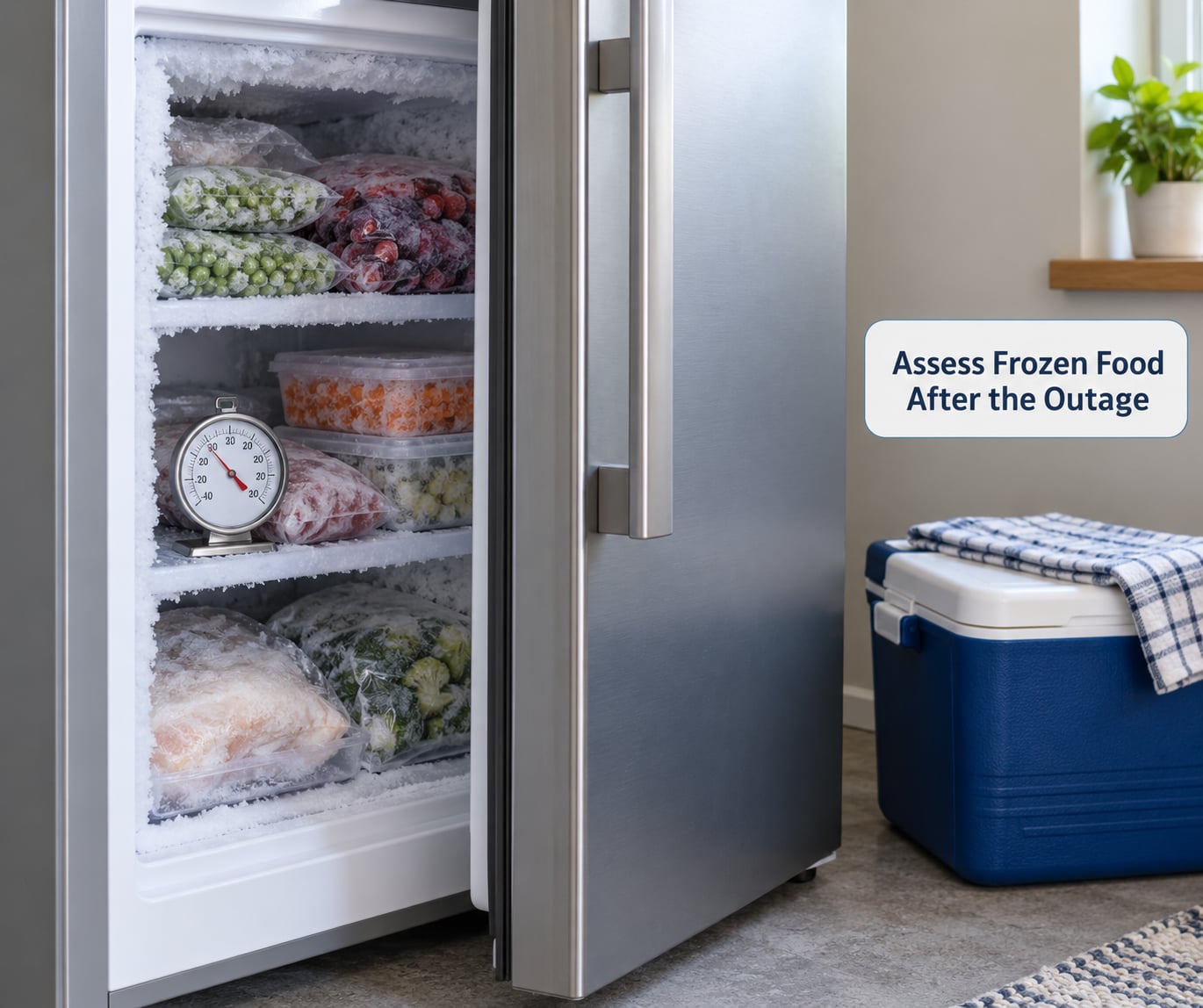
Frozen food stays safe if it is still frozen, still contains ice crystals, or has stayed at 40°F or below. A closed full freezer holds safe temperatures for about 48 hours, and a half-full freezer for about 24 hours.
You can refreeze food that thawed and still holds ice crystals or is at or below 40°F, though quality suffers. Food that thawed and stayed above 40°F for more than two hours has to go.
Refrigerated meat, poultry, fish and eggs with an uncertain temperature history are the ones to discard, refreezing does not undo the time spent warm.
If you have no thermometer, open the freezer once, look for ice crystals, and close it. That single check tells you far more than waiting.
5. Check the Food, Smell and Appearance
Smell, taste and appearance cannot prove that food is safe. Salmonella, Campylobacter and Staphylococcus aureus toxins can all be present in food that tastes, smells and looks perfectly normal, and some toxins survive reheating.
Discard moldy, slimy, discolored or leaking food as a matter of course. Trim at least an inch around mold on firm cheese and hard produce, and throw out soft, moist items with any mold at all, the hyphae run deeper than you can see.
The rule to hold onto: clean-looking food is not evidence of safe food. If the temperature exposure was confirmed unsafe, discard it regardless of how the food presents.
Common Mistakes
Judging safety by smell. Odor is a late signal, not a safety test, and some dangerous organisms and toxins produce no odor at all. Use a thermometer, then use the four-hour rule.
Opening the refrigerator to check. Every open cycle works against you, especially during a long outage. Open once, sort everything, and move the food you will not eat immediately into a cooler with ice.
Cooling food outdoors. A porch or driveway is warmer than your fridge and exposed to insects, dust and pets. Outdoors is not cold storage, it is ambient temperature.
Refreezing food that fully thawed. Refreezing is only acceptable if ice crystals remain or the food is at or below 40°F. Thawed meat that spent more than two hours above 40°F goes straight out.
Trusting a door that feels cold. The outside of the door tells you the compressor is off, not the temperature inside. A sealed bottle of water in the fridge gives you a rough proxy, but an appliance thermometer is the answer.
Pushing past the four-hour limit. If you are not certain how long the food was warm, discard it. The cost of one container of leftovers is far lower than a weekend in a bathroom.
A household line that helps: anyone who is pregnant, elderly, immunocompromised or caring for a small child should discard perishable food far more aggressively than the general guidelines require. Call a doctor for personal advice if you think someone has eaten something unsafe.
Frequently Asked Questions
How long is food good in the fridge without power?
An unopened refrigerator keeps food safe for about four hours at 40°F or below. A half-full refrigerator holds its cold temperature for less time because there is less stored cold mass to keep it steady. Perishable food that stays above 40°F for more than four hours should be discarded, whatever it looks or smells like.
Can I refreeze food that thawed during a power outage?
Yes, if the food still contains ice crystals or is at or below 40°F. Refreezing is safe in that case, though texture and quality often suffer. If the food thawed and stayed above 40°F for more than two hours, discard it instead. Refrigerated meat, poultry, fish and eggs with an uncertain temperature history should not be refrozen at all.
How do I check my refrigerator temperature without a thermometer?
A sealed bottle of water placed in the center of the fridge gives you a rough proxy. If it still feels cold and has ice in it, the refrigerator likely stayed near 40°F. If the water is room temperature, assume the food warmed up and use the four-hour limit. An appliance thermometer is far more reliable, and worth buying before the next storm.
What should I do with cooked food and reheated meals?
Cooked food, leftovers and reheated meals are perishable and follow the same four-hour rule as raw meat. Keep them at or below 40°F, and if the refrigerator was above 40°F longer than four hours, discard them. If they stayed cold, reheat to 165°F (74°C) before serving. Do not rely on reheating to make food that was warm for hours safe.
Do canned and shelf-stable foods go bad in a power outage?
Sealed cans, dry packaged goods, peanut butter, crackers, unopened shelf-stable milk and boxed cereal are fine as long as they stayed dry and cool. A power outage does not spoil them. Discard anything that is swollen, leaking, badly dented along a seam or shows rust. If floodwater reached the cans, treat any that were wet as unsafe unless the label says otherwise.
Conclusion
Start with the longest plausible outage time, keep the refrigerator and freezer doors closed, and read a thermometer rather than guessing from the food. Perishable food that was above 40°F (4°C) for more than four hours goes in the bin, frozen food with ice crystals can be refrozen, and no smell is ever proof of safety.
Keep an appliance thermometer in the fridge and learn to read it before you need to. When the situation is genuinely unclear, follow USDA guidance and check with your local public health department rather than gambling on a container of leftovers.