Building an emergency fund from scratch comes down to three moves: work out what you actually spend each month, open a savings account that is separate from your checking, and move a small fixed amount there every payday until the balance covers your bills. Most people who start at zero reach a first milestone of around 1,000 dollars within three to four months, and a full three-month cushion takes longer depending on income and debt.
It takes maybe an hour of real work to set up the first month, then ten minutes a month to check the balance. Nothing about this is complicated. The hard part is sticking with it when the money is tight, so this guide stays practical about both.
Table of Contents
- What You Need
- Step-by-Step: How to Build an Emergency Fund from Scratch
- 1. Set a small starter goal
- 2. Find money to save
- 3. Open a separate emergency savings account
- 4. Automate regular contributions
- 5. Reach your first savings milestone
- 6. Grow the fund for larger emergencies
- Common Mistakes
- Using the fund for routine spending
- Setting a target that ignores your real expenses
- Skipping the month when things get tight
- Keeping the money where you can spend it by accident
- Treating a credit card or insurance policy as the fund
- Having no plan for putting it back
- Frequently Asked Questions
- How much should I have in an emergency fund before I start investing?
- Where should I keep my emergency fund money?
- What counts as a financial emergency, and what does not?
- Should I pay off high-interest debt or build an emergency fund first?
- How do I build an emergency fund on an irregular or gig income?
- How long does it take to build a three-month emergency fund?
- Conclusion
What You Need
You need four things before you deposit a single dollar, and all four are free to put together.
- A real expense list. Your bank or card app already shows last month’s spending. Use those numbers rather than what you think you spend.
- A starting target you can actually hit. One small emergency, not a full cushion. Think 1,000 dollars, or one month of your most basic bills if that is lower.
- A separate account. Same bank or a different one. It just cannot be the account you swipe your card against every day.
- A way to track it. A monthly check of the balance, a note on your calendar, or a spreadsheet. Whatever you will actually look at.
That is genuinely the whole setup. If you skip the expense list and just pick a round number, you will either overshoot the goal or set one you quietly give up on.
Step-by-Step: How to Build an Emergency Fund from Scratch
Here is the order that works: a small starter goal, money you can redirect, a separate account, automatic deposits, the first milestone, and then growth. Each step depends on the one before it, so do not jump ahead.
1. Set a small starter goal
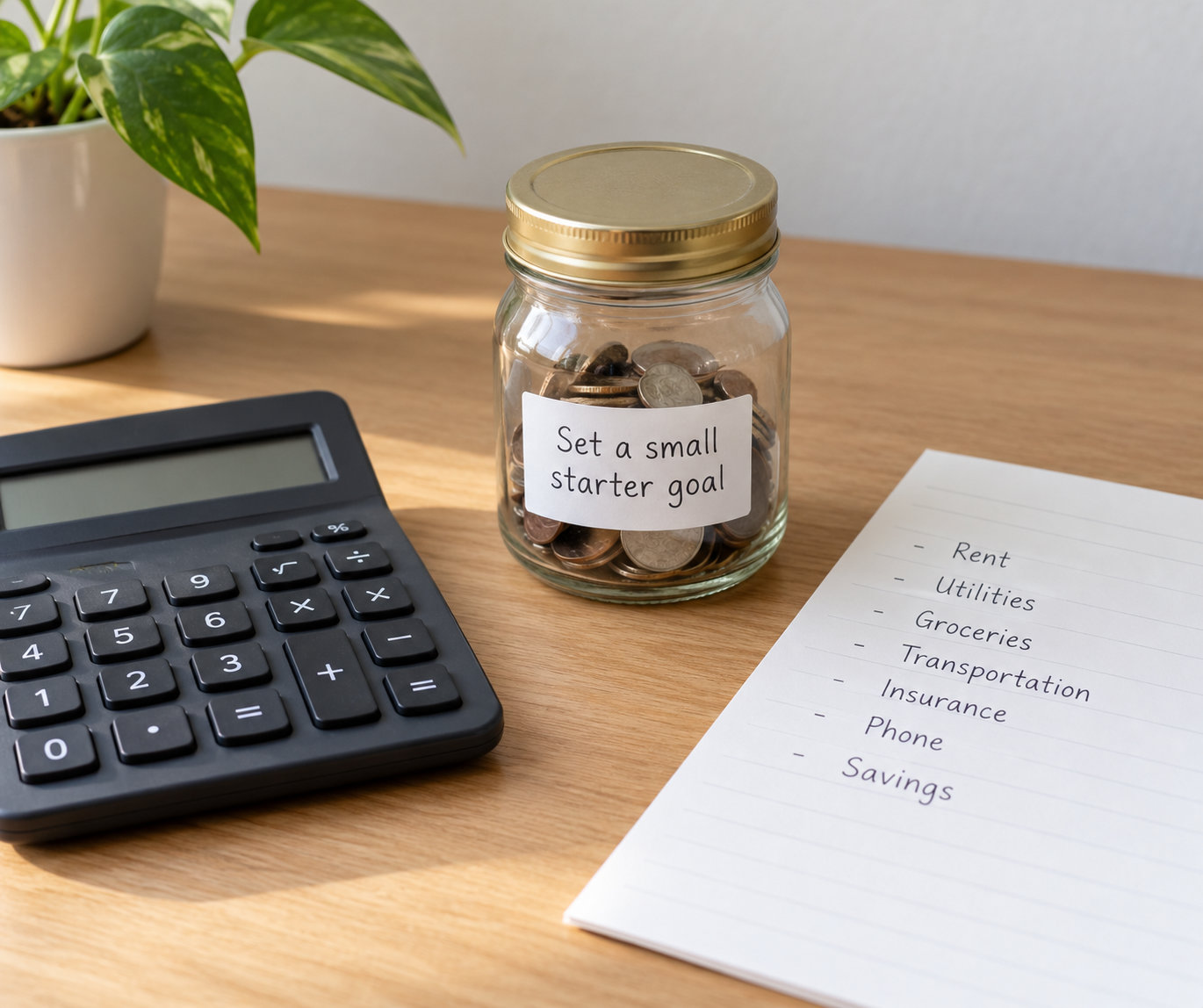
Set your first target at one small emergency, which for most households means about 1,000 dollars in cash savings. That number comes up again and again in saving communities because it does something specific: it covers the most common flat-rate shocks, like a car repair or a deductible, without forcing you onto a credit card.
How to tell it worked: you can name the specific bill this money would cover. If you cannot name it, the goal is too vague. Lower it until you can.
2. Find money to save
Look at your last three months of bank statements and sort spending into two piles: the essentials that would continue if you lost income tomorrow, and the flexible stuff you could adjust. Most people find a surprising amount in the second pile that they were not even tracking, like two subscription renewals, a delivery habit, or a mobile plan they overpay for.
You do not need a dramatic lifestyle overhaul. Redirecting 40 or 50 dollars a month is enough to change the math later, and a target you keep beats a bigger one you abandon in month three.
3. Open a separate emergency savings account
Open a savings account that sits apart from your everyday checking, and preferably at a different bank, so spending it takes a deliberate step. Look for no monthly maintenance fee, no minimum balance requirement, and easy same-day access to the money. A high-yield savings account is the usual answer because it pays a better interest rate than a standard savings account while staying liquid.
Here is how the common options compare.
| Account type | Access to the money | Interest rate | Good fit for |
|---|---|---|---|
| High-yield savings account | Same day, usually by app or phone | Higher than a standard savings account, rates change often | Most people building a fund in under a year |
| Money market account | Same day, sometimes with a debit card | Often higher than a HYSA, varies by institution | Longer timelines where access still matters |
| Treasury bills | Matures on a set date, sold early at a small price | Set by auction, short terms | The part of a fund you will not need for months |
| Everyday checking | Instant | Near zero | Small starter buffer only |
One more thing that costs nothing: name the account something like “job loss” or “car repair fund.” Forum readers describe this as a commitment device, and it works because a generic savings balance is easy to raid without thinking.
How to tell it worked: you can see the account separately in your banking app, and you have to log in somewhere to reach it.
4. Automate regular contributions
Set a transfer that runs the day after payday, ideally through your bank’s bill pay or your bank’s own recurring transfer tool, so the money leaves before you start spending it. This is the pay-yourself-first method, and it works because the decision is made once instead of every month.
If your bank lets you split your direct deposit, ask for a percentage to go straight to the savings account on each payment. Most banks do this from a settings page inside online banking, and it takes about five minutes to turn on.
On irregular income, a fixed amount is a trap because some months would be impossible. Instead, send a percentage of every payment that clears, even 10 percent. A 900-dollar invoice becomes 90 dollars toward the fund before spending it, and in a dry month the fund is exactly what covers you.
5. Reach your first savings milestone
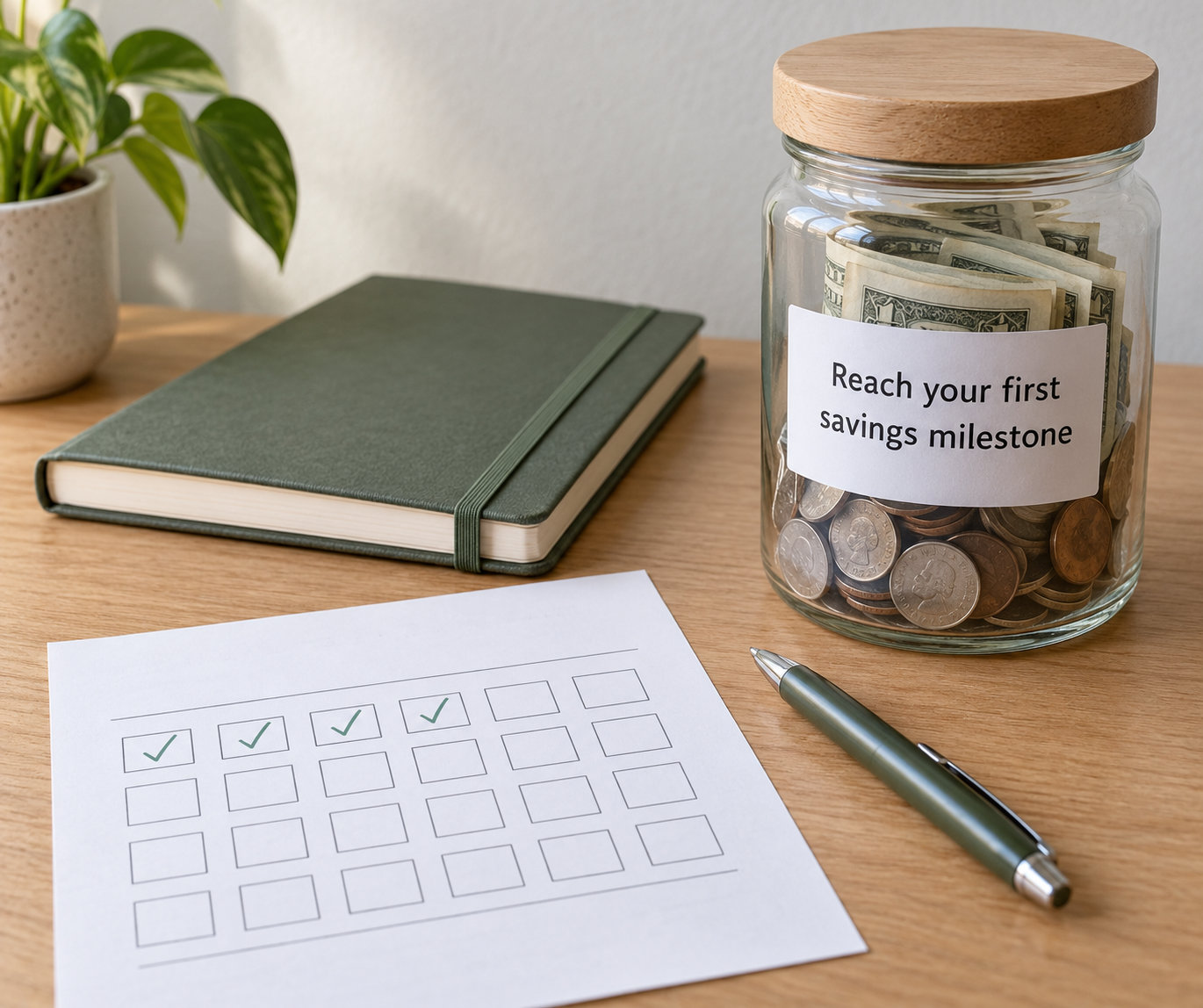
When the balance first hits your starter target, check it, note the date, and decide what the next target is. Long-time savers in personal finance forums describe that first thousand as the single biggest boost to continuing, because the idea stops being abstract.
A useful rule for the next target: aim for one month of essential expenses, then three. Moving from 1,000 dollars straight to a large number tends to stall people halfway. Stacking small milestones keeps the balance moving in a direction you can see.
6. Grow the fund for larger emergencies
Once the starter fund is done, move up the tiers that planners generally call the three, six, and nine month framework. Three months of essential expenses is the standard target for a steady paycheck, six months suits a single income household or one where a job is less secure, and nine months is the version people with variable income or dependents often aim for.
Multiply by essential expenses, not total spending. Essential expenses are housing, utilities, groceries, insurance, transport, minimum debt payments and the basics for anyone depending on you. Lifestyle spending is what you can pause for a few months, and it usually should not be in the target.
How long it takes depends on the monthly amount and the size of your essential expenses. The table below uses a household with 3,500 dollars a month in essentials, so three months is 10,500 dollars and six months is 21,000 dollars.
| Saving each month | To reach 1,000 dollars | To reach 10,500 dollars | To reach 21,000 dollars |
|---|---|---|---|
| 100 dollars | 10 months | 105 months | 210 months |
| 200 dollars | 5 months | 53 months | 105 months |
| 300 dollars | 4 months | 35 months | 70 months |
| 500 dollars | 2 months | 21 months | 42 months |
| 1,000 dollars | 1 month | 11 months | 21 months |
The useful part of that table is the second column. At 300 dollars a month you have a starter fund covered inside two months of consistent transfers, which is a short enough stretch to stay motivated through.
Speed up the middle stretch with three things that do not require changing your lifestyle: send every unexpected payment to the fund, including tax refunds, work bonuses, refunds and gifts; sell the handful of household items sitting unused; and direct any extra hours or side work straight to savings rather than to spending. Insurance does not replace a fund, but solid health, renters or home, auto and disability cover keeps a bad month from becoming a crisis in the first place.
How to tell it worked: your essential expenses for one month are fully covered, and the balance is still earning interest in a separate account.
Common Mistakes
Most stalled funds come from one of these, and each has a simple correction.
Using the fund for routine spending
Write your emergency criteria down before you need it. A flat 20 to 30 percent APR credit card balance is the most common thing a fund prevents, and it is also the most common way funds disappear.
Setting a target that ignores your real expenses
Six months of everything you spend is a much bigger number than six months of essentials. Calculate from the list, then round up slightly for the things that are always irregular, like car repairs and medical copays.
Skipping the month when things get tight
Transferring a smaller amount counts. A five dollar transfer keeps the habit and the balance growing, which matters more than the size of any single month.
Keeping the money where you can spend it by accident
If the balance sits in your main checking account, treat it as gone. Move it somewhere that takes a deliberate login or a phone call to reach.
Treating a credit card or insurance policy as the fund
Neither one is cash. Both can fail at once, and a credit card is a way to borrow rather than a way to save, usually at a rate far above what savings earn.
Having no plan for putting it back
Decide the replenishment order before you need it. The usual sequence is minimums first, then the automatic transfer, then windfalls, and only then optional extras, which lets you restore the balance without stalling other goals.
Frequently Asked Questions
How much should I have in an emergency fund before I start investing?
Most guidance puts a starter fund of about 1,000 dollars ahead of investing or aggressive debt payoff. The reason is simple: without a small cushion, the first flat expense pushes you onto a credit card at a rate far above what most investments return. Once that starter amount is in place, a reasonable middle goal is three months of essential expenses, which many people reach within a year of steady contributions.
Where should I keep my emergency fund money?
A high-yield savings account at a separate bank is the standard choice, because it pays more interest than a basic savings account, stays liquid, and is usually covered by deposit insurance. A money market account can pay a bit more with similar access. Treasury bills suit the portion of a fund you will not need for months, but they take a little more work to cash in early. Rates change often, so check the current figure before you open anything.
What counts as a financial emergency, and what does not?
A real emergency is one you could not have planned for and could not delay: a job loss, a medical bill, a car repair that stops you commuting, a broken water heater, a storm. A phone upgrade, a holiday, a concert ticket or covering a purchase you had been putting on a card is not an emergency. Writing your own short list before you need the money keeps both over-tapping and never using the fund in check.
Should I pay off high-interest debt or build an emergency fund first?
Put enough aside to cover one flat-rate emergency, then pause the extra contributions and attack the highest interest balance. Once that balance is gone, resume saving until you reach three months of essential expenses. The reasoning is that credit card interest keeps compounding while a cash balance does not, so clearing the card first is usually the cheaper order, as long as you are not starting from zero.
How do I build an emergency fund on an irregular or gig income?
Save a fixed percentage of every payment instead of a fixed amount each month, even 10 percent, and target a larger cushion such as six to nine months of essentials. Watch for dry spells, not just good ones. Keep the fund in an account that does not need your income to touch, and treat a slow month as a reason to skip other goals, not this one.
How long does it take to build a three-month emergency fund?
It depends entirely on how much you can move each month. Someone saving 500 dollars a month needs about 21 months to reach 10,500 dollars in essential expenses, while 1,000 dollars a month gets there in about 11. Windfalls shorten it considerably. Reaching a 1,000 dollar starter fund is much faster, usually two to four months of consistent transfers.
Conclusion
The sequence that works is simple: list your essential monthly expenses, pick a starter target you can name a bill for, open a separate high-yield savings account, automate a transfer right after payday, then move up to one month, three months and beyond as the balance grows. Nobody builds a fund in a week, but the first milestone is closer than most people think when the transfer is automatic.
Pick one action for today: open the separate account and set a transfer for an amount you will not miss. That single setting does more than any amount of planning, and you can raise it at your first milestone.
Savings rules, deposit insurance limits and interest rates differ by country and state and change over time, so check the specifics where you bank before you commit money.