A nutrition facts label is the standardized panel on every packaged food that tells you the serving size, the calories in that serving, the percent daily value of key nutrients, and what is in the ingredient list. To read one properly, work down the panel in a fixed order: serving size, servings per container, calories, the nutrients to limit, the nutrients to want more of, then the ingredient list. It takes about a minute.
That order is not arbitrary. Almost every number on the panel only makes sense once you know the serving size, which is why starting at the bottom or jumping straight to calories is the single most common way people misread a label. This guide walks the panel top to bottom, then covers the mistakes that trip up almost everybody and answers the questions people ask most often.
Table of Contents
- What You Need
- How to Read a Nutrition Facts Label Step by Step
- 1. Check the Serving Size First
- 2. Look at Servings per Container
- 3. Find the Calories per Serving
- 4. Review the Nutrients to Limit
- 5. Check Nutrients You May Want More
- 6. Use Percent Daily Value as a Guide
- 7. Check the Serving Suggestions and Ingredients List
- Common Mistakes
- Frequently Asked Questions
- What does 5% Daily Value mean?
- Should I use calories per serving or per package?
- How do I compare nutrition facts labels for different foods?
- What nutrients should I look for most on a label?
- Does a nutrition facts label tell me whether a food is healthy?
- What is the 4 4 9 rule in nutrition?
What You Need
Very little. The package in your hand is the only tool that matters.
A kitchen scale is genuinely useful, though only if you plan to eat packaged food regularly and track anything. A bag of rice that says one serving is two-thirds of a cup weighs 130 grams, and that is a number most people never check. People who track intake usually end up weighing food rather than trusting the stated portion, and the scale takes about fifteen dollars to solve that problem.
Also worth knowing before you start: a nutrition facts label describes a reference serving, not the amount you should eat, and the Daily Value percentages are calculated for a 2,000-calorie diet. Neither of those numbers is personalized to you, and for children, teenagers, pregnant people and anyone with a condition such as diabetes or kidney disease, the reference numbers need adjusting before they mean anything.
How to Read a Nutrition Facts Label Step by Step
Here is the full read, in the order it works. Seven parts, and each one depends on the one before it.
1. Check the Serving Size First
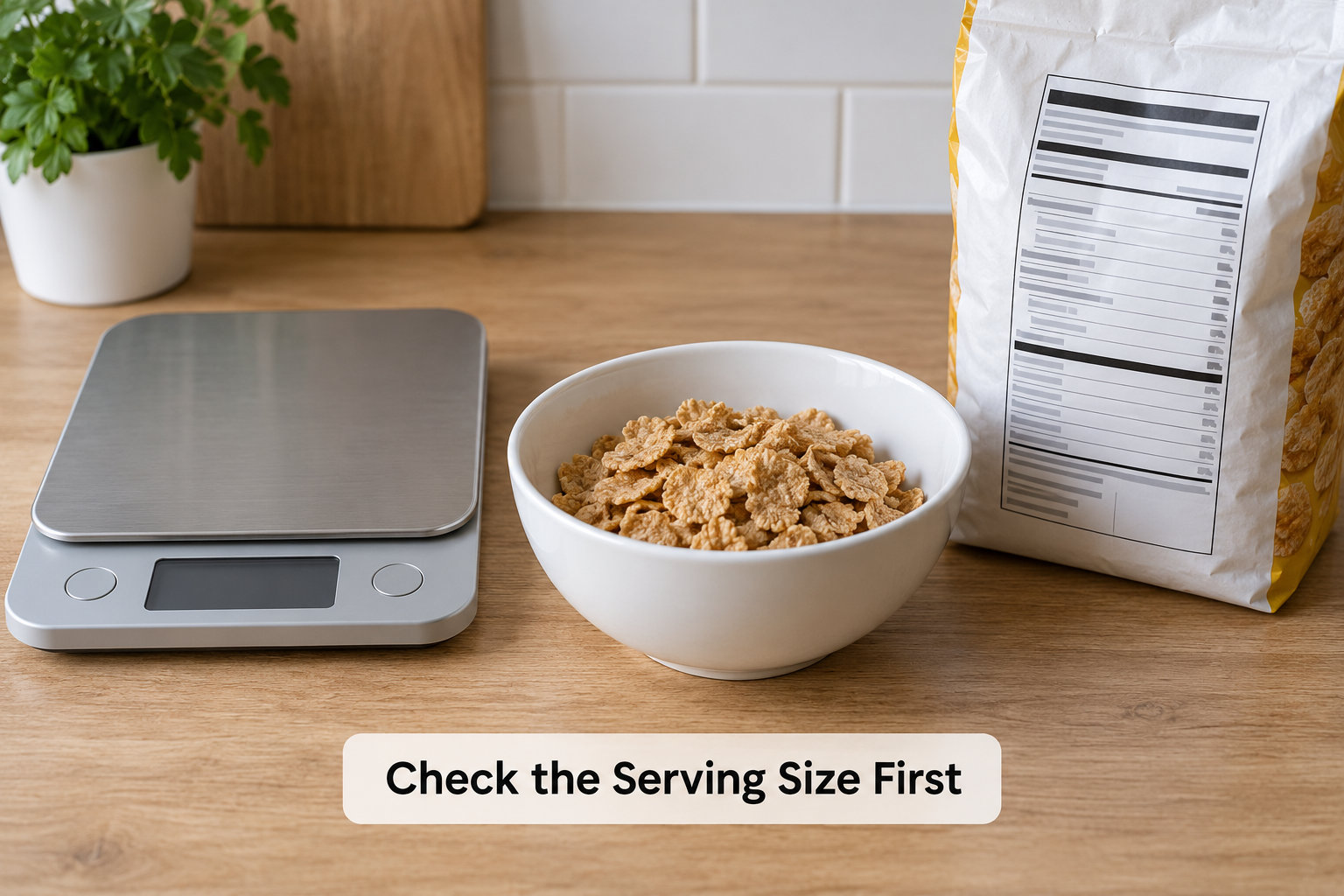
Start at the very top, where the label states the serving size in grams, ounces or household measure. Every other number on the panel describes that amount and nothing else.
There are two kinds of package to watch for. A single-serving package means you eat the whole thing and the numbers are the numbers. A multi-serving package means one portion is smaller than what most people treat as a portion, which is where the arithmetic goes wrong.
Say the label says one serving is 30 grams of cereal with 140 calories. If you pour out twice that because the bowl looked small, the real number is 280 calories and 26 grams of added sugar, not 140. Multiplying is the whole game here, and doing it in your head is fine.
2. Look at Servings per Container
This line sits right under the serving size and tells you how many of those servings are in the package. A family-size bag might say 8, a tub of yogurt might say 2, a bottle of salad dressing might say 5.
When a package holds several servings and you intend to eat all of it, multiply calories and every gram figure by the servings count. A 230-calorie cereal that lists 2 servings per container is a 460-calorie bowl if you eat the box.
Manufacturers were also required to add a dual-column label to packages with more than one serving, showing per-serving figures in one column and per-package figures in the other. If you see two columns, read the per-package column when you plan to eat the whole thing.
3. Find the Calories per Serving
The calorie number sits in the biggest type on the panel, which is why it gets noticed. It is the energy in one serving, and calories are actually kilocalories, the same unit a food label uses in countries that spell the word differently.
Calories are calculated from the three macronutrients using what gets called the 4-4-9 rule: 4 calories per gram of carbohydrate, 4 per gram of protein, 9 per gram of fat, with alcohol at 7. The rule is a good way to check whether a label adds up, but nutritionists have moved past it, because fiber and sugar alcohols contribute fewer calories than 4 per gram, and the body does not handle protein and carbohydrate identically. Use it as a sanity check rather than a law.
One calorie comparison is more useful than any absolute number. Two 200-calorie products mean very different things if one serving is a cup and the other is half the bag.
4. Review the Nutrients to Limit
The panel groups fats and then lists saturated fat and trans fat beneath total fat. For cardiovascular health, saturated fat and trans fat are the two to watch, not the total. Trans fat has been removed from most American products since partially hydrogenated oils were banned in 2018, but the loophole remains: a product can legally print 0g trans fat as long as it contains less than 0.5 grams per serving. If the ingredient list mentions partially hydrogenated oil, keep walking.
Sodium sits under total carbohydrate. For most adults the daily reference is under 2,300 milligrams, and packaged foods do a surprising share of the work of getting you there, especially bread, canned soup, deli meat and sauce. Bread is the classic offender: a soft white loaf can carry 400 to 500 milligrams in two slices with nothing on it.
Added sugars appears directly under total sugars, and this is the line most people misread. Total sugars includes every sugar in the food, both natural and added. Added sugars is a subset sitting inside that total. Added sugars is not extra, it is carved out of the same number, so a label showing 22 grams of total sugars and 12 grams of added sugars contains 12 grams of added sugar, not 34.
The other related line is total carbohydrate, which is the big number. Break it down like this: total carbohydrate contains dietary fiber, total sugars, and the starches that are neither. Fiber is not sugar and it is not counted again anywhere else on the panel. When people ask whether to count total carbs or total sugars, the answer for most purposes is that total carbohydrate already includes the sugars, so the two are not alternatives to pick between.
| Label line | What it includes | How to use it |
|---|---|---|
| Total carbohydrate | Fiber, total sugars and starches | The one carbohydrate number to use; everything else is a piece of it |
| Dietary fiber | Indigestible carbohydrate, listed under carbohydrate | Aim for more; 5% DV or less is low, 20% DV or more is high |
| Total sugars | All sugar, natural and added | Never add the two sugar lines together |
| Added sugars | Only the sugar added in processing, part of total sugars | The line to limit, per the current dietary guidance |
5. Check Nutrients You May Want More
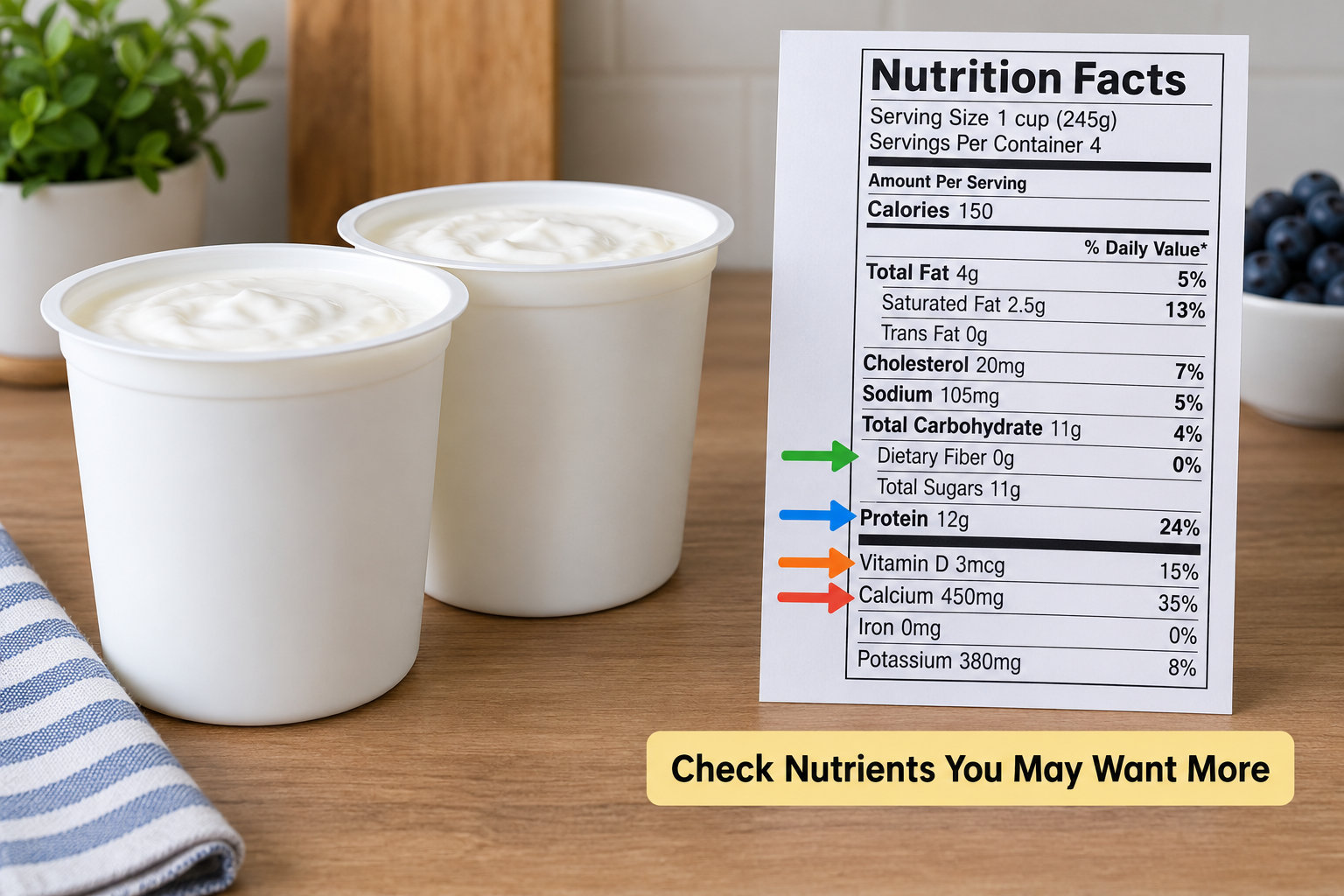
The bottom of the panel lists protein, then vitamin D, calcium, iron and potassium. Protein is a macronutrient and mostly there to tell you how much is in a serving; fiber, vitamins and minerals are the ones most Americans come up short on.
None of these determines whether a food is good for you on its own. A granola bar can carry 12 grams of added sugar and 4 grams of fiber, and both numbers are true and neither settles the question. The useful move is comparing similar products against each other on the same lines rather than hunting for a perfect score on one.
6. Use Percent Daily Value as a Guide
Percent Daily Value is the shortcut that makes the whole panel usable, and the rule is short enough to memorize: 5% DV or less is low, and 20% DV or more is high. Percentages between the two sit in the middle with no official verdict.
Every Daily Value is derived from a 2,000-calorie reference diet, which is why the numbers need adjusting if your target is not 2,000. A simple correction works well enough for daily use: if you eat 2,500 calories, divide the percentages by 1.25. If you eat 1,800, multiply them by 1.1. A label showing 20% DV of sodium at 2,000 calories is closer to 25% on a 2,500-calorie day.
Be careful with that math for children, because the 2,000-calorie reference is an adult number and applying it directly to a nine-year-old overstates what counts as high.
| Nutrient | Daily Value | 5% DV looks like | 20% DV looks like | Aim |
|---|---|---|---|---|
| Total fat | 78 g | 3.9 g | 15.6 g | Aim low to moderate |
| Saturated fat | 20 g | 1 g | 4 g | Aim low |
| Sodium | 2,300 mg | 115 mg | 460 mg | Aim low |
| Total carbohydrate | 275 g | 14 g | 55 g | Context dependent |
| Dietary fiber | 28 g | 1.4 g | 5.6 g | Aim high |
| Added sugars | 50 g | 2.5 g | 10 g | Aim low |
| Protein | 50 g | 2.5 g | 10 g | Context dependent |
| Vitamin D | 20 mcg | 1 mcg | 4 mcg | Aim high |
| Calcium | 1,300 mg | 65 mg | 260 mg | Aim high |
| Iron | 18 mg | 0.9 mg | 3.6 mg | Aim high |
| Potassium | 4,700 mg | 235 mg | 940 mg | Aim high |
7. Check the Serving Suggestions and Ingredients List
Directly under the panel sits the amount the company considers a sensible serving. Treat it as a data point rather than a verdict. A 2,000-calorie adult may want less than the suggested serving of a snack, and a teenager may want more, and neither of you is wrong.
The ingredient list is written in descending order by weight, so the first three ingredients are most of what you are eating. That is how you find things a flavor name never suggests, and it is also where allergens appear, since the major ones must be declared by name.
Read it for four things: where the added sugar is hiding, which oil is used, the order of the ingredients, and whether anything on the panel contradicts the ingredients. Yogurt, granola bars, pasta sauce and dried cranberries are the repeat offenders, and all four look healthy until you read the list.
One more line is worth knowing: the Contains statement, which is legally separate from the ingredients because major allergens have to be declared. It is short by design. Reading it takes two seconds and it matters more than any front-of-package claim.
Common Mistakes
Most of the confusion on this topic comes from four habits, and all four are easy to fix once you see them.
Treating the whole package as one serving. This is the big one. A package that lists 4 servings and is eaten in one sitting is four times every number on the panel. The practical fix is to turn the package over first and find the servings count before you read anything else.
Adding total sugars and added sugars together. People do this constantly, and it inflates the apparent sugar content of the food considerably. Added sugars is a subset of total sugars, not an extra line. The fix is to use the added sugars figure when your goal is limiting sugar, and to remember the total already includes it.
Anchoring on a single number. Calories, protein, carbs, none of them decides the question on their own. Food that fits your goals well can be 300 calories, and food that fits badly can be 90. The fix is to look at the two nutrient groups together, the ones to limit and the ones to seek, and then decide what matters for you.
Letting the front of the package win. The front is advertising, and it is regulated far more loosely than the panel. Natural, multigrain, plant-based, no sugar, free from, lite, healthy and organic each have a specific legal meaning in the United States, and the meaning is rarely that the food is good for you. No sugar usually means under 5 grams of sugars per serving, which says nothing about added sugar. Natural has no nutrition criteria at all. Only a handful of terms are strictly defined, including healthy, low fat, sugar free and high in fiber, and even those meet a floor rather than describing a good food.
Here is what a real comparison looks like when you do it properly. Two cereal boxes sit side by side and the front of one advertises something the other does not.
| Line on the label | Box A | Box B |
|---|---|---|
| Serving size | 30 g | 40 g |
| Servings per container | 8 | 6 |
| Calories per serving | 140 | 160 |
| Total sugars | 11 g | 14 g |
| Added sugars | 9 g | 1 g |
| Dietary fiber | 1 g (4% DV) | 5 g (18% DV) |
| Sodium | 190 mg (8% DV) | 140 mg (6% DV) |
Box A looks better only if you read the front of the package. On the panel it has 9 grams of added sugar, which is 18% DV, against 1 gram in Box B, and it has four times less fiber. Box B also has a bigger serving, so the honest comparison is 160 calories against 140 at a 33% larger portion. That is the kind of read that takes thirty seconds once you know where the lines are.
One question people ask constantly is how accurate these numbers actually are. Label values are regulated, and manufacturers are allowed some tolerance rather than exactness. For most nutrients, a product can test within about 20 percent of its stated value and still comply, and a calorie figure can be off by roughly 10 percent and still be legal. Labels produced by a lab are expected to match what analysis shows; labels calculated from ingredient data are estimates, and the difference matters if you are tracking closely.
Finally, do not put the whole weight of your diet on a single number. The label tells you what is in the food, not what it does to you, and it cannot account for portion, frequency or the rest of the meal. It is one tool, and a good one.
Frequently Asked Questions
What does 5% Daily Value mean?
5% Daily Value or less is considered low, and 20% DV or more is considered high, per FDA guidance. Percent Daily Value is calculated from a 2,000-calorie reference diet, so 5% of 2,300 milligrams of sodium is 115 milligrams. The practical rule is simple: for saturated fat, sodium and added sugars, lower percentages are better, while for dietary fiber, vitamin D, calcium, iron and potassium, higher percentages are better. Numbers between 5% and 20% have no official verdict.
Should I use calories per serving or per package?
Use the number that matches what you actually eat. If the package lists 2 servings and you eat the whole thing, double the calories and every gram figure. If a package has a dual-column label, use the per-package column for the whole container and the per-serving column for one portion. The most common labeling mistake is assuming a large bag, tub or bottle is a single serving when the panel says it holds four, five or eight.
How do I compare nutrition facts labels for different foods?
Line the panels up side by side and compare in this order: serving size, servings per container, calories, the percent Daily Value of the nutrients you care about, then the ingredient list. Comparing only calories between a 140-calorie cereal portion and a 140-calorie granola bar tells you very little, because the fiber, added sugar and protein content is what separates them. Normalize first: make sure both figures describe a similar amount of food.
What nutrients should I look for most on a label?
It depends on your goal, but for most people the priority lines are added sugars, sodium and saturated fat, with dietary fiber, vitamin D, calcium, iron and potassium on the list of things many people come up short on. For blood sugar, total carbohydrate and added sugars matter most, since fiber slows how quickly that carbohydrate is absorbed. For blood pressure, sodium is the number to check. Read the whole panel rather than optimizing one line.
Does a nutrition facts label tell me whether a food is healthy?
No. It tells you what is in a serving of that food, which is a different question. A label cannot account for portion, how often you eat something, or the rest of your diet, and it says nothing about processing, satiety or how a food makes you feel afterward. Use the panel to compare similar options, and treat the front of the package as advertising, since terms like natural, multigrain and no sugar carry very weak legal requirements.
What is the 4 4 9 rule in nutrition?
The 4 4 9 rule is a shortcut for estimating calories from macronutrients: 4 calories per gram of carbohydrate, 4 per gram of protein and 9 per gram of fat. It is useful for checking that a label adds up. It is not precise, because fiber, sugar alcohols and other carbohydrates contribute fewer calories than 4 per gram, and the body handles protein and carbohydrate differently than simple arithmetic implies. Treat it as a rough estimate, not a law.
So: read serving size, then servings per container, then calories, then the percent Daily Value on both nutrient groups, then the ingredient list. Comparing two products, work in that order and use the same reference amount for both, because that is the only honest way to tell which one fits you.
This is general information, not medical or dietary advice. If you are managing diabetes or prediabetes, high blood pressure, high cholesterol, kidney disease, or reading labels for a child, talk with your doctor or a registered dietitian about the numbers that matter for you.