Cold weather does not drain your battery overnight. It cuts how much power the battery can deliver, while thicker engine oil makes the starter work harder at the exact moment the battery has less to give. Most batteries that fail on a freezing morning were already worn out, undercharged by short trips, or slowly drained while parked.
The fix is unglamorous: check the battery before the first freeze, keep it topped up with a maintainer, and drive long enough to actually recharge it. Give it 30 minutes in the driveway and you have covered the whole routine.
Table of Contents
- What You Need
- Step-by-Step: How to Keep Your Car Battery From Dying in Cold Weather
- Step 1: Check the Battery Before Cold Weather Arrives
- Step 2: Test the Battery and Charging System
- Step 3: Protect the Battery During Cold Weather
- Step 4: Recover a Car With a Dead Battery Safely
- Quick Troubleshooting: Symptom, Likely Cause, Fix
- Common Mistakes
- Frequently Asked Questions
- Why does a car battery die faster in cold weather?
- How cold does it have to be before a car battery will not start?
- How long should a car battery last in freezing weather?
- Is it safe to jump-start a car battery in the cold?
- Should I drive my car to charge the battery or replace it?
- Can I use a space heater to warm up my car battery?
- Conclusion
What You Need
You do not need a shop or a special machine for most of this. Here is the honest list.
- A digital multimeter. Any basic one that reads DC volts will do. A battery tester or smartphone app is fine if it is accurate.
- A terminal cleaning kit: a stiff brush, a wire terminal cleaner, and either baking soda with water or a commercial terminal cleaner.
- Dielectric grease or battery protectant spray for sealing the terminals after cleaning.
- Your owner manual, or at least the page covering the battery group size and the recommended cold cranking amps.
- A battery maintainer if the car sits for days at a time, plus a timer or a charger with an automatic float stage.
- Heavy-gauge jumper cables and ideally a portable jump starter, kept in the trunk rather than in the house.
- Basic gloves and eye protection. Battery terminals are live whenever the key is not in the ignition lock.
Also know your battery group size and the engine displacement. A V8 or a diesel pickup needs far more cold cranking amps than a compact sedan, and matching that matters more than any gadget.
Step-by-Step: How to Keep Your Car Battery From Dying in Cold Weather
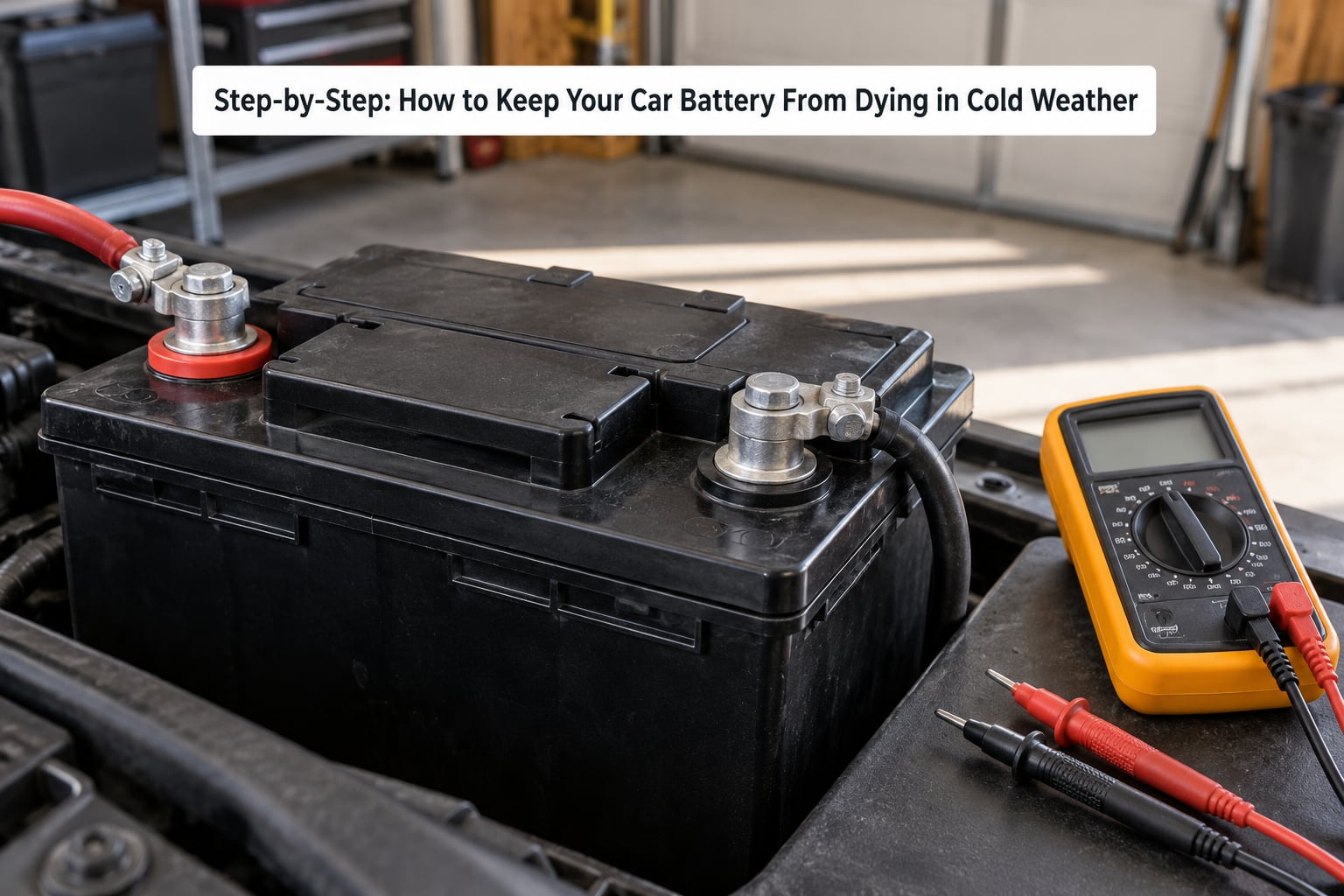
The order matters here. Diagnose first, protect second, recover only if you have to. Working through these steps in sequence is the reliable way to keep a car battery alive through a northern winter.
Step 1: Check the Battery Before Cold Weather Arrives
Find the battery. Most cars put it under the hood, but plenty of models hide it in the trunk or under a floor panel, and a few tuck it inside the cabin near the seat. Your manual shows where.
Look for the manufacture date, usually a small sticker or stamped code on the case. Most lead-acid batteries last three to five years, and in a freezing climate the short end of that range is more common. Three years or older deserves a real test before winter, not a hopeful start on the first cold morning.
Check the cold cranking amps against what your engine needs. Underrated is the quiet problem: the battery is fine until the engine needs more than it can give.
Inspect the case for bulging, cracks or a swollen lid. A bulging battery can vent acid and should not be brought back to life with a charger. Look at the terminals for white, blue or green corrosion. A little on the outside is normal; heavy crust that you can scrape off and see metal underneath is not.
How you know it worked: you have the manufacture date, you know the CCA rating, the case is not deformed, and either the terminals are clean metal or you have noted that they need cleaning.
Step 2: Test the Battery and Charging System
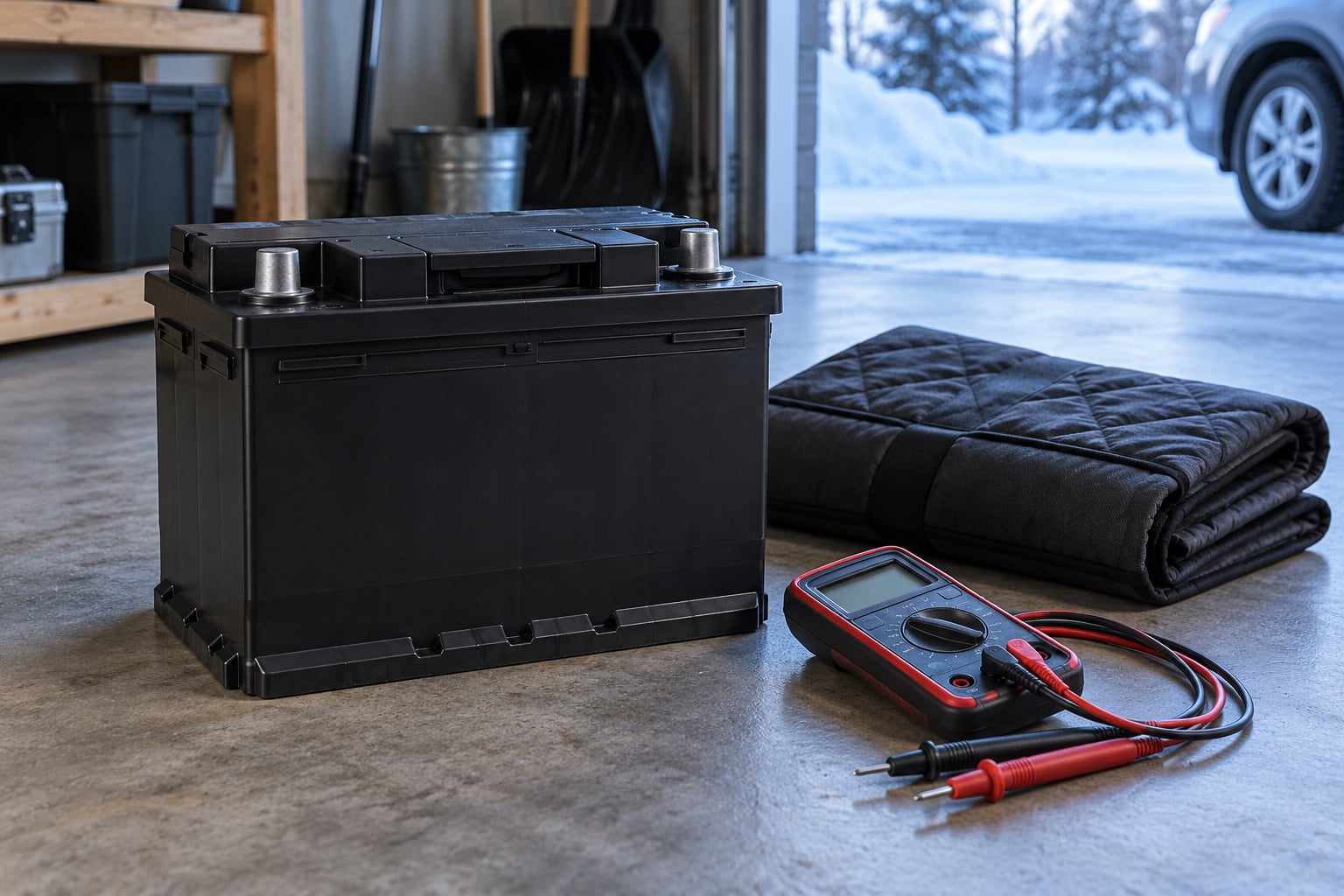
Set the multimeter to DC volts, connect the red lead to the positive terminal and the black to the negative, and read the resting voltage with the engine off and the car parked for several hours, ideally overnight. Do not run the engine or open the doors first, because that reading will be misleading.
Rough guideposts that most owners use: about 12.6V or higher is fully charged, 12.4V means the battery is partway down, and 12.0V or lower means it is nearly depleted. Follow the thresholds in your battery or vehicle manual where they differ from these.
Then check the charging side. Start the engine and look at the voltage again. A healthy alternator typically pushes somewhere between 13.7V and 14.7V with the engine running. Anything sitting near 12V means the car is running on the battery alone, and no amount of jump-starting fixes that.
For a clearer answer, most auto parts stores will run a load or conductance test, which measures how the battery behaves under cranking demand. It is free and takes a few minutes.
How you know it worked: resting voltage holds above 12.5V and the running voltage sits in the mid-teens. Anything else, take the reading to a shop before winter.
Step 3: Protect the Battery During Cold Weather
Clean the terminals. Disconnect the negative first, brush the corrosion off, rinse with water, dry everything, then smear a light coat of dielectric grease on the posts. Salt and road grime hold moisture against the metal, and moisture is what turns a marginal connection into a dead morning.
Park in a garage or under cover if you have one. Moving the car out of sub-zero air to a space that never freezes is the single most effective thing you can do, because cold and aging compound each other.
| Temperature | Approximate deliverable capacity |
|---|---|
| 32 F | about 80% |
| 0 F | about 60% |
| -20 F | about 50% |
| -40 F | roughly half or less |
A fully charged battery will not freeze until well below the coldest temperatures most drivers see. A discharged one can start freezing around 20 F, so keeping the charge up matters twice in deep cold.
Drive longer than you think you need to. A ten-minute commute uses more energy cranking than the alternator puts back, which is exactly why short-trip drivers keep meeting flat batteries. Aim for at least 20 to 30 minutes of driving, and take the highway occasionally rather than only crawling through traffic.
Hook up a maintainer for anything that sits. A maintainer holds roughly 13.6V and tops up whatever the car has drawn. Yes, you can leave it connected all winter in a ventilated, dry location: pick a unit with an automatic float or maintain stage and follow its instructions for the battery chemistry, and use a timer if the model has one.
Mind the accessories and the overnight drain. Heated seats, heated mirrors, the stereo and an aftermarket alarm all run off that same battery. On a car driven once a week, that parasitic draw is often the reason a battery is flat by the weekend even though nothing is wrong with it. If the battery is nearly new and still dies, that is where I would look first.
How you know it worked: clean terminals, a garage if possible, one properly long drive each week, and a maintainer doing the work on the weeks you do not drive. Follow the owner’s manual for anything beyond that.
Step 4: Recover a Car With a Dead Battery Safely
Turn both vehicles off, park the good battery car close, open the hoods and check that you are not near fuel fumes. Follow the manuals for your vehicles and use proper heavy-gauge cables.
Connect the red clamp to the dead battery’s positive terminal, then the other red clamp to the good battery’s positive terminal. Connect the black clamp to the good battery’s negative terminal, and finally the black clamp to an unpainted ground point on the dead car, away from the battery.
Start the good car, give it a minute, then attempt to start the dead one. Do not let the clamps touch each other while you work, and keep hands and clothing clear of the fans. Once it starts, remove the cables in the reverse order and drive for 20 to 30 minutes so the alternator puts back what the jump took.
A portable jump starter does the same job without a second car, which is why owners on car forums praise them for single-vehicle households.
Test the battery again after charging it. If the resting voltage stays low, or the car dies again within a few days, the battery or the charging system is the problem, and a shop can tell you which in a few minutes.
Quick Troubleshooting: Symptom, Likely Cause, Fix
| What you notice | Likely cause | What to do |
|---|---|---|
| Slow crank, headlights dim | Battery low on charge or worn out | Test resting voltage, then load test |
| Rapid clicking, no start | Battery deeply discharged | Jump start and charge, then retest |
| Battery light on while driving | Alternator or belt not charging | Check running voltage, have the belt inspected |
| Fine all week, flat by Sunday | Parasitic drain or short trips | Measure draw with a meter, drive longer, add a maintainer |
| White crust on posts | Corrosion | Clean terminals and seal with protectant |
| Starts in summer, not in winter | Battery worn out or CCA too low | Replace with the group size and CCA the manual calls for |
Common Mistakes
Applying direct heat to the battery. A space heater or a blowtorch aimed at a frozen battery is dangerous. Batteries are lead-acid, not water, and none of them need warming that way. Warm the car instead, with a block heater or a battery blanket, following the manufacturer’s instructions.
Driving only short trips. This is the most common self-inflicted battery killer and it feels productive. Cranking draws a big surge of power and idling in traffic puts back very little of it, so the battery slowly works downward until it cannot crank.
Adding tap water to a battery. Some older batteries have refill caps and need distilled water topped up to the marked line. Never use tap water on anything you have not checked, and never open a sealed battery, which is common on modern cars and needs no water at all.
Ignoring the warning light or a slow start. A battery light, a slow crank or headlights that dim at idle are all early warnings. Treat them as a service trigger rather than something that will clear itself in spring.
Replacing the battery without checking the charging system. If the alternator is weak or a belt is slipping, the new battery dies the same way the old one did. A running-voltage reading takes a minute and rules this out.
Idling to warm the car up. Idling for 30 minutes in a parking lot mostly burns fuel. It gives the battery a small top-up at best and does nothing for engine temperature. If you must let a car idle outdoors, do it in a well-ventilated area and drive it properly afterwards.
Frequently Asked Questions
Why does a car battery die faster in cold weather?
Cold slows the chemical reaction inside a lead-acid battery and raises its internal resistance, so it delivers less power at exactly the moment the engine needs more to crank. Thick cold oil and a stiff engine raise the demand further. A worn-out battery that started fine in October can fail on the first freezing morning for that reason alone.
How cold does it have to be before a car battery will not start?
There is no single temperature, because it depends on the battery’s state of health and charge. Roughly speaking, a fully charged battery delivers about 80 percent of its capacity at 32 F, about 60 percent at 0 F and close to half at -20 F. A marginal battery may crank at 40 F and fail at 5 F the next morning.
How long should a car battery last in freezing weather?
Most lead-acid batteries last three to five years, and freezing climates tend to use up the short end of that range. Three years or older, especially with a history of short trips or sitting for weeks, deserves a load test before winter rather than a replacement on guesswork. Check the manufacture date first, since it is printed on the case.
Is it safe to jump-start a car battery in the cold?
Yes, as long as the batteries are not frozen or leaking and you follow both vehicle manuals. Park the vehicles nose to nose, connect red to positive first and black to an unpainted ground point last, keep the clamps from touching, and remove them in reverse order. Never connect a charger or jump starter to a battery that is visibly bulging or cracked.
Should I drive my car to charge the battery or replace it?
Drive it if the battery holds charge above 12.5V and the alternator reads between about 13.7V and 14.7V with the engine running. A 20 to 30 minute drive will restore a light discharge. Replace the battery if it reads 12.0V or lower, fails a load test, or dies again within a few days of charging.
Can I use a space heater to warm up my car battery?
No. Direct heat from a space heater, a campfire or a torch can damage the battery and it is a fire risk around fuel vapours. Warm the vehicle with an engine block heater or an insulated battery blanket, both connected to mains power outdoors, and keep the battery itself clean, dry and fully charged instead.
Conclusion
Start with the four things that predict a winter failure: the age of the battery, a bulging or cracked case, corrosion on the terminals, and the state of your charging system. Read the resting voltage, run a free load test if the battery is three years old, and add a maintainer if the car sits for weeks.
If it still dies after a proper charge, or the alternator reading never climbs into the mid-teens, have a shop look at it before the first freeze rather than on the first freezing morning. Your owner’s manual always has the last word on the numbers for your vehicle.