Most drivers should rotate tires every 5,000 to 8,000 miles, or about every six months, whichever comes first. Plan on shorter intervals, around 3,000 to 5,000 miles, for all-wheel-drive and four-wheel-drive vehicles, performance cars and anything that tows. Your owner’s manual always wins over any generic number, so check it first.
Here is why the number is not the whole answer. I have owned vehicles with a rotation record going back decades and vehicles where nobody ever turned a wheel, and the difference shows up in the tire tread long before it shows up in a repair bill.
Table of Contents
- How Often to Rotate Tires?
- What Does Tire Rotation Do?
- What Rotation Schedule Should You Use?
- Which Tire-Rotation Pattern Should You Use?
- How to rotate front-wheel-drive tires
- Rear-wheel drive and all-wheel drive
- Directional tires and the two-tire pattern
- How to Rotate Tires Safely
- When Should You Rotate Tires More Often?
- Do You Need to Balance or Align Tires During Rotation?
- How Do Tire Pressure and Tread Depth Affect Rotation Timing?
- Frequently Asked Questions
- Should you rotate tires at every oil change?
- Do all-wheel-drive and four-wheel-drive tires need rotating?
- What happens if you rotate directional tires wrong?
- What is the 3 percent rule for tires?
- Is it worth paying for a tire rotation?
- Key Takeaways
How Often to Rotate Tires?
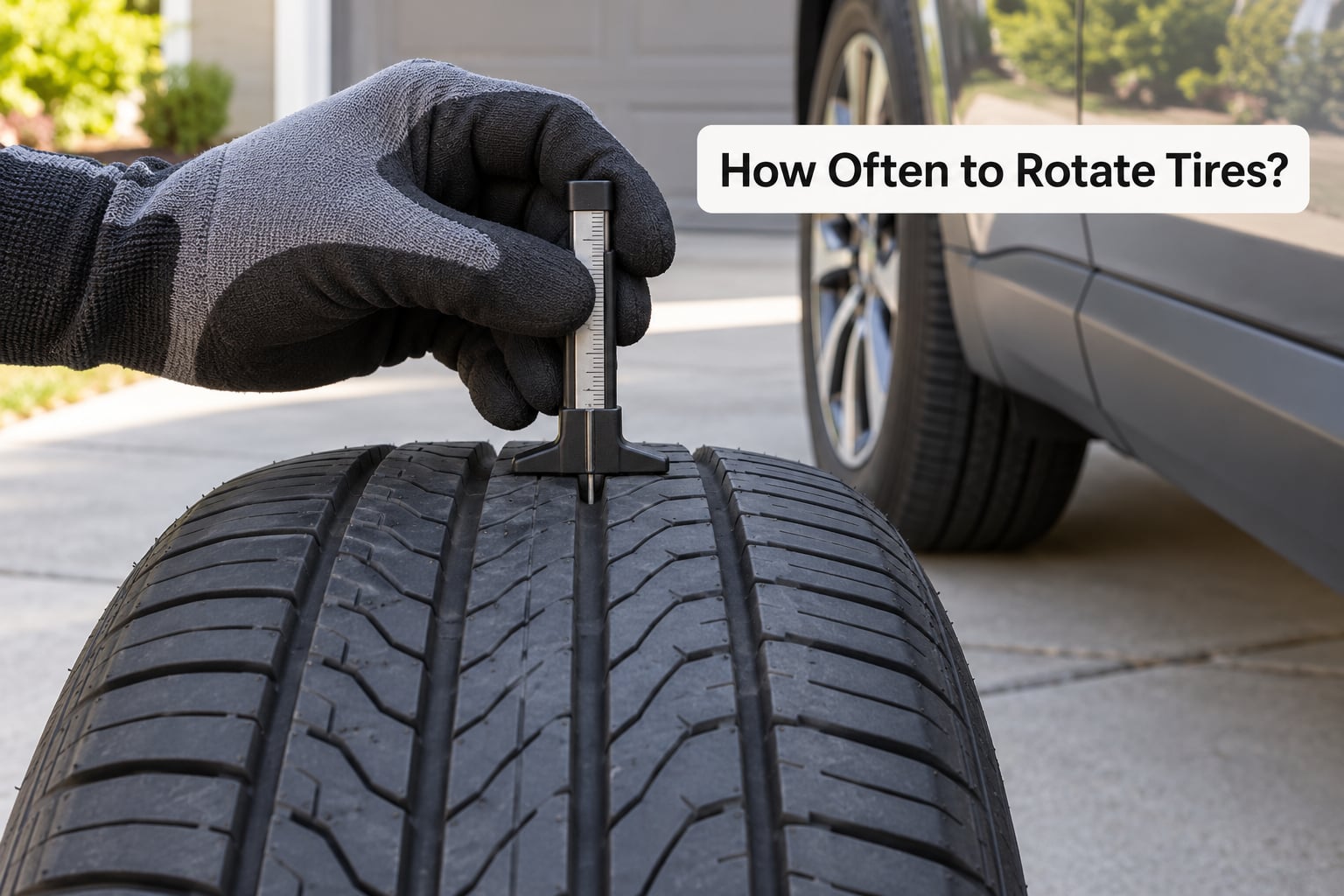
The short answer is 5,000 to 8,000 miles or six months for a typical front- or rear-wheel-drive car on all-season tires. A six-month floor matters more than the mileage number for low-mileage drivers, because time on the road still ages rubber and weather still ages the surface.
Where the conflicting advice comes from is easy to untangle. Manufacturers publish 5,000 to 8,000 miles because it covers the widest range of driving styles, from gentle highway commuters to stop-and-go city drivers. A number you saw on a tire shop page, 6,000 miles, is a service interval that works for a fleet of similar vehicles. Both are reasonable; they answer different questions.
Use three sources in this order: your owner’s manual, the tire manufacturer’s recommendation, then the miles-and-months rule of thumb. The manual wins when they disagree, and it also tells you which rotation pattern is approved for your specific wheel sizes.
What Does Tire Rotation Do?
Every position on a car does a different job, and the jobs are not equal. Front tires take most of the braking force and nearly all of the steering load. On a front-wheel-drive car they also transmit engine torque while the front wheels pull the car out of a slow corner.
Rear tires handle less and, on front-wheel drive vehicles, mostly follow. That difference is why the front pair on many cars wears out noticeably faster than the rear pair, and why an unrotated set often needs two tires replaced while the other two still have usable tread.
Moving each tire to a different position spreads that work across the set. You keep four tires until the shallowest one is worn out rather than retiring a pair early, and you keep braking, cornering and wet-weather traction consistent instead of changing as the car ages.
Two other things ride along with it. Road noise usually drops when tread blocks stop wearing unevenly, and AWD and four-wheel-drive vehicles put less uneven load on the front and rear differential and center coupling when all four tires wear at similar rates.
Then there is paperwork. Many tire treadwear warranties ask for documented rotations at the specified interval, so skipping them can give a warranty adjuster an easy reason to reduce what they pay.
What Rotation Schedule Should You Use?
Start from the table below, then shorten the interval if your driving does not match the row you are in.
| Vehicle or tire type | Typical rotation interval | Also rotate at |
|---|---|---|
| Sedan or coupe, front-wheel drive, all-season tires | Every 5,000 to 8,000 miles | 6 months |
| Rear-wheel drive sedan or coupe | Every 5,000 to 7,500 miles | 6 months |
| SUV or crossover, front-wheel drive | Every 5,000 to 7,500 miles | 6 months |
| All-wheel drive or four-wheel drive | Every 3,000 to 5,000 miles | 6 months |
| Electric vehicle | Every 5,000 to 6,000 miles | 6 months |
| Performance car or high-performance tires | Every 3,000 to 5,000 miles | Every oil change |
| Light truck, tow vehicle or off-road use | Every 3,000 to 5,000 miles | Before and after heavy use |
| Low-mileage driver on a new set | Once a year is usually fine | 6 months |
The AWD and four-wheel-drive row is not a marketing trick. With a locked or near-locked center coupling, tires of different diameters force the drivetrain to fight itself on every corner and every hill, and that shows up as uneven wear across the same axle.
Electric vehicles sit closer to the front than most people expect. Instant torque and the weight of the battery pack put more load on the rear axle, which is why many EV manufacturers schedule rotations more often than the mileage alone would suggest.
Which Tire-Rotation Pattern Should You Use?
The pattern depends on your drivetrain and on what is printed on the tire sidewall. Read both before you move anything.
How to rotate front-wheel-drive tires
For most front-wheel-drive cars with non-directional tires, use the forward cross pattern. Rear left moves to front left, rear right moves to front right, and the front pair moves straight back to the rear axle on the same side. Crossing the front tires to the rear opposite corners, the backward version of the cross, works too when your manual lists it, and it is the better choice on some models.
Rear-wheel drive and all-wheel drive
Rear-wheel-drive cars usually use the rearward cross, which is the mirror image of the forward cross. All-wheel-drive and four-wheel-drive vehicles get an X-pattern rotation, where each front tire moves diagonally to the rear and each rear tire moves diagonally to the front, so all four tires see both an axle and a left or right side.
Directional tires and the two-tire pattern
A directional tire has an arrow on the sidewall showing which way it rolls, and those tires must not be crossed or turned backwards. When all four are directional, rotate them front to rear on the same side. When you are replacing two tires, the usual rule is that new tires go on the rear axle, even on front-wheel-drive cars, because that is the axle that will be doing the least predictable work in the wet.
Some shops use a side-to-side-only rotation for exact-match front and rear tires, but that pattern barely evens out front-to-rear wear, so it is the least useful option on most vehicles.
Trucks and SUVs with a genuine full-size spare can do a five-tire rotation, which keeps the spare usable and matching the other four. A temporary spare is not part of a rotation. If the spare has its own TPMS sensor, the vehicle may need a sensor re-learn afterward, and some shops will ask you to leave the vehicle for an extra step.
How to Rotate Tires Safely
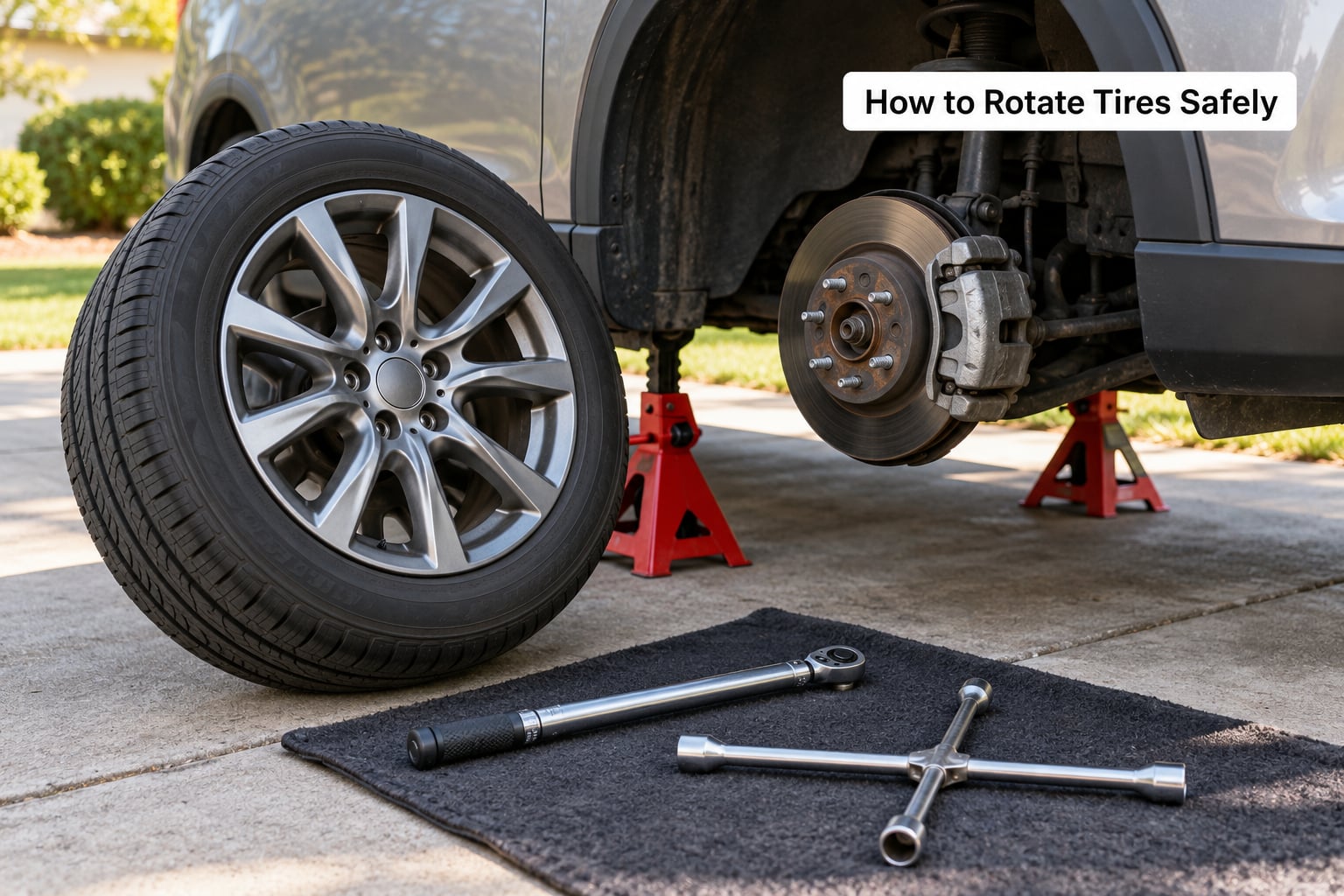
A rotation is a straightforward job if you have the right tools and a flat driveway. Most shops do it in 15 to 30 minutes, and the extra time usually comes from seized lug nuts, specialty wheels or TPMS programming.
- Check the manual first. Confirm the approved pattern, the cold tire pressure on the driver’s door placard, and the lug torque specification.
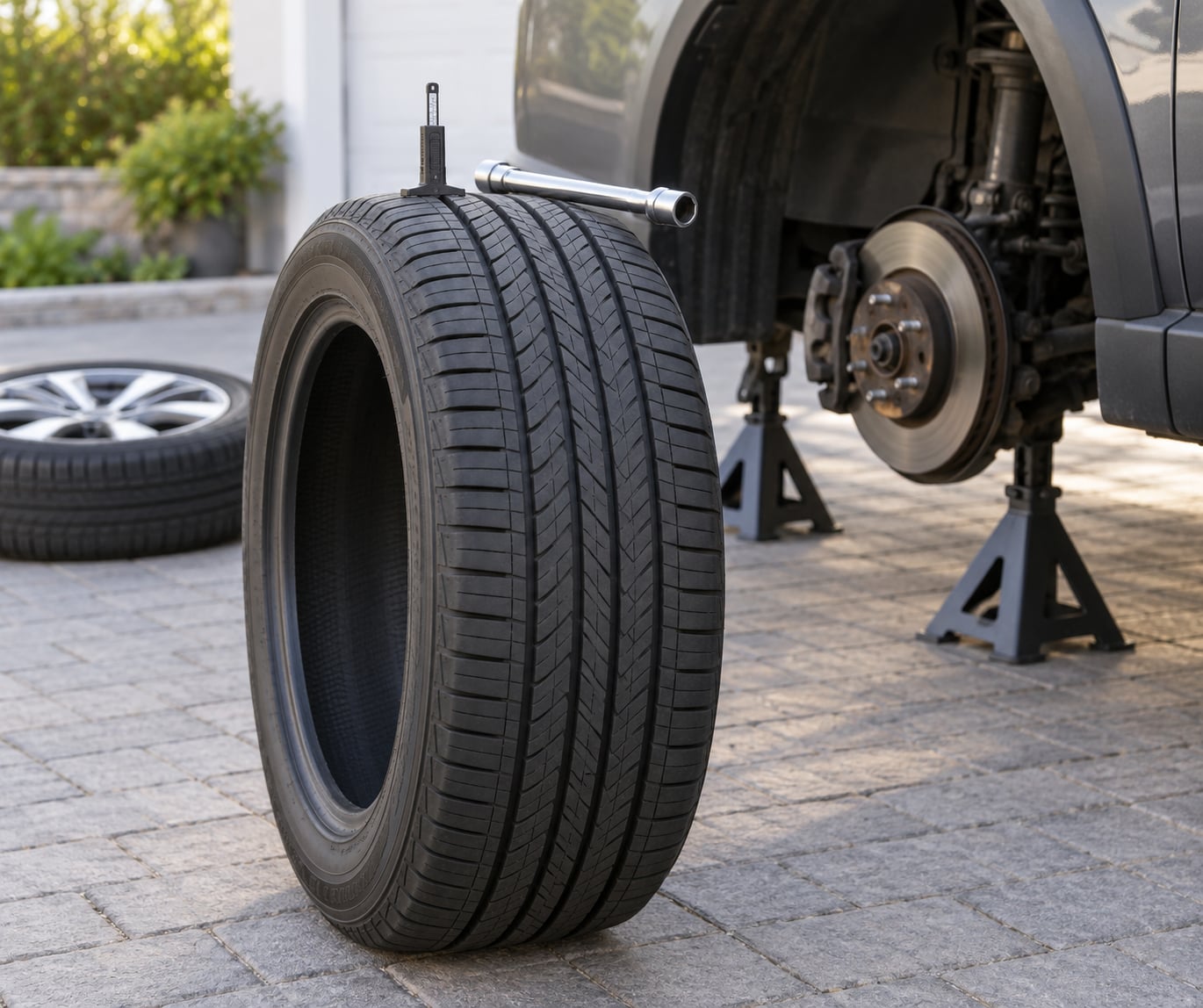
- Gather tools. A hydraulic floor jack or a good lug wrench, four jack stands rated above your vehicle weight, a torque wrench, a tire pressure gauge, and the wheel lock key if your vehicle uses one.
- Work on level, hard ground. Set the parking brake, leave the vehicle in gear or in Park, and block a wheel so the car cannot roll.
- Loosen before lifting. Break the lug nuts half a turn while the wheel is still on the ground. If a nut will not budge, stop and figure out why rather than leaning on the wrench.
- Lift and stand the vehicle. Jack one side, set stands under the manufacturer-recommended points, lower the vehicle onto the stands, and give the body a firm shove before getting underneath it.
- Move each tire to its new position. Follow the approved pattern, and note where each tire came from so you can put the least worn tire back on the driven axle if the set is uneven.
- Check pressure as you go. Inflate to the placard cold pressure while the tire is off the car. The placard number beats the number molded into the tire sidewall.
- Reinstall and torque in a star pattern. Tighten in a crossing sequence so the wheel seats evenly, then finish with the torque wrench rather than by feel.
- Recheck cold pressure in three days. Wheels can lose a pound or two and settle differently after being re-torqued.
- Walk around the car. Confirm all four are on, nothing is left under a tire, and the tread wear looks similar from side to side.
Skip the DIY job if the car sits low, the rims are large and heavy, or a lug stud is corroded and barely turning. A shop has the lift and the torque wrench, and the labor is small next to a ruined stud or a bent wheel.
When Should You Rotate Tires More Often?
Shorten your interval when any of these describe your driving or your car right now.
- Heavy city driving. Stop-and-go traffic works the front tires far harder than steady highway miles.
- Towing or carrying heavy loads. The extra mass loads the rear on a pickup and the front on a trailer combination.
- Off-road or rough-surface driving. Sidewall and shoulder wear show up long before the center blocks change.
- Aggressive cornering and braking. Track days and mountain roads eat the outer shoulder of a tire.
- Uneven wear you can already see. One tire visibly shallower than its partner means the interval no longer matters; something else is going on.
- Repeated pressure loss. If a tire keeps losing air between top-offs, rotate it to see whether the position, not the tire, is the problem.
- A worn shock, strut or alignment setting. Rotating does not correct any of these, and it hides them for a while.
That last point is worth stating plainly: if the front tires have a smooth inner edge and a ragged outer edge, or vice versa, the cause is mechanical. Take the car for an alignment check before paying for another rotation.
Do You Need to Balance or Align Tires During Rotation?
No, those are three different services, and mixing them up is how people end up paying for work they did not need.
A rotation moves tires between positions. Balancing corrects the weight distribution inside a tire and wheel so it spins smoothly, and it fixes vibration at highway speed, a steering wheel shimmy, or a dip in the road that feels like a rumble. Ask for it when a tire is replaced or when a wheel has been off the car and scuffed.
Alignment adjusts the angles the wheels sit at, and it fixes a car that pulls to one side, wanders, or wears one edge of a tire. Rotating those tires will spread the wear but will not stop the cause.
Shop staff disagree on whether every rotation needs a rebalance, and it is reasonable to ask why a specific tire is being balanced. If the tire came off, the wheel was hit, or you feel a vibration, it makes sense. If nothing changed, you can usually skip it.
How Do Tire Pressure and Tread Depth Affect Rotation Timing?
Pressure first, because it is the cheapest thing to check and it changes how a tire wears. A tire that runs low on a loaded axle develops shoulder wear, and one that runs high wears a hard center band. Set cold pressures to the number on the driver’s door placard, not the sidewall maximum, and check all five including the spare once a month.
Then look at the tread. Most passenger tires carry a set of narrow bars molded into the grooves, known as wear indicators. When the tread wears level with those bars, the tire is finished, whether the rest of the block still looks deep. Replacing a set of tires needs new tires before then, but the legal minimum in most places is only 2/32 inch, which is well past the point where wet braking suffers.
A common shop rule compares the new tire against the worn tire and replaces them once the depth difference passes about a third, commonly called the 3 percent rule. A looser version of that idea, sometimes called the seven-seven rule, compares seven evenly worn tires against one with more than seven thirty-seconds of an inch of difference left. Both are heuristics, and both assume the tire can be saved at all.
Stop and replace rather than rotate if you see cracks across the tread, bulges or a bubble on the sidewall, exposed steel cord, a patch or plug on the tread area, or a bead that no longer seats. None of those improve by moving the tire to another corner of the car.
If you have never rotated your tires and you bought the car used with no service history, start with a full inspection: measure all four, compare the pairs, and let an alignment check decide whether rotation is even the right first move.
Frequently Asked Questions
Should you rotate tires at every oil change?
Rotating at every oil change is a fine habit for most drivers, and it is how many people keep track of the interval at all. The 5,000 to 8,000 mile rule usually lands there naturally, since most oil change intervals fall in that range. Rotate sooner if you tow, drive in heavy city traffic, or own an all-wheel-drive vehicle, which typically needs a shorter interval. Nothing bad happens if you rotate more often than required.
Do all-wheel-drive and four-wheel-drive tires need rotating?
Yes. All-wheel-drive and four-wheel-drive vehicles generally need the shortest rotation interval, around 3,000 to 5,000 miles, because a locked or near-locked drivetrain forces the front and rear tires to work against each other when they wear at different rates. That mismatch shows up as uneven wear and extra strain on the drivetrain. Use the X-pattern rotation so all four tires see both an axle and a side.
What happens if you rotate directional tires wrong?
Directional tires are designed to roll one way, in the direction of the arrow on the sidewall. Crossing them or mounting them backwards puts the tread blocks facing the wrong direction, which cuts wet-weather grip and braking traction and increases tread noise. On a set where all four are directional, rotate front to rear on the same side instead of crossing. Never mix directional and non-directional tires on the same axle.
What is the 3 percent rule for tires?
The 3 percent rule compares the depth of the new tire with the depth of the oldest tire on the axle. When the difference between them reaches roughly one thirty-second of an inch, the shop recommends replacing the pair rather than rotating them. The reasoning is that once one tire is near the end, moving the newer one back and forth just moves the problem around. Check the owner’s manual, since some manufacturers set their own limit.
Is it worth paying for a tire rotation?
For most drivers, yes, because it lets you keep four tires until the shallowest one is worn out instead of replacing a pair early, and many treadwear warranties ask for documented rotations. Rotation is often included free when you buy tires from a dealer, big-box retailer or independent shop. Low-mileage drivers on a near-new set can safely stretch the interval, but check for uneven wear before assuming there is nothing to gain.
Key Takeaways
Start tonight, in your driveway, with three things. Open the owner’s manual and find the rotation interval and approved pattern for your model. Then walk around the car and look at all four tires for uneven wear, cracking or bulges, and set the cold pressures to the number on the driver’s door placard.
With that done, schedule the rotation at the manufacturer’s recommended mileage, or sooner if the wear does not look even. Most people land somewhere between 5,000 and 8,000 miles, and all-wheel-drive, four-wheel-drive, performance and towing setups land closer to 3,000 to 5,000.
Keep rotating them twice a year even when the miles are low, because time and weather age tires that are sitting still, and because the owner’s manual is the version of this advice that actually applies to your car. This guide was checked against current manufacturer guidance in 2026, but your manual always has the final say.