Airlines decide to overbook flights by forecasting how many ticketed passengers will actually turn up for a specific departure, then opening a few more tickets than the aircraft has seats. The extra margin, called the overbooking allowance, is sized from decades of no-show history for that route, that day of the week and that season. If more people show up than there are seats, the airline first asks for volunteers, then selects who gets bumped using a ranking algorithm nobody outside the airline publishes.
This guide breaks that decision into the parts you can actually check against: the forecast inputs, the aircraft and crew limits, the fare math, the gate process, and the compensation rules that follow. Figures are current as of October 2026.
Table of Contents
- Why Do Airlines Overbook Flights?
- How Airlines Decide to Overbook Flights in One Formula
- How Do Airlines Forecast Passenger Demand?
- What Role Do No-Show Rates Play?
- How Do Aircraft, Routes, and Crews Affect the Decision?
- How Fare Types and Revenue Expectations Change the Math
- Why Do Airlines Overbook Flights? The Main Factors at a Glance
- What Happens If More Passengers Show Up Than Seats?
- What Rights Do Passengers Have When a Flight Is Overbooked?
- Common Misconceptions About Airline Overbooking
- Overbooking does not mean the plane is full
- Every empty seat is a mistake, and every full flight is proof the system works
- Bumping is random
- A confirmed ticket guarantees a seat on that flight
- Volunteering is always a bad deal
- Frequently Asked Questions
- Do airlines really overbook flights on purpose?
- How much does an airline usually overbook a flight?
- Why does an airline overbook a flight even when the plane looks full?
- Can an airline deny boarding if I have a confirmed ticket?
- How are passengers selected when a flight is overbooked?
- Is airline compensation different when boarding is voluntary?
- What To Do First If You Are At Risk Of Being Bumped
Why Do Airlines Overbook Flights?
Because an empty seat earns nothing, and an airline margin is thin enough that empty seats hurt. A seat sold in advance and flown pays for the fuel, the crew and the aircraft that flew it. A seat that stays open is a cost with no revenue attached, and it cannot be sold once the doors close.
Passenger forecasts are never exact, so some fraction of every flight is booked and never boarded. Airlines call that the no-show rate: the share of ticketed passengers who never appear. When that rate is predictable, it is cheaper to sell past capacity than to fly with holes in the cabin.
Two terms explain the rest. Load factor is the share of available seats actually occupied on a flight. Spilled seats are sold seats that go unfilled because nobody bought them, and every spill is revenue the airline knows it gave away. Overbooking is the trade: accept a small risk of bumping in order to shrink spills.
Three more reasons sit behind the decision. Business travelers book and rebook constantly, so a meeting that ends early or a flight that gets delayed leaves a confirmed ticket unused. Connecting itineraries amplify the same effect, since one delayed inbound leg can strand a passenger who never reaches the gate. And demand on popular routes overshoots the forecast more often than it falls short, so the allowance leans toward a bump rather than a spill.
How Airlines Decide to Overbook Flights in One Formula
The logic reduces to a simple comparison that a revenue management system runs for every flight, every day, at several points before departure. The carrier estimates the number of passengers who will actually show, weighs the cost of bumping one of them against the value of the extra ticket, and sets a booking limit above the seat count.
A carrier willing to bump one passenger to sell one more ticket can push the booking limit to about 105% of seats on a route with a 5% no-show rate. The same carrier would open far less extra inventory on a short-haul shuttle with a 2% no-show rate, where the extra seat is likely to go unsold.
How Do Airlines Forecast Passenger Demand?
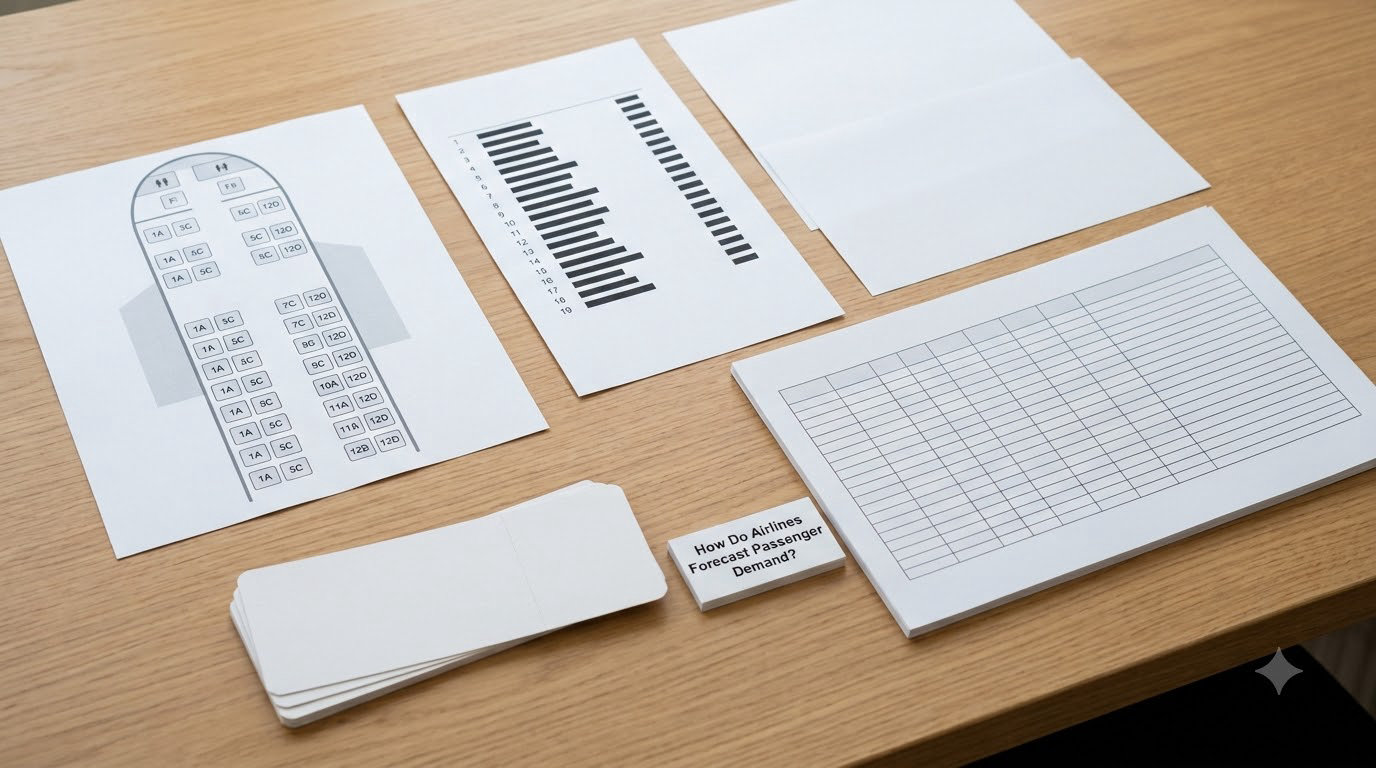
The forecast is rebuilt continuously rather than set once. A passenger forecast team at a large carrier maintains historical records going back decades and re-estimates the flight as the departure date approaches, so a route that looked 90% full in March can be forecast as oversold by July.
Seven inputs matter most:
- Historical no-show rates by route, broken out by length of haul, because a three-hour hop and an overnight transatlantic behave nothing alike.
- Day of week and season, since a Monday morning business route and a Friday evening leisure route fill and no-show on completely different curves.
- Current booking pace, meaning how reservations compare to the same point on the booking curve for that flight in comparable weeks.
- Fare class mix, where a cabin full of flexible tickets behaves differently from a cabin full of restricted ones.
- Event calendars, covering conventions, sporting events, holidays and school breaks. A convention city gets an adjusted forecast rather than the usual baseline.
- Weather and operational conditions, because a forecast of storms or a hub-wide delay cuts the expected arrival rate sharply.
- Connection banks, since a delayed inbound wave means passengers booked on later flights may never reach the gate to claim their seats.
An illustrative example makes the arithmetic concrete. Take a 180-seat aircraft on a route forecasting an 8% no-show rate: 180 multiplied by 0.92 gives about 166 expected show-ups, so the airline might set a booking limit near 185, adding a buffer of roughly 5 seats. If 186 passengers show up, the airline is short six seats and needs six volunteers or six involuntary removals.
That forecast is an estimate, not a promise. Forecast error margin is the whole game: an allowance sized too small shows up as an empty row, and one sized too large shows up as a customer at the gate being told the flight is full.
What Role Do No-Show Rates Play?
The no-show estimate is the anchor. Airlines build it from route-specific history rather than a company-wide average, so the same carrier can forecast 5% no-shows on one pair of cities and 12% on another.
Behavior drives those differences. Corporate contracts produce travelers who cancel late and rebook, often buying several seats for one trip. Leisure travelers holding a confirmed seat and a hotel reservation usually show up, so their no-show rate runs lower even when the fare is higher. Flexible fares are easier to cancel before a no-show charge applies, which pushes their absence rate up. The most restrictive fare class tends to show up most reliably of all.
Carriers combine the two halves of the model: a forecast of total demand and a forecast of how much of that demand fails to materialise. Subtracting the second from the first gives the expected number of bodies on the aircraft, and everything the airline opens for sale above that number is a calculated bet.
How Do Aircraft, Routes, and Crews Affect the Decision?
The seat count is the ceiling, but it is rarely the only constraint. A plane configured with nine-abreast economy rows carries fewer passengers than one with ten, and the extra seats are often premium rows that sell out early.
Route economics shape the allowance more than most travelers expect. A long-haul flight costs hours of crew time and large amounts of fuel, so an empty cabin seat is expensive enough to justify a generous buffer. A short regional hop costs less to operate, so the airline may run tighter and rely on the next departure to absorb a bumped passenger.
Turnaround pressure cuts the same way. When an aircraft has a tight connection window or a crew duty limit, rebooking a bumped passenger onto a later flight can break the schedule entirely. Gate agents know this, so flights with few onward options usually attract volunteers more reluctantly.
Crew availability and aircraft substitution can rewrite the plan on the day. A maintenance swap to a smaller plane, a jet assigned elsewhere, or a schedule irregularity at the hub can shrink usable capacity after the booking limit was set weeks earlier.
Connecting passengers add a second, less obvious variable. If a whole inbound wave is running late, passengers connecting through the hub will not be in the airport at boarding time, so the airline may hold back on bumping anyone whose onward segment depends on the same day.
Weight and balance limits work independently of overbooking. A fuller aircraft with heavy baggage or many passengers needing aisle seats can exceed limits on what the crew can safely accommodate, and a seat may be given up for that reason rather than because the flight is oversold. Passengers on forums describe this happening on flights that were already overbooked, which makes it hard to diagnose from the gate.
How Fare Types and Revenue Expectations Change the Math
Overbooking is not simply selling one extra ticket and hoping. The revenue management system behind it prices every seat against what that seat could earn instead, so the decision changes as the flight fills.
A flight that sells out early shifts into a different mode. Instead of protecting against empty seats, the system starts weighing a cheap extra sale against the risk of bumping a passenger who paid far more. That is why an airline may quietly accept a bumped passenger near the end of the booking curve rather than fill the last seat.
Booking classes also act as self-selection into risk. Passengers who buy the most flexible fares tend to hold confirmed seats that go unused more often, and passengers on restricted fares tend to show up, which lets the airline set a higher limit on a cabin full of restricted tickets.
Two things follow for travelers. A cheap ticket carries more bump risk than a flexible one bought direct from the airline, not because the price is lower but because of how that product was designed to behave. And a passenger holding a through-ticket on a full itinerary is harder for the airline to remove than a local passenger with a single segment.
Why Do Airlines Overbook Flights? The Main Factors at a Glance
| Factor | What the airline estimates | Effect on the booking limit |
|---|---|---|
| Forecast demand | Reservations booked for the flight at each point before departure | Sets the baseline the limit is measured against |
| No-show rate | Historical share of ticketed passengers who do not appear, by route, day and season | The main source of the extra tickets opened above capacity |
| Aircraft capacity | Installed seats after configuration changes and same-day swaps | The hard ceiling the limit is calculated from |
| Route economics | Operating cost of flying the sector and the value of a later departure | Tight schedules and costly sectors usually run tighter |
| Fare mix | Distribution across booking classes and how flexible each one is | Restrictive fares support a higher limit than flexible ones |
| Operational constraints | Weather, hub delay waves, connection banks, crew and weight limits | Can cut the effective limit hours before departure |
What Happens If More Passengers Show Up Than Seats?
The process runs in a fixed order, and it starts well before the gate agent speaks to you. First the airline works its standby list. Passengers who booked a clearable seat are cleared into any inventory that opened up through cancellations, and those seats come off the oversold count before anyone else is considered.
Next comes volunteer solicitation at the gate. The agent explains that the flight is oversold and asks for volunteers to take a later flight in exchange for compensation. Reported offers in recent years have ranged from a few hundred US dollars to well over a thousand, and the amounts vary widely by carrier, route and how hard the agent is working to fill the flight.
Why do first offers run low? Because the gate agent wants volunteers, not a crowd. The first number announced is usually a test of the room, and it is expected to be refused. Each round of refusals raises the pressure on everyone still seated, which is a familiar pattern from travelers on flight forums describing exactly how it played out at their gate.
If nobody volunteers, the airline moves to involuntary denied boarding. Passengers are ranked and the lowest-ranked are removed, and compensation follows the rules of the country the flight departs from. Rebooking to the next available flight, a refund, and sometimes meals or a hotel come into play depending on how long the delay runs and whether onward connections were missed.
That fallback is also where the stated reason and the real reason diverge. Gate staff and airline websites often cite unacceptable service or a booking error, terms too vague to contest, while passengers on r/travel and r/frontierairlines describe being told very little at all. No airline publishes the ranking formula, so the selection is effectively unappealable on the spot.
What Rights Do Passengers Have When a Flight Is Overbooked?
Rights depend on where the flight departs from and where it lands, and they also depend on the ticket contract. A reservation is generally for a journey on a flight, not for a specific seat on a specific aircraft, which is why holding a confirmed ticket is not the same as holding a guaranteed seat.
For flights departing from the United States, the Department of Transportation sets the compensation tiers. A voluntarily bumped passenger has agreed to give up the seat, and the terms offered decide what they receive. An involuntarily bumped passenger on a domestic flight is entitled to a percentage of the one-way fare, with the amount depending on the arrival delay.
| Situation | US rule | Cap in US dollars |
|---|---|---|
| Voluntary bump, passenger agrees to rebook later | Whatever the airline offers, usually travel credit | Varies by carrier |
| Involuntary bump, arrival delay under 1 hour | 200% of the one-way fare | 775 |
| Involuntary bump, arrival delay 1 to 4 hours | 200% of the one-way fare | 775 |
| Involuntary bump, arrival delay over 4 hours | 400% of the one-way fare | 1,550 |
Those figures cover US-departing itineraries. A flight departing from the European Union falls under Regulation 261/2004, commonly called EU261, which sets its own compensation amounts based on distance and delay, and which applies regardless of the nationality of the passenger. Travellers booked through third-party sites should note that the airline, not the booking site, is the party to claim against, a point that comes up repeatedly in advice forums.
In both systems the passenger is also entitled to rerouting on the next available flight or a refund of the unused ticket, and meals or lodging apply in defined circumstances, particularly overnight misconnects. Rules change and differ by jurisdiction, so treat these figures as a starting point rather than a final answer.
Denied boarding is also not the only source of removal. If the cause was weight and balance or a safety limitation rather than oversales, the compensation framework can be entirely different. Passengers who suspect that distinction should ask for the written reason before accepting any voucher.
Common Misconceptions About Airline Overbooking
Overbooking does not mean the plane is full
An overbooked flight may still board with empty seats, because more passengers cancelled than expected or an earlier flight arrived full of standby passengers. Roughly 316,000 passengers were denied boarding by the largest US carriers in 2024, and global reporting in 2025 put the worldwide figure at about 6.6 million a year, which sounds enormous until you set it against billions of passengers carried.
Every empty seat is a mistake, and every full flight is proof the system works
Neither holds. Spilled seats and bumps are two sides of the same bet, and the carrier is trading one against the other. A low load factor on a costly route is a much bigger problem than a denied boarding, which is why the allowance is set per flight rather than applied uniformly across a network.
Bumping is random
It is not random, but the criteria airlines publish rarely match the ranking algorithm underneath. Gate staff describe removals using generic phrases such as unacceptable service, while the system that actually ranked passengers weighs fare paid, check-in timing, boarding priority, elite status and itinerary complexity. Passengers report on forums that early check-in, a through-ticket and elite status all seem to matter, and nobody outside the airline can confirm the weights.
A confirmed ticket guarantees a seat on that flight
It does not. It guarantees carriage on the journey under the conditions of the fare you bought, which is a different promise. That distinction is the legal foundation underneath the entire overbooking system.
Volunteering is always a bad deal
Sometimes it clearly is, since a voluntary bump typically yields travel credit with expiry restrictions while an involuntary bump is paid in cash. But a passenger with a tight onward connection, an unaccompanied minor, or a fare that cannot be changed may be the wrong choice at the gate, and the first offer is rarely the last.
Frequently Asked Questions
Do airlines really overbook flights on purpose?
Yes. Carriers run a forecast for each departure that estimates how many ticketed passengers will show up, using decades of historical no-show data by route, day of week and season. Because that estimate is never exact, they open a booking limit slightly above the physical seat count. The gap between the two is a deliberate, calculated allowance, not an accident.
How much does an airline usually overbook a flight?
Typically a few percentage points above capacity, and much higher on routes with a strong no-show history. A carrier might open about 105% of seats on a 5% no-show route, or 115% where the rate is higher. Long-haul and low-cost short-haul flights often run the widest allowances, while tight-turnaround shuttle routes usually run tighter.
Why does an airline overbook a flight even when the plane looks full?
Because the plane does not fill to the last row. Load factors on many routes sit in the eighties and nineties rather than at one hundred percent, and the airline expects a slice of confirmed passengers to cancel or fail to show. That expected empty inventory is exactly what overbooking is designed to fill before departure.
Can an airline deny boarding if I have a confirmed ticket?
In most jurisdictions, yes. A confirmed reservation is for the journey, not for a specific seat on a specific flight, so a carrier can deny boarding when more passengers appear than seats. If the denial is involuntary and the flight departs from the United States, compensation of 200% or 400% of the one-way fare generally applies, subject to caps.
How are passengers selected when a flight is overbooked?
The airline asks for volunteers first, offering compensation to leave on a later flight. If too few step forward, it selects passengers involuntarily, using internal ranking factors that typically include fare paid, check-in and boarding order, elite status, and the complexity of the onward itinerary. No carrier publishes the formula or its weights, which is why the stated reason rarely matches the real one.
Is airline compensation different when boarding is voluntary?
Yes, substantially. A voluntary bump is a deal the passenger accepts, so the compensation is whatever the airline offers at the gate, most often travel credit with expiry and blackout restrictions. An involuntary bump is governed by law and carries a defined cash or payment order plus rerouting or a refund, with different amounts under US rules and under EU261.
What To Do First If You Are At Risk Of Being Bumped
Check in as soon as the airline allows, book direct rather than through a third-party site, and avoid itineraries that depend on a tight same-day connection. If the flight does oversell, be at the gate early and listen to the solicitation, because the compensation on offer rises every round someone refuses.
Know the rules before you need them. For US departures, the 200% and 400% tiers with their 775 and 1,550 US dollar caps are worth having in your head, and an EU-departing flight follows EU261 instead. Whatever happens, ask for the reason in writing before you sign anything, and remember that involuntary payments and voluntary vouchers are not the same deal.