What Global Entry does that TSA PreCheck does not is narrower than most people expect: it adds expedited customs and immigration processing when you come back into the United States, plus use of your membership card at participating land and sea ports of entry. Everything TSA PreCheck does at a U.S. departure airport, Global Entry already includes at no extra charge.
That single fact settles most of the argument. You are not choosing between two programs. You are choosing between a domestic-only screening pass and a superset that carries the same screening benefit plus a customs lane.
So the question “what does Global Entry add” has a short honest answer, and everything past it is detail: which airports participate, what a Known Traveler Number actually does, who is allowed to apply, how long membership lasts, and what none of these programs can do for you.
Table of Contents
- What Global Entry Does That TSA PreCheck Does Not at a Glance
- What Global Entry Does That TSA PreCheck Does Not in Practice
- Global Entry vs. TSA PreCheck: Airport Screening Coverage
- Why your boarding pass does not show TSA PreCheck even though you have Global Entry
- International Screening Benefits
- Eligibility and Enrollment
- Fees, Refunds, and Membership Validity
- Can a credit card statement credit cover the enrollment fee?
- Children and Traveling Families
- Global Entry Alternatives and Other Trusted Traveler Programs
- Which Program Should You Choose?
- Frequently Asked Questions
- Does Global Entry include everything TSA PreCheck offers?
- Can TSA PreCheck members enter the United States faster abroad?
- Does Global Entry replace a visa or determine whether I can travel?
- Can my family use one Global Entry membership?
- Is Global Entry worth the cost for someone who only flies within the United States?
- Conclusion
What Global Entry Does That TSA PreCheck Does Not at a Glance
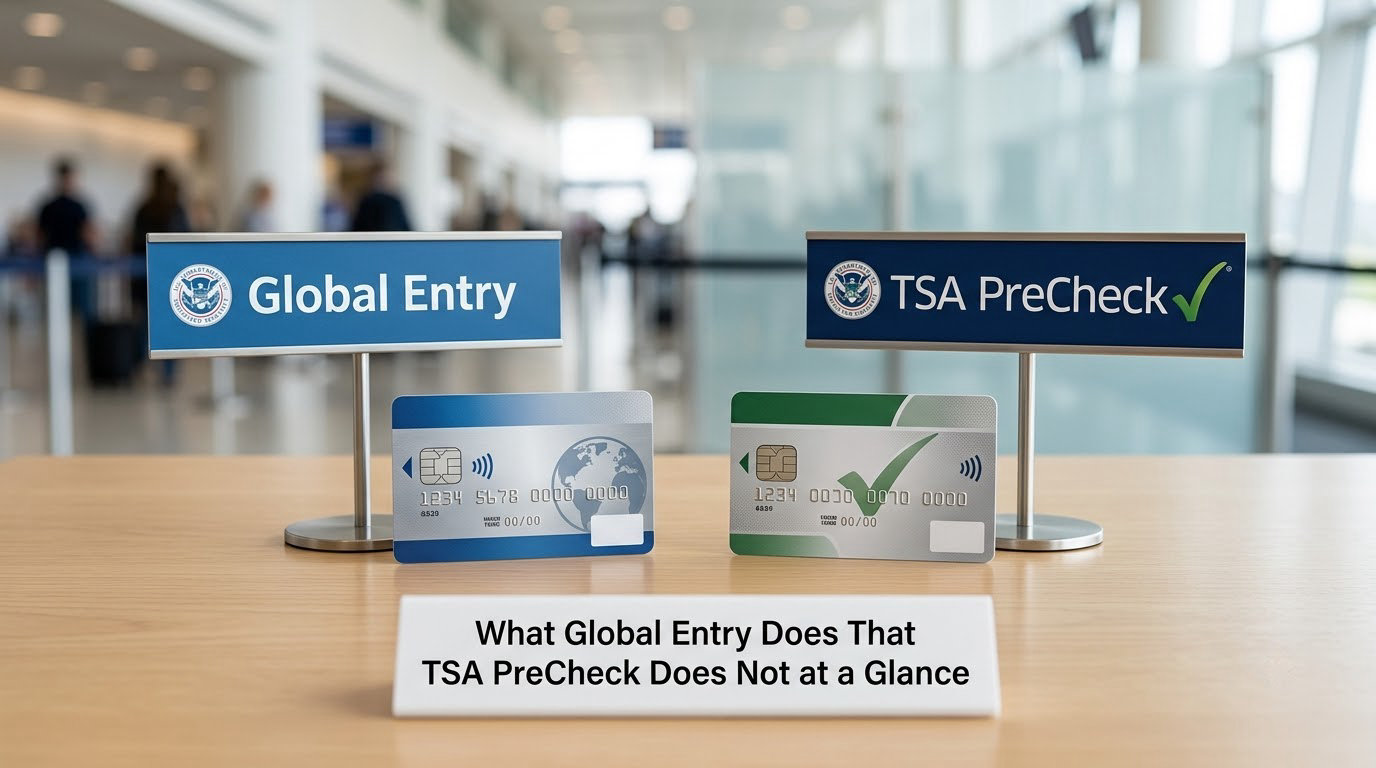
The table below sets the two side by side. The single most important row is the third one: Global Entry membership already covers your domestic departure screening, so there is no scenario in which you need both.
| Criterion | Global Entry | TSA PreCheck |
|---|---|---|
| Run by | U.S. Customs and Border Protection (CBP) | Transportation Security Administration (TSA) |
| What it speeds up | Departure security plus customs and immigration on return | Departure security only |
| TSA PreCheck lane access | Included at no extra charge | That is the entire program |
| Expedited re-entry after international travel | Yes, at participating U.S. ports of entry | No |
| U.S. land and sea ports of entry | Yes, card is RFID and usable at participating crossings | No |
| Fee level | Higher five-year government fee | Lower five-year government fee, cheaper to renew |
| Membership length | Five years | Five years |
| Children | Each traveler needs their own application and fee | Each traveler needs their own enrollment; children 12 to 14 may be interviewed with a parent |
| Best for | Anyone crossing the U.S. border by air, land or sea more than once a year | Domestic flyers who never leave U.S. territory |
Fee amounts are set by the government and change from time to time, so check the official CBP and TSA program pages before you apply rather than trusting a number you read in a forum thread.
What Global Entry Does That TSA PreCheck Does Not in Practice

TSA PreCheck operates on the departure side of a U.S. airport. You enter a shorter lane, keep your shoes on, keep your laptop in your bag, and usually walk through a standard metal detector instead of a body scanner. It ends when you board.
Global Entry adds a second lane on the return side. When you fly back into the United States and the airport is a participating port of entry, you can use a kiosk that reads your passport and takes a photo, then walk through an expedited lane instead of standing in the general immigration queue. Some airports pair this with a CBP officer taking your customs declaration at the same point rather than at a separate desk.
Here is the part people confuse most often. Global Entry does not let you board a flight you were not allowed to board, does not substitute for a visa or an electronic travel authorization, and does not decide whether you may enter a country. If you need permission to enter somewhere, you get that permission separately, and a membership card does not change it.
Nor does it speed up security in countries other than the United States. At a departure airport in Mexico City or Toronto, you are in the local queue with everyone else. The benefit only exists where the program actually operates, which is why the same membership can feel transformative for one traveler and invisible to another.
Global Entry vs. TSA PreCheck: Airport Screening Coverage
For the security lane at a U.S. departure airport, the two memberships are equivalent. A Global Entry member who enters their Known Traveler Number, or KTN, is treated as a PreCheck member and routed to the same lane.
Do not expect every airport to behave identically. Participation varies by airport, and some airports handle PreCheck members in a shared lane rather than a dedicated one. Airport staffing, construction and time of day all change how the lanes run, so a Global Entry member can still end up walking through the standard queue without that meaning anything is wrong with the membership.
Why your boarding pass does not show TSA PreCheck even though you have Global Entry
This is the single most common complaint in the Global Entry communities, and it is almost always a data problem rather than a membership problem. Work through this list in order.
- Confirm your nine-digit Known Traveler Number is correct and still active in your CBP Trusted Traveler account.
- Enter the KTN into your airline profile, then re-check a fresh reservation. Profile edits do not always push to bookings already made.
- Look for a separate Trusted Traveler number field on the booking. Some airline sites ask for it separately from the frequent flyer profile, and skipping it is the usual culprit.
- Re-check in online the day before departure. Airlines repopulate the indicator late, and boarding passes often update without needing a new reservation.
- Compare against another Global Entry member on the same flight. If theirs shows the indicator and yours does not, it is your booking data, not your membership.
- Contact the airline with your KTN in hand and ask them to confirm the value stored against the ticket.
One reassurance worth repeating: you do not need the physical card to use the PreCheck lane. The number in your airline record is what the checkpoint reads. The card exists for land and sea crossings and for identity confirmation at interview.
International Screening Benefits
A returning U.S. citizen lands at a participating airport after ten hours in the air. In the general lane they wait behind a long queue, fill a paper or digital customs declaration, and get processed one traveler at a time. With Global Entry they use the kiosk, which captures the passport details and a photo, then move to the expedited CBP lane and a customs officer who takes the declaration on the spot.
That is the practical difference. It is a real time saving on busy international arrivals, and it is most noticeable at large hubs where the general queue spills past the terminal windows.
An eligible Canadian citizen traveling with a Canadian passport can apply and uses the same kiosk experience on entry to the United States by air, land or sea at participating crossings. What the membership does not do is carry across the border in the other direction. Canada does not run a Global Entry-equivalent arrival benefit, so if you cross into Canada often, NEXUS is the program built for that.
Two limits to keep straight. Expedited processing is not a guarantee of zero waits; volumes, staffing and equipment outages still apply. And admission is never guaranteed. A CBP officer still makes the admissibility decision, and membership only changes the queue you stand in while that happens.
Eligibility and Enrollment
Global Entry has narrower eligibility than TSA PreCheck. TSA PreCheck admits U.S. citizens, lawful permanent residents and citizens of participating countries broadly. Global Entry admits U.S. citizens, U.S. lawful permanent residents, and citizens or permanent residents of certain partner countries who apply with a qualifying passport.
For non-U.S. citizens, the application asks about citizenship outside the United States and, where the system requires it, a Canadian passport number. Applicants from countries without a partner agreement generally cannot enroll in Global Entry and should look at the alternatives below.
The enrollment sequence itself is straightforward, with one step that catches people out because they assume approval is automatic.
- Apply online through the official CBP Trusted Traveler program site during an enrollment period, paying the government fee.
- Receive conditional approval by email. This is not a membership yet.
- Schedule an in-person enrollment interview at a CBP center, which is usually at or near an international airport.
- Attend the interview, where staff verify your identity, documents and fingerprints.
- Receive your Known Traveler Number and membership card, then add the KTN to your airline profile.
Interview availability is the bottleneck. Appointment calendars at busy hubs can stretch out for months, which is why members in the forums commonly advise starting early or using Enrollment on Arrival, where CBP can add an eligible future international traveler to the program at a participating airport during re-entry. That shortcut is open only to travelers who are already in the country returning through a qualifying port, so it helps next year’s trip more than this month’s.
Fees, Refunds, and Membership Validity
Both memberships run five years and both fees are government charges that can change. Treat the figures below as a comparison of size and structure, not a quote, and verify the current amount on the official CBP and TSA pages before you apply.
| Fee point | Global Entry | TSA PreCheck |
|---|---|---|
| Five-year fee | Higher, set by CBP | Lower, set by TSA |
| Renewal fee | Payable online without a new interview in most cases | Payable online, lower than the first enrollment |
| Children under 12 | Fee still applies per applicant | No fee, but an enrollment appointment is still needed |
| Ages 12 to 14 | Apply as a minor with a parent or guardian present | May be interviewed with a parent or guardian |
| Ages 75 and over | No fee exemption advertised for this program | Fee exemption may apply; confirm current rules on the TSA site |
| Refunds | Limited; conditional approval alone does not create a refundable enrollment | Limited; check current policy before paying |
Because the difference is spread across five years, per-year cost is the fairer way to compare. Roughly speaking, TSA PreCheck works out near the price of a monthly streaming subscription and Global Entry somewhat above that. If you fly internationally only once every two years, the added five-year cost may never pay for itself in saved time.
Can a credit card statement credit cover the enrollment fee?
Often, yes. Several premium cards reimburse Trusted Traveler enrollment fees as a statement credit, and because those credits are reimbursement rather than a reward, they are not treated as taxable income the way a points bonus would be. Card benefit terms change more often than government fees do, so confirm the current benefit and its annual fee threshold on your card’s benefits page before applying specifically to trigger it.
Children and Traveling Families
Every traveler needs their own membership. There is no family plan that covers children the way a car seat or a loyalty account might, and each child needs a separate application and their own KTN.
For TSA PreCheck, children 12 to 14 can be enrolled with a parent or guardian present, and children under 12 are exempt from the fee while still needing an appointment. For Global Entry, every applicant including infants is processed individually, and the fee applies to each one.
On documents: a child cannot simply use a parent’s card or the parent’s KTN. Each child travels with their own passport and, for the screening lane, their own number in the airline record. The practical tip from experienced family travelers is to add every family member’s KTN to each adult’s booking profile before you check in, since the airline pulls from the traveler record rather than from the reservation.
Traveling internationally with young children is where the customs benefit earns its keep. Arriving with a tired six-year-old in a general immigration queue at the end of a long trip is a very different experience from the kiosk lane, and families mention that difference more than the security side.
Global Entry Alternatives and Other Trusted Traveler Programs
Global Entry is one of several Trusted Traveler programs, and each covers a different border.
- NEXUS covers both the United States and Canada for air, land and sea, and includes a fast lane for Canadian departures as well. It is the sensible pick if you cross the U.S.-Canada border regularly.
- SENTRI serves frequent travelers of the U.S.-Mexico border, with enrollment handled by CBP on a walk-in basis.
- FAST is a faster, more expensive, invitation-only Trusted Traveler option for people who re-enter the United States very often.
- TSA PreCheck remains the right answer for travelers who only need departure screening.
- Mobile Passport Control is a free CBP app used at participating airports and cruise ports after a customs declaration, and it needs no membership at all.
- CLEAR is a private service that adds an identity-verified lane at participating airports. It costs more, it is not international, and members in the forums point out that it can be slower outside peak hours.
Which Program Should You Choose?
Pick TSA PreCheck if you fly domestically and have no plans to cross a U.S. border in the next five years. It delivers the whole benefit at the lower five-year cost and the shorter enrollment wait.
Pick Global Entry if you return to the United States from abroad, by air or by land, once or twice a year or more. The customs lane is the reason to pay more, and it compounds across every arrival.
Pick NEXUS if your travel is concentrated between the United States and Canada. It covers both directions of that border, which Global Entry does not.
If you cross a border once a year, do the math honestly first. One faster arrival may not cover the added five-year cost, and a refunded fee through a card benefit changes the arithmetic. If fee sensitivity matters and international re-entry is rare, TSA PreCheck plus the free Mobile Passport Control app covers most of the ground for less.
Already holding Global Entry? Do not let it lapse. Renewal is normally online, while a full reapplication after expiration means a new interview and a new wait, and members who have gone through that report it is the part nobody enjoys.
Frequently Asked Questions
Does Global Entry include everything TSA PreCheck offers?
Yes. Global Entry membership includes TSA PreCheck benefits at no additional cost, so your departure security screening works the same way. If your airline record carries your Known Traveler Number, you are routed to the PreCheck lane just like a standalone member. That is why buying both programs separately is usually wasted money, and why a boarding pass missing the PreCheck indicator is a booking data problem rather than a membership gap.
Can TSA PreCheck members enter the United States faster abroad?
No. TSA PreCheck only affects security screening at U.S. departure airports and does nothing at a foreign airport or a U.S. port of entry. Faster arrival processing in the United States requires a program run by U.S. Customs and Border Protection, such as Global Entry or NEXUS. Even then, expedited processing means a shorter queue, not a guaranteed minimum time, and officers still make every admissibility decision.
Does Global Entry replace a visa or determine whether I can travel?
Not at all. Global Entry is a trusted traveler membership, not a travel document. You still need a valid passport, any required visa, and any electronic travel authorization for your destination. Membership also does not guarantee entry anywhere, in the United States or abroad. It changes which queue you use at participating ports and nothing about your right or permission to travel.
Can my family use one Global Entry membership?
Each traveler needs their own membership, including children. There is no family rate that covers several people under one application, and every applicant pays the government fee separately. Each family member also needs their own Known Traveler Number entered into their own airline record, and each child travels with their own passport. Children under 12 are fee-exempt for TSA PreCheck enrollment, but Global Entry charges for each applicant.
Is Global Entry worth the cost for someone who only flies within the United States?
Usually not. If you never cross a U.S. border, the customs and immigration benefit never applies, and TSA PreCheck gives you the identical departure screening for a lower five-year fee. Cases worth making are trips to Canada or Mexico, cruise ports, or any plan to cross a border in the next five years. Check whether a statement credit on a card you already hold reimburses the fee before deciding.
Conclusion
Start with the one fact that resolves the question: TSA PreCheck is bundled inside Global Entry at no extra cost, so Global Entry gives you every domestic screening benefit plus two more, expedited customs and immigration processing on return to the United States and use of an RFID card at participating land and sea ports.
Stay with TSA PreCheck if you only fly domestic. Move to Global Entry when you cross a U.S. border regularly, and consider NEXUS instead if that border is with Canada.
Before you apply, confirm the current fee and eligibility rules on the official CBP and TSA program pages. Government charges change, and those pages are the only reliable source.