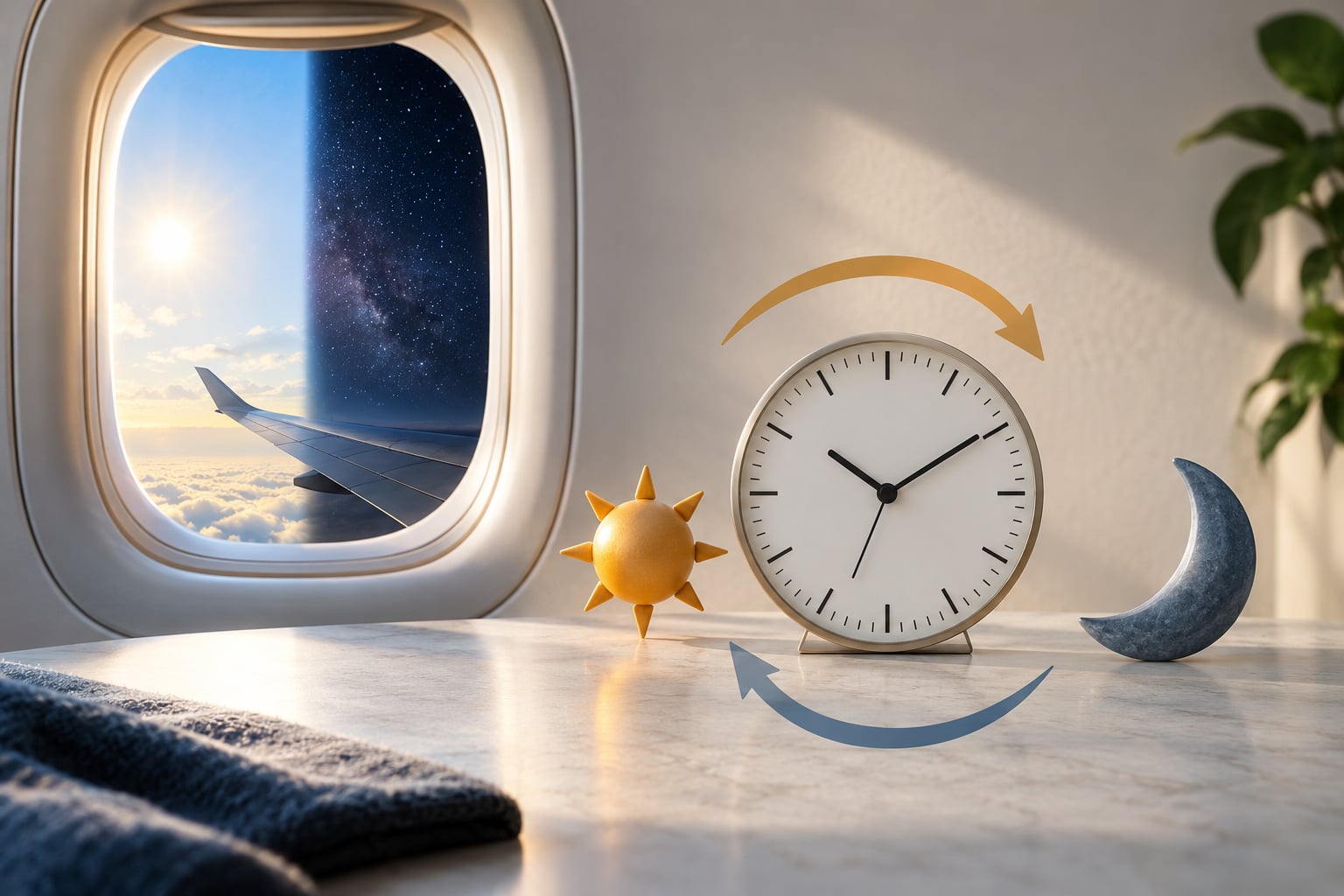
Jet lag happens because your internal clock stays set to home time while the sun, meals and social schedule around you have already moved. To understand how jet lag works and how to beat it, the whole thing reduces to one lever: light. Get bright light at the right hour and the clock shifts quickly. Get it at the wrong hour and you push the adjustment in exactly the wrong direction.
Most travellers adjust within about a day per time zone crossed, and the second or third day is usually the roughest. Everything below is built around that one fact, so you can decide what to do before you fly, on the plane, and after you land.
Table of Contents
- What Is Jet Lag and Why Does It Happen?
- How Jet Lag Works in Your Body
- Jet Lag by Direction: Eastward vs. Westward Travel
- How Long Does Jet Lag Last?
- How to Beat Jet Lag: A Practical Plan
- How to Adjust Before You Travel
- What to Do During the Flight
- How to Reset Your Body Clock at Your Destination
- Does Melatonin Help With Jet Lag?
- Tips for People Traveling With Children
- When to Seek Medical Advice
- Frequently Asked Questions
- Can you really beat jet lag before a flight?
- Can jet lag last for several days after returning home?
- Should I stay awake until my destination bedtime?
- Is daylight the fastest way to adjust to a new time zone?
- Can food and hydration cure jet lag?
- What symptoms are not normal jet lag?
- What to Do First
What Is Jet Lag and Why Does It Happen?
Jet lag is a temporary sleep disorder caused by travelling across time zones faster than your body can follow. Your circadian rhythm, a roughly 24-hour internal cycle, stays anchored to home. The local clock has not.
Travel fatigue is different. That is the dullness of a night flight, a cramped seat and no proper sleep. It fades with a normal night’s rest. Jet lag does not, because the cause is a mismatch between clocks rather than a lack of sleep itself.
You need a sleep schedule, appetite and clear thinking at hours your body considers the middle of the night. That is why jet lag is more than tiredness. It is a scheduling error running through your whole day.
How Jet Lag Works in Your Body

The master clock is a small group of nerve cells called the suprachiasmatic nucleus, sitting in the middle of the brain. Its main input is light. Specialised cells in your retina, separate from the ones that let you see, detect daylight and report it directly to that clock.
When the clock reads daylight, it suppresses melatonin, the hormone that makes you sleepy, and supports cortisol, the hormone that helps you wake. When it reads darkness, the pattern reverses. Those two signals then shape sleep pressure, body temperature, digestion and alertness.
Think of it as a dial that drifts slightly past 24 hours each day when it gets no correction. Fly east and you need that dial to jump forward, which is hard. Fly west and it only has to slip back, which it does comfortably. The second half of how jet lag works is timing: the wrong light at the wrong hour lands you in the wrong part of the curve.
One specific quirk catches nearly everyone. In the middle of your new night, around 3 to 4 in the morning local time, your body temperature drops and the clock becomes less responsive to light. You wake up alert, not rested, and the light then streaming through the curtains reinforces the wrong time. That window is where a lot of people give up on the first night.
Jet Lag by Direction: Eastward vs. Westward Travel
Eastward travel asks for a phase advance. Westward travel asks for a phase delay, and phase delays come far more easily. Human rhythms lengthen with light in the evening and shorten with light in the morning, so evenings bend more than mornings.
| What changes | Flying east | Flying west |
|---|---|---|
| Shift type | Phase advance, body clock moves earlier | Phase delay, body clock moves later |
| Light on arrival | Seek it in the morning, block it in the evening | Block it in the morning, moderate it in the evening |
| Pre-flight shift | Earlier wake time, brighter mornings | Later wake time, dimmer mornings |
| Evening melatonin use | Timed earlier in the destination evening | Timed later, closer to local bedtime |
| Typical difficulty | Harder, roughly 1 day per zone | Easier, often a little less per zone |
If you fly from Los Angeles to London, your body wants to wake at 6 a.m. while the street outside is still dark. If you fly London to Los Angeles, you want to fall asleep at 11 p.m. while it is broad daylight, and you probably will not.
How Long Does Jet Lag Last?
A common rule is one day of adjustment per time zone crossed. Cross three zones and budget three days. Cross nine and you are looking at a week of feeling off, even though your energy may return earlier than your sleep does.
| Time zones crossed | Rough days to feel mostly normal | Rough days for stable sleep |
|---|---|---|
| 1 to 2 | Same day | 1 to 2 days |
| 3 to 5 | 2 to 3 days | 3 to 5 days |
| 6 to 9 | 4 to 6 days | 6 to 9 days |
| 10 or more | 1 week or more | Up to 2 weeks |
Sleep usually lags behind alertness. You can feel roughly human on day three and still wake at 4 a.m. until day six.
Length of trip changes the maths completely. For anything under 48 hours, most experienced travellers advise living on home time and adapting on the way back. Resetting for a weekend costs more than it gives.
Ordinary jet lag builds gradually and eases as your clock catches up. An illness that hits suddenly with fever, or that does not improve across several days, is a different thing.
How to Beat Jet Lag: A Practical Plan
This is the short version. Work through it in order rather than all at once.
- Shift your sleep and meal times by 30 to 60 minutes a day for several days before departure, in the direction you are travelling.
- On arrival eastbound, get outside within an hour of waking and keep curtains open all morning.
- Protect your first night. Stay awake until local bedtime, even if that feels punishing.
- Cap any nap at 20 to 30 minutes and keep it before 3 p.m. local time.
- Eat on local time and stop caffeine roughly eight hours before you want to sleep.
- Set your watch to destination time the moment you land and treat it as the truth.
If you only do one of these, do number two. Morning light does more for adjustment than anything else you can buy or drink.
How to Adjust Before You Travel
Start three to five days out. Move your wake time earlier by 30 to 60 minutes each day if you are going east, and later by the same amount if you are going west. Keep your wake time fixed even when the evening was bad. A steady wake time does more for the clock than an ideal bedtime.
Match light to the direction. Going east, get outside early and dim your evenings. Going west, keep mornings dim with heavy curtains and seek light later in the day.
Shift meals in the same direction, earlier for east, later for west. A travellers forum rule of thumb that works well is to skip caffeine and alcohol the day before departure. Both blur the signals you are trying to sharpen.
What to Do During the Flight
Set your watch to destination time on board and live in it for the whole flight. Sleep when destination time says sleep, even if that means sleeping through a meal service.
An eye mask and earplugs block more light than most people expect. A neck support stops the small movements that keep you half awake. Keep the cabin cool rather than warm.
On hydration, be sensible rather than religious. Aircraft cabins are dry, so drink water through the flight, mostly to avoid a headache. But over-drinking on a long route is unpleasant and unhelpful, and dehydration is not what causes jet lag.
Coffee is a tool, not a habit. Have it early in the flight if your destination morning is ahead of you. Avoid it in the last two hours before a destination-night sleep.
Alcohol is the most common mistake. It helps you fall asleep and then pulls you out of deep sleep several hours later, so you wake up tired with a disrupted clock. Skip it in flight.
How to Reset Your Body Clock at Your Destination
Day one is about light and staying awake. Do not sleep in, even after a red-eye. Eat breakfast at a local cafe, walk for twenty minutes, and keep the morning bright.
Day two is the hard one. Your body clock is now fully committed to the old time, which is why so many travellers report feeling worse on day two than day one. The 3 a.m. waking usually shows up here. If you are awake, keep the room dim and boring. Do not eat a large meal and do not scroll.
Day three is where it usually breaks. Sleep starts stretching, appetite returns, and the fog lifts. Protect the night before it, because a short nap late on day three can push you back a full day.
Two habits matter most here. Eat meals at local times, and use an alarm on your phone for breakfast, lunch and your target bedtime. It works as an external time cue, which is exactly what your clock is missing.
If you travel east, be stricter about morning light and about staying up. If you travel west, the opposite: block early light and use the late evening to stay awake a little longer.
Does Melatonin Help With Jet Lag?
Mainstream guidance accepts that melatonin can help, mostly because it gives the clock a clear signal about when night begins. The evidence supports it as a timing aid rather than a cure. Nothing you swallow shifts your clock as fast as the right hour of daylight.
Direction matters. When travelling east you want the signal earlier in your destination evening. When travelling west you want it later, closer to your local bedtime. Getting this wrong works against you.
A few honest caveats. Melatonin is sold as a supplement in some countries and requires a prescription in others, including the UK and France. Product strength varies widely between brands, so check the label rather than trusting the front of the pack. It can also cause grogginess, headache and vivid dreams.
This is general information, not a dosing plan. Melatonin interacts with some medicines, including blood thinners and diabetes drugs, and it is not a good fit for pregnancy. Ask a pharmacist or doctor what suits you before adding it to a long-haul routine.
Sleeping pills are a different category and a poor choice. They suppress REM sleep and interact badly with alcohol. A light therapy lamp is the better-tolerated option when you cannot reliably get morning sun.
Tips for People Traveling With Children
Adult rules do not transfer cleanly. A child told to stay awake until local bedtime at five years old simply cannot, and forcing it produces a worse night for everyone.
Keep naps short and early, keep bedtime anchored to local time even if the day was long, and offer familiar foods. A toddler who will only eat pasta at 6 p.m. is better served by a predictable dinner hour than by a new meal schedule.
Use daylight as the main tool, because it is the one thing that works on everyone without negotiation. Stroller walks after lunch and again before dinner do more than any schedule chart.
Expect slower adjustment. Children often wake very early for the first few days, which drags the adults into the same problem, so protect their sleep as much as you can.
When to Seek Medical Advice
Ordinary jet lag is uncomfortable but recognisable. Get medical help if symptoms are unusual for you, and seek urgent care for confusion, chest pain, difficulty breathing, a severe headache that does not settle, or weakness and numbness on one side of the body.
Fever, chills or a rash appearing after travel also deserve a clinician rather than a sleep diagnosis. So does jet lag that is not improving after two weeks, or insomnia that continues long after you are home.
If you take regular medication, ask your doctor before travelling, especially across many zones or for long periods. And if you are driving on arrival, give yourself a recovery day. Fatigue at the wheel is not jet lag you can push through.
Frequently Asked Questions
Can you really beat jet lag before a flight?
Partly. In the three to five days before departure you can shift your wake time, meals and light exposure by 30 to 60 minutes a day in your direction of travel. That gives your clock a head start, so the adjustment after landing is shorter rather than instant. It cannot remove the shift entirely, but going east it noticeably reduces how hard the first two days feel.
Can jet lag last for several days after returning home?
Yes, and it is more common coming back than going out. Your body spent the trip adapting to destination light, and now it has to shift again in the reverse direction. Sleep is usually the last thing to settle. Budget roughly a day per time zone crossed before your nights are reliably normal again.
Should I stay awake until my destination bedtime?
On arrival, yes. Staying awake until local bedtime is the single most useful habit because it anchors the first real night sleep to the new clock. Napping is fine if you are desperate, but keep it under 30 minutes and finish before 3 p.m. local. A long afternoon nap is what turns one bad night into three.
Is daylight the fastest way to adjust to a new time zone?
Daylight is the strongest and fastest signal your body clock has. Within an hour of waking, go outside for 20 to 30 minutes rather than sitting behind a window, and keep the room bright through the morning. On arrival travelling east this matters most, because you are asking the clock to move forward, which it resists.
Can food and hydration cure jet lag?
Neither one, and the hydration claim is widely overstated. Eating on local times genuinely helps because meal timing is a real time cue for the clock. Water prevents the headache that comes with dry cabins and long flights. But dehydration is not the cause of jet lag, and drinking more than you need will not reset anything.
What symptoms are not normal jet lag?
Seek help for confusion, chest pain, difficulty breathing, a severe unremitting headache, weakness or numbness on one side, or vision changes. Fever, chills or a rash after travel are not jet lag either. Ordinary jet lag builds gradually and eases; anything sudden, severe or still present after two weeks needs a doctor.
What to Do First
Eastbound: go outside within an hour of waking on arrival and stay awake until local bedtime. Westbound: block early light with curtains and keep your evenings relaxed until bedtime.
Whichever way you fly, set your watch to destination time on the plane and treat every meal, nap and cup of coffee as a deliberate choice against the local clock. That plan is short enough to actually follow, and it is what turns a bad three days into a rough one.