How to lower your water bill at home comes down to four moves: find the water you are losing, stop the habits that waste it, replace the fixtures that pour it, and ask your utility what it will do to help. Most people can knock off a real chunk of their bill in one evening with a screwdriver, a dye tablet and three quiet nights of meter reading, and none of it needs a renovation.
The order matters. Fixing a toilet that has been quietly running for a month beats installing a low-flow showerhead, because a leak adds thousands of gallons you never see. Below is the diagnostic sequence I would follow, with the gallon figures for each step and the point where a plumber takes over.
Table of Contents
- What You Need
- Step-by-Step: How to Lower Your Water Bill at Home
- 1. Establish a Baseline
- 2. Find and Repair Water Leaks
- 3. Fix Dripping Faucets and Toilets
- 4. Reduce Showers, Baths, and Faucet Waste
- 5. Use Efficient Toilets, Showerheads, and Faucets
- 6. Use Washing Machines and Dishwashers Wisely
- 7. Limit Outdoor Water Use
- 8. Install Water-Saving Devices
- 9. Monitor Usage and Adjust
- Common Mistakes
- Frequently Asked Questions
- How much water should a family of four use per month?
- How do I find a hidden water leak?
- Are water-saving fixtures actually worth the cost?
- How much can a dripping faucet add to your water bill?
- When should I call a plumber or my water utility?
- Can I dispute a water bill that looks too high?
- Conclusion
What You Need
Gather these before you start, and the whole job goes faster.
- Three months of bills. You want the highest one, not the average one. A spike only shows up against history.
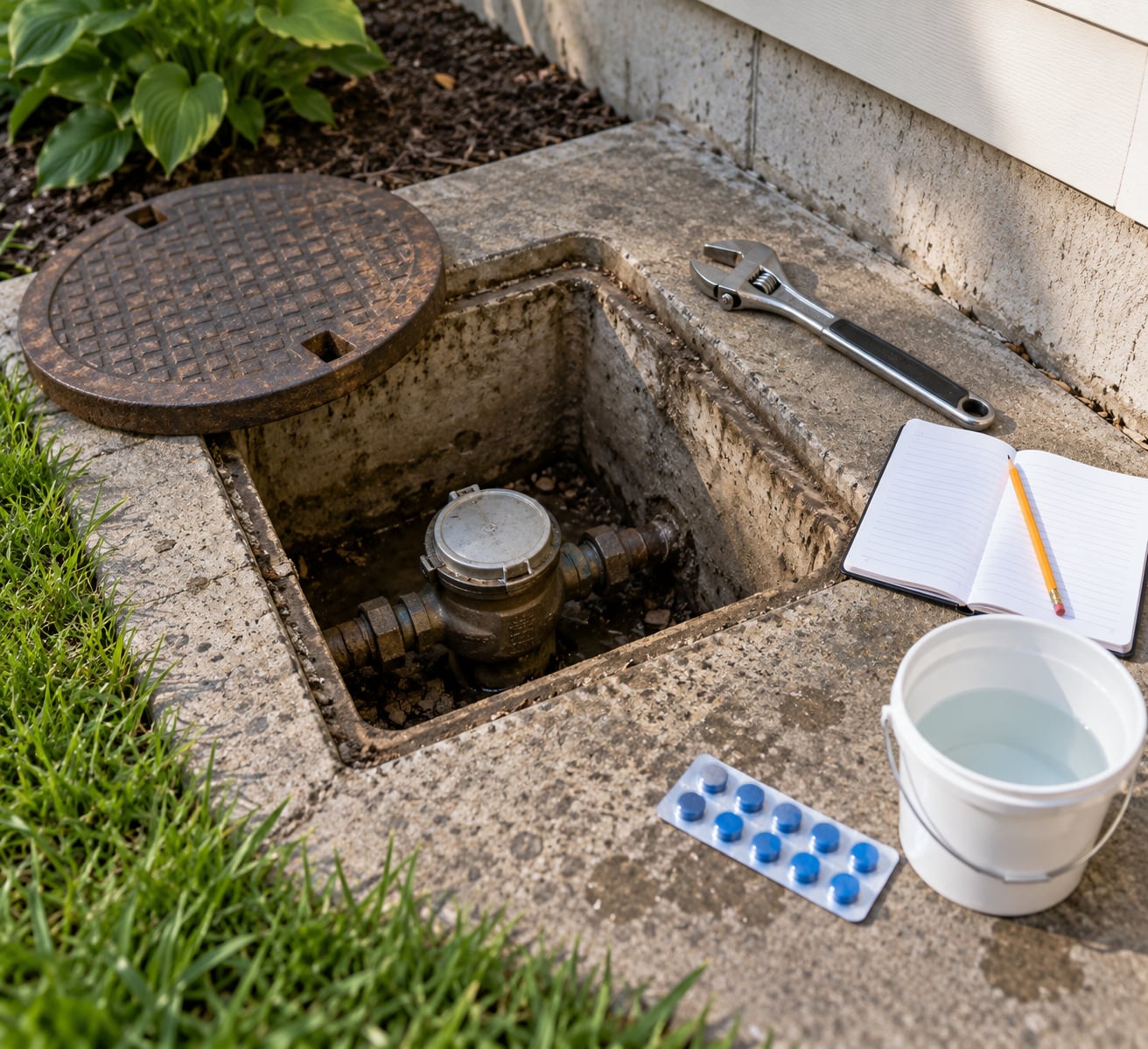
- The water meter. Usually in a basement, garage, crawlspace, or an outside box near the curb. If you cannot find it, your landlord or utility can tell you in one phone call whether the property is even metered.
- A calculator and a notebook. You will multiply small numbers by large ones, and you will want last month’s reading in front of you.
- An adjustable wrench, a screwdriver and a flathead. Enough to aerators, faucet washers, and a showerhead.
- Dye tablets or a bottle of food coloring. For the toilet test.
- A bucket and a stopwatch. For measuring shower and faucet flow.
Step-by-Step: How to Lower Your Water Bill at Home
1. Establish a Baseline
Read the meter now, write the number down, and read it again at the same time of day three days later. The difference, converted with the constant printed on the meter face, is your real daily use.
Then read the bill itself, because most people look at the total and miss where it goes. A residential bill usually has four moving parts, and only one of them responds to anything you do.
| Line item | What it means | Can you change it? |
|---|---|---|
| Fixed or base charge | The flat cost of being connected, covering service and part of the infrastructure | No. It stays on every bill you receive. |
| Water usage charge | Billed in blocks of 100 gallons or as measured gallons used | Yes. Leaks and habits move this number. |
| Sewer or wastewater charge | Often a percentage of your water volume, since most sewage is water you used | Indirectly, by using less water overall. |
| Tiered or conservation rate | The unit price rises once you pass a usage threshold | Yes. Staying below the threshold is worth real money. |
If your bill arrives as an estimate because nobody could read the meter, note that too. Estimated bills are the single most common reason a household believes it is leaking when it is not.
2. Find and Repair Water Leaks
A hidden leak is the reason most surprise bills happen, and you can narrow one down without calling anyone. Turn every fixture off, flush nothing, and watch the meter: if the dial keeps creeping with the house quiet, water is leaving somewhere you cannot see.
Start with toilets, because a bad flapper is the most common leak in a home and the easiest to miss. Drop a dye tablet in the tank, flush, and wait ten minutes. Color in the bowl with no flush means the flapper is passing water, and a running or hissing toilet alone can waste close to 200 gallons a day, or roughly 6,000 gallons a month.
After toilets, check faucets, then the shower drip, then the irrigation system and anything underground: the hose bibs, the irrigation valve box, the slab. Damp spots, warm patches on a floor in winter, or grass that stays green long after everything else has gone brown all point the same way.
Stop and call a licensed plumber if the meter moves with everything inside the house shut off, if you hear water running when nothing is running, if a toilet rocks or the bowl tilts, or if you find any sign of sewer gas. Those are supply-line or drainage problems, and they are not a screwdriver job.
3. Fix Dripping Faucets and Toilets
Most dripping faucets need one part, not a new fixture. Shut off the supply valves under the sink, remove the handle, and replace the worn rubber washer or the cartridge, following the manufacturer’s directions for your model. Budget ten minutes and a few dollars of parts.
For a running toilet, the flapper is the first thing to try. Shut the water off at the valve behind the bowl, flush it dry, and swap in a new flapper sized to your tank. If the flapper looks fine, the fill valve or the float is usually what is sticking.
Water hardness matters here in a real way: it eats rubber parts faster, which is why landlords who deal with hard municipal water put flappers on a routine maintenance checklist. Check every toilet in the house twice a year, since most households only notice the one they can hear.
4. Reduce Showers, Baths, and Faucet Waste
A shower running at 3 gallons per minute uses 36 gallons in twelve minutes. Timing yours once with a bucket tells you exactly what your household is paying for, and most people find out their shower is a good deal faster than they assumed.
The single highest-value habit is turning the tap off while you brush your teeth or shave. A bathroom tap left running while you do either one wastes more than most people use in a full dishwasher cycle. Washing hands in a basin rather than under a running tap saves the same water every time.
Baths are the other half of the bathroom problem. A bath for two adults can easily exceed 40 gallons, so if anyone in the house bathes daily, swapping in an eight-minute shower is the biggest routine change available. Nobody has to give up a bath to make the change; the household just does it a few times less.
5. Use Efficient Toilets, Showerheads, and Faucets
WaterSense labeled fixtures are the easiest upgrade with a real, measurable ceiling. A WaterSense toilet uses at most 1.28 gallons per flush against the 1.6 that older efficient models use, and high-efficiency models go down to 1.0 or less. A WaterSense showerhead moves 2.0 gallons per minute instead of the 2.5 most older heads were built for.
Before you replace anything, check what you already have. Put a bucket under the showerhead for ten seconds and multiply, or measure the old faucet at the sink the same way. If what you have is already close to the efficient number, you are shopping for nothing.
Swap the showerhead and sink aerators yourself, they are one thread each. Toilets are a different story: the bowl is heavy, the flange is waxed, and a mistake here shows up as water spreading under the floor. Unless you have done it before, pay a plumber for the toilet and keep the DIY for the cheap parts.
6. Use Washing Machines and Dishwashers Wisely
Laundry is the second-largest indoor use in most homes, and the waste is almost always in the way we run it. Run full loads only, match the cycle to the soil, skip the extra rinse unless the clothes are heavily soiled, and clean the lint filter on the dryer so the washer is not doing the dryer’s job.
The dishwasher is easy to get wrong in both directions. Modern machines use far less water than hand washing, so hand washing dishes under a running tap is usually the more wasteful choice. Use the eco or short cycle, clean the filter on a schedule, and stop pre-rinsing, since that rinse and the machine’s own cycle overlap.
If your washing machine is more than a decade old, its gallons per load may beat a new machine of any age. Compare the gallons-per-load figure before you buy, not the sticker price, because two machines that both wash a basket of laundry can differ by thousands of gallons a year.
7. Limit Outdoor Water Use
Outdoor use is where the biggest single savings live. Irrigation accounts for a large share of residential water in most regions, and where people report seasonal spikes on water bills, summer irrigation is almost always the reason.
Water early in the morning, when evaporation is lowest, and never at midday in full sun. Sweep driveways and sidewalks instead of hosing them. Put a cover on the pool, since evaporation is the main loss in a warm climate and a cover removes most of it.
Convert spray heads to drip irrigation where you can, and check the system each spring for heads pointing at pavement instead of plants. Rain barrels and cisterns work well and are legal in most places, though a few jurisdictions restrict them for flood reasons, so check your rules before building one.
8. Install Water-Saving Devices
These are the cheap items that work together. A faucet aerator caps a bathroom tap at about 1.0 to 1.5 gallons per minute for a few dollars and takes five minutes to install. A shower-flow restrictor fits inside an existing head and cuts it to a trickle on a vacation setting.
Smart leak detectors go under sinks, behind toilets and next to water heaters, and they shut off or alert you when the floor is wet. They cannot find a leak inside a wall, so they are a backstop rather than a diagnosis. Choose ones that do not require a monthly fee, or the cost quietly erases the savings.
Toilet tank displacement devices and refill bags reduce the volume in an older tank. Work with them carefully: any object in a tank must not float or block the flush valve, and if you are not confident, use a plumber. A blocked toilet is a much worse day than a high water bill.
9. Monitor Usage and Adjust
Do the baseline reading again after a month and compare it with the same period last year. The trend matters more than any single month, because ground frost and a hot spell can move a summer bill on their own.
A rough benchmark helps you tell whether your household is normal. A family of four using 70 to 90 gallons per person per day indoors is at or near the average, which puts a typical month somewhere around 8,400 to 10,800 gallons. Add whatever the yard and garden take in summer. Owners running irrigation will be far above that, and it is not a leak, it is a lawn.
Then use what your utility offers, because this is the part nearly everyone skips. Most utilities offer budget billing that spreads annual usage evenly across twelve months, leak adjustment credits that reduce or rebill charges after a leak you fixed, tiered conservation rates that reward staying under a threshold, rebates for efficient fixtures, hardship assistance, and free low-flow showerheads. Ask what is available in your area, and ask in writing so you have the terms.
If a bill looks wrong, dispute it in writing and keep everything: photos of the meter, the plumber’s invoice, the dates you shut the water off. Ask how the utility estimated your usage, whether the meter read is on file, and what documentation they require. Many utilities will adjust a genuine billing error, and none of them will find it unless you ask.
Common Mistakes
- Ignoring a small drip. One drip per second adds up to something in the neighborhood of 3,000 gallons a year. Correct it the day you notice it, and while you are there check the other taps.
- Pouring boiling water on a frozen pipe. Boiling water can crack porcelain and melt supply lines. The safe move is a hair dryer or a warm damp rag, and if the pipe is already split, call a plumber.
- Putting bricks or pebbles in the toilet tank. Displacement devices exist and are sized for it; a brick can shift, sit above the water line, or block the overflow. Buy the device instead of improvising.
- Using a tankless water heater to save water. It does not save water. A tankless unit changes how water is heated, not how much your family uses, and using one as a space heater wastes both water and energy.
- Trusting a leak detector to find a leak inside a wall. These devices catch wet floors and drips. Anything inside a structure or in the slab needs a meter-off test and, usually, a plumber.
- Adjusting the main shutoff valve yourself. Turning or replacing it can trigger a municipal shutoff notice or leave you unable to stop a flood. Leave the street-side valve to the utility.
- Waiting to call the utility because a bill looks high. Credits, leak adjustments and hardship programs have deadlines. A phone call costs nothing and the window is often short.
Frequently Asked Questions
How much water should a family of four use per month?
Indoor use for most US households runs about 70 to 90 gallons per person per day. A family of four using that range lands somewhere around 8,400 to 10,800 gallons a month indoors, before any irrigation. Add lawn, garden and pool use in summer and a normal household can climb well past that. If your number is far above it, start with the meter-off test before you start shopping.
How do I find a hidden water leak?
Turn off every fixture, flush nothing, and watch the meter. If it keeps moving, close the house’s main shutoff valve and check again. Movement with the house shut off means a supply line, irrigation line or slab leak, which is a plumber’s job. No movement at all with the house shut off but steady movement with it on points to a toilet, faucet or running appliance you can test yourself.
Are water-saving fixtures actually worth the cost?
Aerators and showerheads pay back in weeks because they cost very little and cut the two most-used fixtures in the house. Toilets cost more and depend on how much water your old model used. The check is simple: measure your current shower and faucet flow with a bucket, then measure your toilet’s gallons per flush on its spec sticker. Only replace what measures high.
How much can a dripping faucet add to your water bill?
A slow drip of one drop per second wastes roughly 3,000 gallons over a year, and a faucet running during a single daily use can waste several hundred gallons a month. The dollar figure depends entirely on your local rate, and rates vary enormously by region. The practical point is that it is a permanent addition to every bill until the washer or cartridge is replaced, which is a ten-minute fix.
When should I call a plumber or my water utility?
Call a plumber when the meter moves with the house shut off, when you hear water running with nothing running, when a toilet rocks, or when you find a wet slab or warm floor. Call the utility when the bill was estimated, when the meter read looks wrong, when you want a leak adjustment, or when you need the street-side valve shut. Utility staff cannot repair household plumbing, and plumbers cannot adjust your bill.
Can I dispute a water bill that looks too high?
Yes, and you should dispute it in writing. Ask how your usage was determined, whether a meter read is on file, and whether your utility offers a leak adjustment after a leak has been repaired. Keep the plumber’s invoice, dated meter photos and the date you shut the water off. Documented plumbing problems are routinely credited or rebilled, and estimated bills are the easiest ones to challenge.
Conclusion
Start where the water is actually going, not where the spending feels biggest. Read the meter, run the toilet dye test and the meter-off test, and fix anything that fails this week. That alone has fixed the bill for more households than any fixture upgrade.
Then change what you do daily, measure your fixtures before you replace them, and cut outdoor use where your region actually uses water. Once a month of new numbers is on the meter, call your utility and ask about budget billing, leak adjustments and conservation rates, because those programs are free to ask about and nobody will offer them to you unprompted.