
How travel insurance claims work in four moves: you notify the insurer, you document the loss and prove you paid for it, you submit the claim form with those documents, and an adjuster checks it against your policy wording before the insurer pays you, pays your provider, or issues a denial you can appeal. Because travel cover is indemnity-based, a claim only pays when you can prove the event happened, was unforeseen, and fell inside your coverage before the deadline ran out.
That last point is the one that surprises people. Travelers tend to assume a denial means the insurer disagreed with what happened. Far more often, the claim died because a document was missing, a deadline slipped, or nobody called the assistance line before treatment started. This guide walks through the whole journey, from the first phone call to a payment landing in your account.
One note before we start: this is general information, not advice about your specific policy. Terms, limits and regulators vary by country and state, and every policy is its own contract. When a claim is on the line, your insurer’s claims department is the authority, not a general article.
Table of Contents
- What Is a Travel Insurance Claim?
- What Coverage Do You Need to Check Before Filing?
- How Travel Insurance Claims Work Step by Step
- How to File a Travel Insurance Claim
- What Happens After the Insurer Receives Your Claim?
- What Evidence Should You Submit?
- How Long Does a Travel Insurance Claim Take?
- Why Would a Travel Insurance Claim Be Denied?
- How to Appeal a Denied Travel Insurance Claim
- Frequently Asked Questions
- Should I contact my travel insurer before receiving medical care?
- Can I use my travel insurance if I paid for the trip with a credit card?
- How long do I have to submit a travel insurance claim?
- What happens if my flight is delayed and my insurance covers additional expenses?
- Do I have to file a claim from the country where the problem happened?
- Can I submit a travel insurance claim after returning home?
- What to Do First
What Is a Travel Insurance Claim?
A travel insurance claim is a formal request for payment of a covered loss, submitted to the insurer that issued your policy. It works like any other property or health claim: you state what happened, attach proof, and the insurer measures the loss against the terms of the contract you bought.
The main coverage types answer for different situations, and each has its own documents and deadlines:
- Trip cancellation pays non-refundable costs when you cannot go at all, usually because of illness, a covered family emergency, a legal proceeding, or a weather or advisory event that qualifies.
- Trip interruption pays out when you have already left and cut the trip short, plus added costs like a one-way flight home.
- Emergency medical covers treatment abroad, including hospital stays, surgery and outpatient care, often capped by a per-policy limit you choose.
- Trip delay or interruption cover pays additional accommodation and meals when a flight is delayed, missed or cancelled, often after a set waiting period.
- Baggage reimburses lost, stolen or damaged personal effects, sometimes capped per item and per bag.
- Medical evacuation and repatriation pays to move you to a proper hospital or fly you home for treatment, and these costs can be very high in remote areas.
- 24/7 assistance is not itself a benefit, but the hotline that co-ordinates care, guarantees of payment and evacuation logistics.
What Coverage Do You Need to Check Before Filing?
Read the policy’s certificate of insurance and its exclusions before you fill in a single form. Insurers decide claims by matching facts to wording, and the wording is where your money is won or lost.
Look at five things. First, the coverage limit for your specific benefit, since a medical limit and a baggage limit are completely different numbers. Second, the deductible or excess, which is the part you always pay, and whether it is expressed in the destination’s currency rather than dollars. Third, the exclusions, especially government travel advisories, named storms, pre-existing conditions and anything the policy treats as foreseeable. Fourth, the documentation duties, which are conditions of coverage rather than suggestions. Fifth, the deadline, which usually runs from the event and differs by claim type.
Pre-existing conditions get their own rules. Most policies exclude conditions diagnosed or treated before the effective date unless you bought a waiver, and insurers often require that waiver within 14 to 21 days of the first deposit. Buying it later does nothing retroactively.
How Travel Insurance Claims Work Step by Step
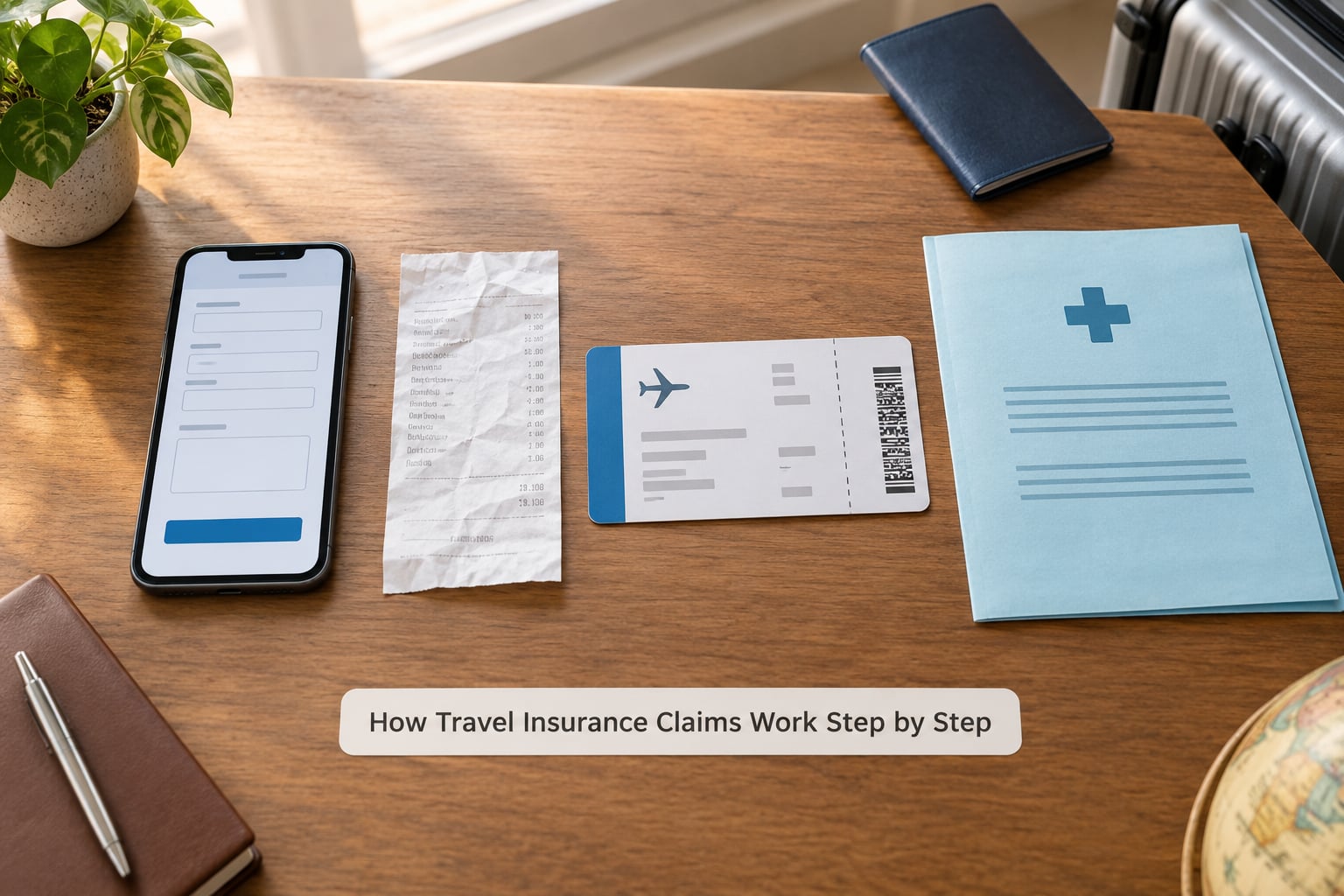
The process is the same for every claim type. Six steps, and the first three decide whether the last three are worth doing.
- Get safe and get authorized. If you need medical care, call the insurer’s 24/7 assistance line before treatment whenever you can. Hospitals in some countries will not accept a foreign insurance card and ask for cash or a card deposit, which is exactly when the guarantee of payment matters.
- Document the loss while you are there. Photograph receipts, tickets, medical paperwork and damaged or missing items. Forum consensus across travel boards is consistent on this: what you photograph on day one is what saves you in month three.
- Keep proof you paid. Credit card statements and bank debits are repeatedly cited by travelers who got reimbursed after the insurer pushed back on an initial submission.
- Notify the insurer in writing. Most policies require notice within a set window, commonly 24 to 48 hours for medical events, and some carriers set 30 to 60 days for other claims after you return. Cover-More, for example, publishes a 60-day window after the trip for the initial claim.
- Submit the claim form with attachments. Use the insurer’s portal, app, email address or claims address exactly as your policy specifies. A claim sent to the wrong channel can miss the filing date. Save the confirmation number and a screenshot of everything you uploaded.
- Answer follow-up questions fast. Adjusters regularly request medical records, a medical release form, an itemized bill or proof of travel. Silence is the most common reason a claim stalls.
How to File a Travel Insurance Claim
File through the channel named in your policy, not the one you find first on a search engine. Travel insurers route claims through either their own claims department or an assistance and assistance-adjacent administrator, and a claim sent to the wrong desk can sit unprocessed.
Describe the incident in plain chronological order. Insurers compare your account against medical records, airline records and travel advisories, and contradictions cost you time. Attach every supporting file in one submission rather than drip-feeding them, and keep a copy of everything for yourself.
Yes, you can file after you get home. Most claims are submitted weeks later, once itemized bills and physician notes are in hand. What you cannot do is file after the deadline has passed.
What Happens After the Insurer Receives Your Claim?
The period after submission is where most frustration builds, because the insurer is doing work you never see. Six things usually happen, in this order.
You get an acknowledgment with a claim number. That number is how you chase progress, and quoting it gets you a real answer instead of a general queue. Then a completeness review happens, where missing items are requested. That is why your claim goes quiet right after you submit it.
Next comes investigation. For a medical claim, the insurer may request records directly from the treating physician, which can take weeks and sometimes requires a signed medical release form. They may also check travel advisories and weather records to test whether the event was foreseeable, and confirm you were actually in the destination country using boarding passes, passport stamps or dated photos.
Then comes coordination of benefits. If you have health insurance at home, a provincial or national health plan, or a credit card policy, the insurer may pay first and seek recovery from them, or vice versa. This is normal and it does not reduce your payout, but it does explain a delay while they sort out who pays first.
One term worth learning is soft denial versus hard denial. A soft denial is a request for more information, and the claim can still be paid. A hard denial is a final refusal citing the policy wording. Knowing which one you have tells you whether to gather documents or start an appeal.
Finally you get the decision. Payment usually goes to you or, for medical claims, directly to the provider. Appeals and settlement times are covered below.
What Evidence Should You Submit?
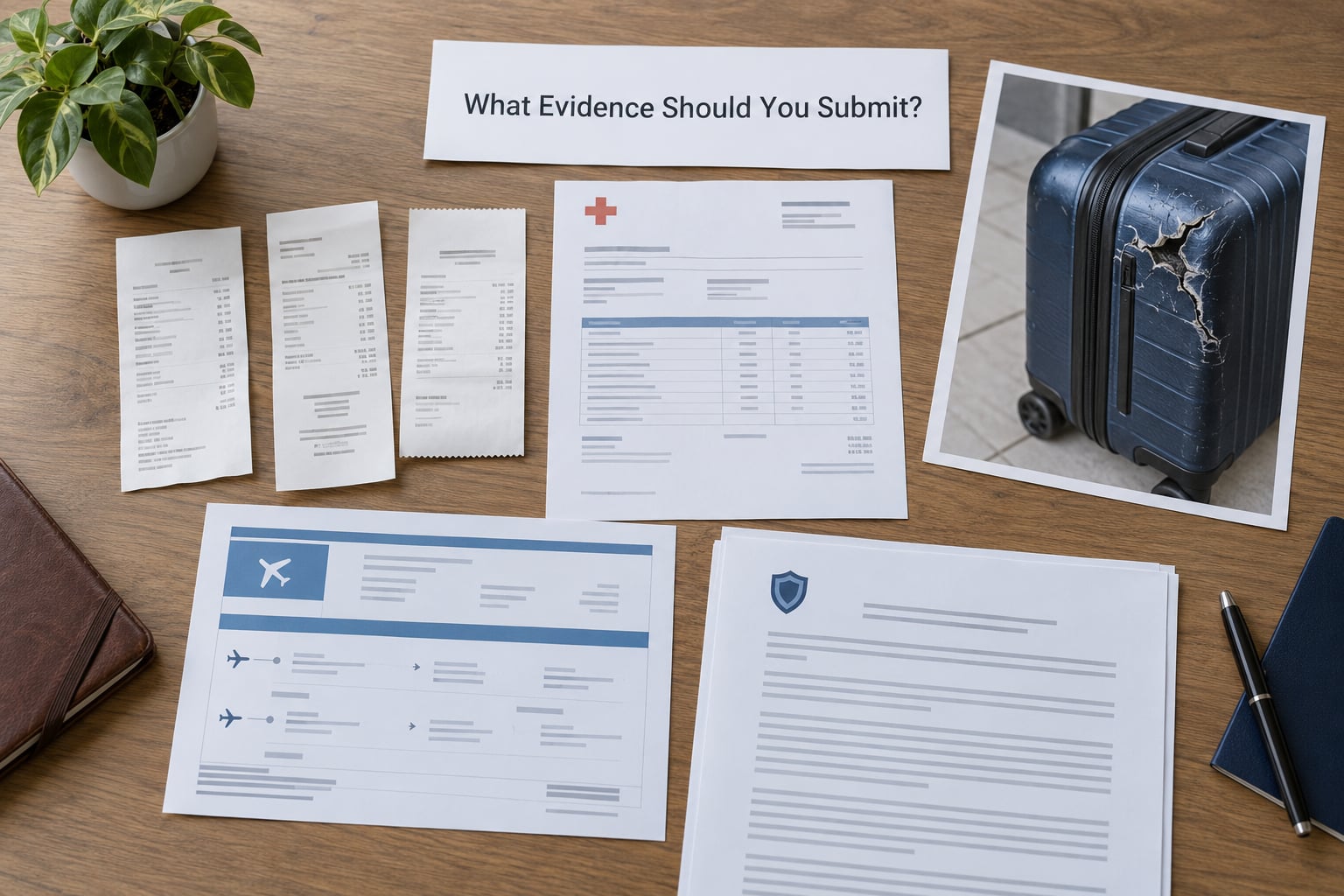
Insurance calls the core document a proof of loss: evidence that the event happened and what it cost you. Beyond that, each claim type needs its own set. Here is the checklist competitors rarely put in one table.
| Claim type | What to submit | Typical deadline |
|---|---|---|
| Trip cancellation | Claim form, cancellation notice, proof the reason (physician statement, death certificate, legal or court documents, employer letter), non-refundable receipts, credit card or bank proof of payment, travel advisory or storm documentation | Often 10 to 30 days from the event, varies by carrier |
| Trip interruption | Claim form, proof you had departed, the event causing the cut-short, receipts for unused bookings and added costs home | Usually 30 to 60 days |
| Emergency medical | Claim form, itemized bill, medical report or discharge summary, medical release form, proof of payment, passport or ID, proof of travel | Frequently 24 to 48 hours to notify, then 30 to 90 days for documents |
| Trip delay | Claim form, delay or cancellation notice from the airline, receipts for meals and hotel, boarding pass, explanation of the missed connection | Usually 30 to 90 days |
| Baggage | Claim form, itemised list with estimated values, police report for theft, proof of purchase or ownership, photos of damage or the bag contents | Usually 30 to 90 days |
| Evacuation or repatriation | Claim form, medical justification, invoices from the evacuation provider, the assistance log confirming authorization | Notify immediately; authorization often runs through the assistance line |
Getting an itemized bill from an overseas hospital after you have flown home is harder than it sounds. Ask the hospital’s billing office for the full itemized invoice, not the receipt summary, and request that it be emailed to you while you are still there. Follow up in writing before you leave the country, because chasing it from another time zone means paying for a courier or a records request.
Two more documents cause trouble. For theft, a police report is usually mandatory, and reporting it on the spot makes that realistic. For proof of travel, keep your boarding pass and passport stamp page, since travelers have had claims questioned simply because they could not show they were in the country.
How Long Does a Travel Insurance Claim Take?
A simple claim with complete documents is often settled in two to four weeks. A medical claim that requires records from a foreign hospital routinely takes six to ten weeks. Evacuations and disputed claims can run for months; several threads on travel insurance forums describe unresolved claims lasting months with a global assistance provider.
Separate acknowledgment from resolution. Getting a claim number is fast. Getting a decision is the part that takes time, and the insurer is usually waiting on a third party rather than on you.
You can move things along. Ask what is outstanding and who is holding the file. Provide everything in one request instead of trickle-feeding. Set a written reminder after about two weeks of silence. And if the claim has clearly stalled, use the escalation path below rather than waiting for a deadline to pass.
Why Would a Travel Insurance Claim Be Denied?
Squaremouth, a claims marketplace, puts the share of travel insurance claims denied because of simple errors such as missing paperwork or clerical mistakes at roughly 20 to 30 percent. USA Today has also reported a rise in denials among travellers. Most of that is avoidable.
- The event was excluded. Named storms, government advisories and foreseeable weather are common exclusions. The fix is to read the exclusion list before the event, not after.
- A pre-existing condition was declared. The insurer says the condition existed before the policy date. The fix is the waiver, bought inside the 14 to 21 day window, plus records showing when you were diagnosed and treated.
- Evidence is missing or thin. No itemized bill, no proof of payment, no police report. The fix is in your phone’s camera roll if you took photos.
- The deadline passed. Late notice or late documentation is a straightforward reason to refuse.
- Duplicate reimbursement. You were already refunded by the airline, the hotel or your home health plan. Policies reimburse net loss, so the fix is to declare other recoveries honestly.
- Treatment was not authorized or medically necessary. Skipping the assistance line for non-emergency procedures is a frequent problem.
- Procedural failure. Filing through the wrong channel, or not signing the medical release form, gives the insurer a clean reason to stop.
- Inaccurate description. Travel records and medical records contradict the account in the claim form.
How to Appeal a Denied Travel Insurance Claim
A denial is not always final. The escalation ladder runs from the insurer outward, and it works best when each step is specific and documented.
- Get the denial in writing. You need the stated reason and the policy section cited. A phone call that ends with no letters gives you nothing to argue against.
- Check the appeal deadline immediately. These are often 30 to 60 days from the denial letter, and missing it ends the process regardless of merit.
- Send a written appeal. Answer the stated reason point by point, quote the policy wording you rely on, attach the missing evidence, and attach new documents such as a treating physician statement. Keep it short and factual.
- Ask for an internal review by someone above the original adjuster, and request the claims advocate or ombudsperson the insurer provides for complaints.
- Escalate to your consumer regulator. In the US, that is your state Department of Insurance. Elsewhere, it is your national financial or insurance regulator, your banking ombudsman service, or the ombudsperson for long-term policies at your financial regulator.
- Consider legal steps last. For a large disputed medical or evacuation claim, a consumer lawyer or a travel insurance claims advocate may take the case on contingency.
Keep every letter and reference number from this stage. Regulators and ombudspersons ask for the full file.
Frequently Asked Questions
Should I contact my travel insurer before receiving medical care?
Yes, whenever the situation is not a true emergency. Calling the 24/7 assistance line before non-emergency treatment lets the insurer authorize the procedure, arrange a guarantee of payment and steer you to a provider that will actually bill them. If you cannot reach anyone and the care cannot wait, get treated and notify the insurer as soon as you safely can.
Can I use my travel insurance if I paid for the trip with a credit card?
Two policies may apply and both can be used. Your travel insurance policy is separate from any coverage your credit card provides for trip cancellation, delays or lost luggage, and card benefits rarely cover medical expenses. Claim against the card provider for what it covers and against your insurer for the rest, and declare the second claim to the first. Both will ask whether other coverage exists.
How long do I have to submit a travel insurance claim?
It depends on the claim type and the carrier. Medical claims often require notice within 24 to 48 hours, while cancellation and interruption claims commonly allow 30 to 60 days after the event, and some insurers give 60 days after you return. The exact window is in your policy, and it is a condition of coverage, so treat the shortest deadline on your certificate as the real one.
What happens if my flight is delayed and my insurance covers additional expenses?
You pay the hotel and meals yourself, then claim them, unless your insurer issues a guarantee of payment to the hotel. Delay cover usually kicks in after a set waiting period, commonly several hours or a missed overnight stay, and it typically reimburses up to a daily limit. Keep itemized receipts, the airline’s delay notice and your boarding pass, and file within the policy deadline.
Do I have to file a claim from the country where the problem happened?
No, but speed and cost argue for doing as much as possible from where you are. You can submit a claim after you return home, and most do. What you cannot do is lose the deadline or fail to request documents while you are still nearby, because getting an itemized bill or a police report from another country later is slow and sometimes expensive.
Can I submit a travel insurance claim after returning home?
Yes, that is normal and expected. The claim only has to reach the insurer within the deadline stated in your policy, through the channel your policy names. Because it takes time to obtain itemized medical bills and physician notes from an overseas provider, most travellers file weeks after the trip. Do request those documents in writing before you leave the country.
What to Do First
Most claim problems come down to five habits. Get yourself safe, then call the assistance line before any non-emergency treatment. Photograph every receipt, ticket, bill and damaged item while you are standing in front of it. Save proof you paid, because credit card statements settle arguments that receipts alone do not. Copy your policy and note its claim deadlines and exclusions before you leave home. Then submit one complete claim through the channel the policy names, and keep the confirmation.
That is the whole travel insurance claim process in practice. Prove the loss, prove the payment, hit the deadline, and answer the adjuster quickly.